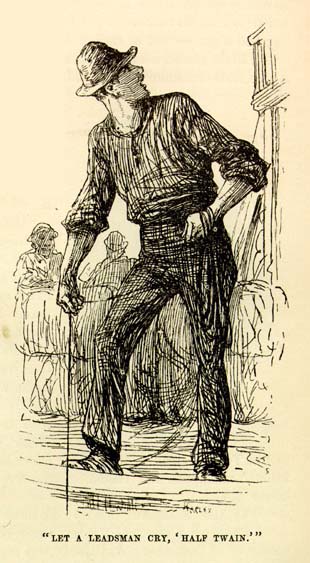
“Half twain…quarter twain…mark twain!”

Leadsman

It was on this date in 1863 that Samuel Clemens first signed ‘Mark Twain’, in his reporter’s letter from Carson City, Nevada to the Virginia City Territorial Enterprise. I’m currently rereading Life on the Mississippi, and happened to read of the pen name’s origin in chapter 50 last night:

I was a fresh new journalist, and needed a nom de guerre; so I confiscated the ancient mariner’s discarded one, and have done my best to make it remain what it was in his hands – a sign and symbol and warrant that whatever is found in its company may be gambled on as being the petrified truth; how I have succeeded, it would not be modest in me to say.

He sent his letter by stage to the paper on Saturday the 31st; it arrived on Sunday, the typesetters’ day off, and was published in the next edition on Tuesday, 3 February 1863.

The letter:

LETTER FROM CARSON CITY

January 31, 1863

EDS. ENTERPRISE: I feel very much as if I had just awakened out of a long sleep. I attribute it to the fact that I have slept the greater part of the time for the last two days and nights. On Wednesday, I sat up all night, in Virginia, in order to be up early enough to take the five o’clock stage on Thursday morning. I was on time. It was a great success. I had a cheerful trip down to Carson, in company with that incessant talker, Joseph T. Goodman. I never saw him flooded with such a flow of spirits before. He restrained his conversation, though, until we had traveled three or four miles, and were just crossing the divide between Silver City and Spring Valley, when he thrust his head out of the dark stage, and allowed a pallid light from the coach lamp to illuminate his features for a moment, after which he returned to darkness again, and sighed and said, “Damn it!” with some asperity. I asked him who he meant it for, and he said, “The weather out there.” As we approached Carson, at about half past seven o’clock, he thrust his head out again, and gazed earnestly in the direction of that city – after which he took it in again, with his nose very much frosted. He propped the end of that organ upon the end of his finger, and looked down pensively upon it – which had the effect of making him appear cross-eyed – and remarked, “O, damn it!” with great bitterness. I asked him what he was up to this time, and he said, “The cold, damp fog – it is worse than the weather.” This was his last. He never spoke again in my hearing. He went on over the mountains, with a lady fellow-passenger from here. That will stop his clatter, you know, for he seldom speaks in the presence of ladies.

In the evening I felt a mighty inclination to go to a party some where. There was to be one at Governor J. Neely Johnson’s, and I went there and asked permission to stand around awhile. This was granted in the most hospitable manner, and visions of plain quadrilles soothed my weary soul. I felt particularly comfortable, for if there is one thing more grateful to my feelings than another, it is a new house – a large house, with its ceilings embellished with snowy mouldings; its floors glowing with warm-tinted carpets; with cushioned chairs and sofas to sit on, and a piano to listen to; with fires so arranged that you can see them, and know that there is no humbug about it; with walls garnished with pictures, and above all, mirrors, wherein you may gaze, and always find some thing to admire, you know. I have a great regard for a good house, and a girlish passion for mirrors. Horace Smith, Esq., is also very fond of mirrors. He came and looked in the glass for an hour, with me. Finally, it cracked – the night was pretty cold – and Horace Smith’s reflection was split right down the centre. But where his face had been, the damage was greatest – a hundred cracks converged from his reflected nose, like spokes from the hub of a wagon wheel. It was the strangest freak the weather has done this Winter. And yet the parlor seemed very warm and comfortable, too.

About nine o’clock the Unreliable came and asked Gov. Johnson to let him stand on the porch. That creature has got more impudence than any person I ever saw in my life. Well, he stood and flattened his nose against the parlor window, and looked hungry and vicious – he always looks that way – until Col. Musser arrived with some ladies, when he actually fell in their wake and came swaggering in, looking as if he thought he had been anxiously expected. He had on my fine kid boots, and my plug hat and my white kid gloves (with slices of his prodigious hands grinning through the bursted seams ), and my heavy gold repeater, which I had been offered thousands and thousands of dollars for, many and many a time. He took these articles out of my trunk, at Washoe City, about a month ago, when we went out there to report the proceedings of the Convention. The Unreliable intruded himself upon me in his cordial way and said, “How are you, Mark, old boy? when d’you come down? It’s brilliant, ain’t it? Appear to enjoy themselves, don’t they? Lend a fellow two bits, can’t you?” He always winds up his remarks that way. He appears to have an in satiable craving for two bits.

The music struck up just then, and saved me. The next moment I was far, far at sea in a plain quadrille. We carried it through with distinguished success; that is, we got as far as “balance around,” and “halt-a-man-left,” when I smelled hot whisky punch, or some thing of that nature. I tracked the scent through several rooms, and finally discovered the large bowl from whence it emanated. I found the omnipresent Unreliable there, also. He set down an empty goblet, and remarked that he was diligently seeking the gentle men’s dressing room. I would have shown him where it was, but it occurred to him that the supper table and the punch-bowl ought not to be left unprotected; wherefore, we staid there and watched them until the punch entirely evaporated. A servant came in then to replenish the bowl, and we left the refreshments in his charge. We probably did wrong, but we were anxious to join the hazy dance. The dance was hazier than usual, after that. Sixteen couples on the floor at once, with a few dozen spectators scattered around, is calculated to have that effect in a brilliantly lighted parlor, I believe. Everything seemed to buzz, at any rate. After all the modern dances had been danced several times, the people adjourned to the supper-room. I found my wardrobe out there, as usual, with the Unreliable in it. His old distemper was upon him: he was desperately hungry. I never saw a man eat as much as he did in my life. I have the various items of his supper here in my note-book. First, he ate a plate of sandwiches; then he ate a handsomely iced poundcake; then he gobbled a dish of chicken salad; after which he ate a roast pig; after that, a quantity of blancmange; then he threw in several glasses of punch to fortify his appetite, and finished his monstrous repast with a roast turkey. Dishes of brandy-grapes, and jellies, and such things, and pyramids of fruits, melted away before him as shadows fly at the sun’s approach. I am of the opinion that none of his ancestors were present when the five thousand were miraculously fed in the old Scriptural times. I base my opinion upon the twelve baskets of scraps and the little fishes that remained over after that feast. If the Unreliable himself had been there, the provisions would just about have held out, I think.

After supper, the dancing was resumed, and after a while, the guests indulged in music to a considerable extent. Mrs. J. sang a beautiful Spanish song; Miss R., Miss T., Miss P., and Miss S., sang a lovely duet; Horace Smith, Esq., sang “I’m sitting on the stile, Mary,” with a sweetness and tenderness of expression which I have never heard surpassed; Col. Musser sang “From Greenland’s Icy Mountains” so fervently that every heart in that assemblage was purified and made better by it; Mrs. T. and Miss C., and Mrs. T. and Mrs. G. sang “Meet me by moonlight alone” charmingly; Judge Dixson sang “O, Charming May” with great vivacity and artistic effect; Joe Winters and Hal Clayton sang the Marseilles Hymn in French, and did it well; Mr. Wasson sang “Call me pet names” with his usual excellence (Wasson has a cultivated voice, and a refined musical taste, but like Judge Brumfield, he throws so much operatic affectation into his singing that the beauty of his performance is sometimes marred by it – I could not help noticing this fault when Judge Brumfield sang “Rock me to sleep, mother”); Wm. M. Gillespie sang “Thou hast wounded the spirit that loved thee,” gracefully and beautifully, and wept at the recollection of the circumstance which he was singing about. Up to this time I had carefully kept the Unreliable in the background, fearful that, under the circumstances, his insanity would take a musical turn; and my prophetic soul was right; he eluded me and planted himself at the piano; when he opened his cavernous mouth and displayed his slanting and scattered teeth, the effect upon that convivial audience was as if the gates of a graveyard, with its crumbling tombstones, had been thrown open in their midst; then he shouted something about he “would not live alway” – and if I ever heard anything absurd in my life, that was it. He must have made up that song as he went along. Why, there was no more sense in it, and no more music, than there is in his ordinary conversation. The only thing in the whole wretched performance that redeemed it for a moment, was something about “the few lucid moments that dawn on us here.” That was all right; because the “lucid moments” that dawn on that Unreliable are almighty few, I can tell you. I wish one of them would strike him while I am here, and prompt him to return my valuables to me. I doubt if he ever gets lucid enough for that, though. After the Unreliable had finished squawking, I sat down to the piano and sang – however, what I sang is of no consequence to anybody. It was only a graceful little gem from the horse opera.

At about two o’clock in the morning the pleasant party broke up and the crowd of guests distributed themselves around town to their respective homes; and after thinking the fun all over again, I went to bed at four o’clock. So, having been awake forty-eight hours, I slept forty-eight, in order to get even again, which explains the proposition I began this letter with.

Yours, dreamily,

twain_sig

You can read of Clemens’s hair-raising run-in with the depth of the river in chapter 13 of Life on the Mississippi.
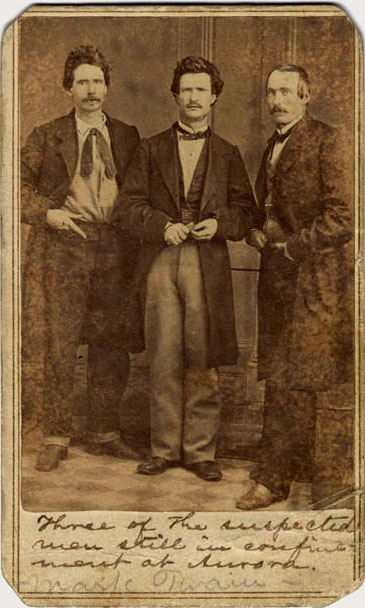
Cabinet Card

“Three of the suspected men still in confinement at Aurora” Twain in 1863, flanked by Rep. William Clagett and Speaker A.J. Simmons of the Nevada Territorial legislature.
A blizzard’s the idea

A friend was supposed to visit Monday and Tuesday this week, but those plans were cancelled due to the weather, which reminded me that Mark Twain had a similar problem a while back – March 1888 to be precise. Olivia, his wife, was to have joined him for a week in New York City, but it was not to be. From his letter to her dated 10 March 1888:

And so, after all my labor and persuasion to get you to at last promise to take a week’s holiday and go off with me on a lark, this is what Providence has gone and done about it. It does seem to me the oddest thing – the way Providence manages. A mere simple request to you to stay at home would have been entirely sufficient; but no, that is not big enough, picturesque enough – a blizzard’s the idea; pour down all the snow in stock, turn loose all the winds, bring a whole continent to a stand-still: that is Providence’s idea of the correct way to trump a person’s trick. If I had known it was going to make all this trouble and cost all these millions, I never would have said anything about your going. Now in the light of this revelation of the methods of Providence, consider Noah’s flood – I wish I knew the real reason for playing that cataclysm on the public: likely enough, somebody who liked dry weather wanted to take a walk. That is probably the whole thing – and nothing more to it.

The blizzard he refers to was the Great Blizzard of 1888, which paralysed the Northeast US, sank or grounded 200 ships, blanketed the countryside with 20-60 inches of snow, and killed 400 people – 200 of them in New York City. The supremely annoying “Weather predictions must be perfect! You made me stay off the roads and I didn’t have to! What about my Taco Bell dinner! Call 9-1-1! Waaaa!” people in that area would be well-advised to stick that in their collective pipe and smoke it. Those ubiquitous “Me, me, me! Outrage, outrage, outrage!” chowderheads regretfully now fully enabled by antisocial media remind me of the Italian government trying to jail earthquake scientists a few years ago. I’m happy to report that their manslaughter convictions were finally overturned last November.

The GOES-EAST satellite – GOES-13 at the moment – captured the genesis and follow-through of this week’s blizzard in exquisite detail:

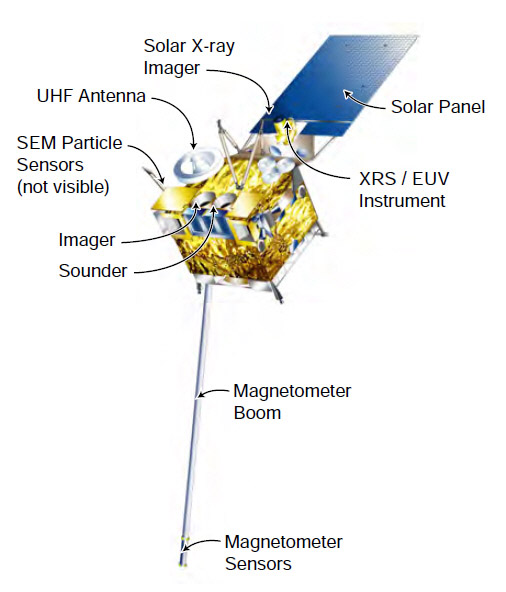
GOES-13, known as GOES-N before launch, was built by Boeing Satellite Systems [PDF of GOES-N databook] and contains several other instruments in addition to its imager:

GOES-N

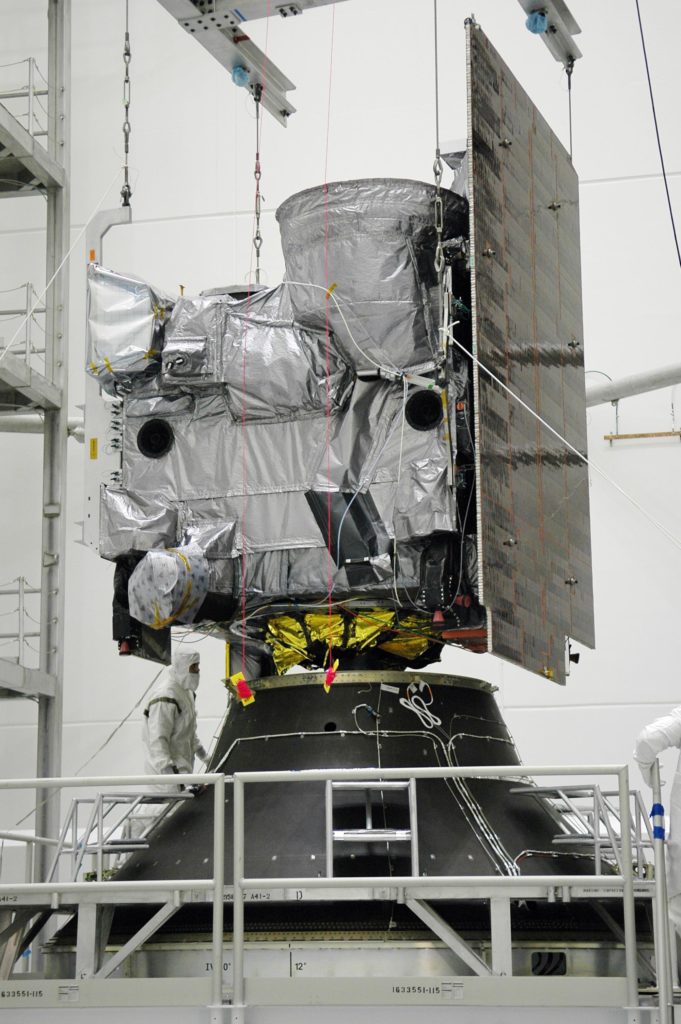
It’s about the size and weight of a large SUV:

GOES-N prep

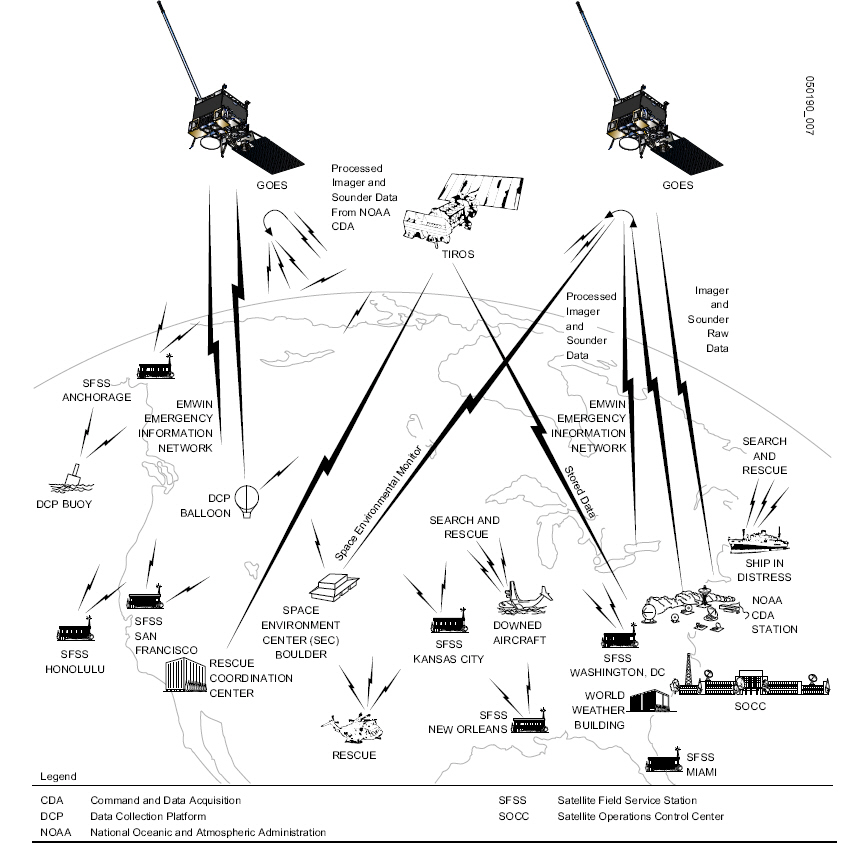
The operational infrastructure behind – or perhaps I should say underneath – the satellite is rather breathtaking. Presented in both org chart and geographic styles here:

GOES-N org

GOES-N geo

And now for the other Twain bookend. I’ve read dozens of his speeches, but his talk on New England weather is my favourite. His part begins several paragraphs into this article, at the subhead SPEECH OF MR. SAMUEL L. CLEMENS.

From The New York Times, 23 December 1876

FOREFATHERS’ DAY.
NEW-ENGLANDERS AT DINNER.

THE ANNUAL FESTIVAL OF THE NEW-ENGLAND SOCIETY – SPEECHES BY HON. GEORGE WILLIAM CURTIS, ‘MARK TWAIN,’ REV. EDWARD EVERETT HALE, REV. DR. JOHN COTTON SMITH, REV. DR. TAYLOR, AND OTHERS – INTERESTING LETTER FROM GEN. SHERMAN.

The New England Society’s annual dinner at Delmonico’s last night was one of the most brilliant celebrations of the kind that has ever been held in this City. The preparations were made with great thoroughness, and the addresses by the respondents to the several toasts were full of earnestness, good feeling, good sense, and good wit. The dining-hall was filled with seven tables, the President’s table overlooking six others arranged opposite to it at right angles. Above the head of the President was suspended against the wall the banner of the New England Society, flanked by silken national ensigns, and on the opposite side of the hall, before the orchestra balcony, was a national shield also draped with United States flags. the tables were elegantly and tastefully decorated with baskets and set pieces of flowers. Before the President was a design, in flowers of delicate hues, representing Plymouth Rock, and there were many viands in the feast that recalled to genuine New Englanders the plain and beauty fare of the land of steady habits. The guests entered the dining room just before 7 o’clock, and at that hour Rev. Dr. John Cotton Smith, at the invitation of President Borden, said grace. Among those present were Rev. Edward Everett Hale, ex-Gov. Edwin D. Morgan, Hon. George William Curtis, Rev. John Cotton Smith, Rev. Richard S. Storrs, Samuel L. Clemens (Mark Twain,) Mayor Wickham, Joseph H. Choate, Rev. Dr. William M. Taylor, Hon. Elliot C. Cowdin, Hon. Salem H. Wales, Commodore J. W. A. Nicholson, G. B. Loring, Hon. Isaac H. Bailey, Dexter A. Hawkins, Prof. Bartholdt, (sculptor of the colossal Statue of Liberty), District Attorney Benjamin K. Phelps, Prof. F. B. Sanborn of Dartmouth College, representatives of St. George’s, St. Andrew’s and St. Patrick’s Societies, Assistant District Attorneys Bell, Russell and Rollins, Parke Godwin, Clark Bell, Police Commissioners, Wheeler and Erbardt, and Prof. W. E. Chandler, the whole company numbering more than two hundred. More than two hours were spent at dinner, when, at 9:30 o’clock, Rev. Mr. Courtenay gave thanks. President Borden then rose, and having called the company to order, he announced that Gen. William T. Sherman had written a letter of regret, saying that in the present condition of affairs at Washington he was unable to leave that city, and William M. Evarts was also detained in Washington and was unable to attend, and that letters of regret had been received from ex-Speaker James G. Blaine, Gov. Tilden, Gov. Chamberlain, of South Carolina, Robert C. Winthrop, and Gen. John C. Newton.

Hon. George William Curtis was called upon to respond to the toast of “Forefathers’ Day.” He was received with prolonged applause, and by many of the company rising to their feet with waving handkerchiefs and loud cheers. His remarks were frequently interrupted by hearty expressions of approval, and his allusion to Abraham Lincoln as the development of the seed sown here two centuries ago by the coming of the Mayflower, was followed by vehement applause. His suggestions for the conduct of the Senate and the House of Representatives in the settlement of the political difficulties threatening the nation roused is hearers to the highest pitch of excitement, and evoked unanimous and prolonged applause.

As Mr. Curtis sat down, he was greeted with the heartiest cheers, which subsided only to be renewed with greater vigor. Cheers followed the announcement of the sentiment, “The President of the United States.” In reply to the “City of New York,” Mayor Wickham humorously arraigned a large number of City officers for alleged shortcomings, charging them with being New Englanders, and succeeding in finding so many against whom the charges were applicable, and indicated them so plainly, as to cause unbounded merriment.

Rev. Edward Everett Hale, in responding to the toast, “New England Culture,” made an address in which wit and wisdom were happily blended. Commodore Nicholson responded to the toast, “The Army and Navy.” Mark Twain provoked a storm of laughter by his rambling talk about “New England Weather.” Rev. John Cotton Smith commanded the fullest attention of the company by his response to the toast set down for him. Responses were made by Rev. Dr. William M. Taylor, Prof. Sanborn, and others.

THE PROCEEDINGS

The proceedings were begun by the President, Mr. William Borden, who said:

Gentlemen, will you give your reverent attention for a moment while I call upon Rev. Mr. Courtenay to return thanks?

Rev. Mr. Courtenay responding to the suggestion of the Chairman, offered prayer as follows:

“Most merciful God, and Father, in whom we live and move and have our being; Thou who can satisfy the desire of every living thing, we render Thee our thanks for the satisfaction of our bodily appetites, and pray Thee that what we shall now hear may be for the satisfaction of the higher appetite of our intellects and our reason for the sake of Jesus Christ our Savior. Amen.

SPEECH OF MR. SAMUEL L. CLEMENS.

The Oldest Inhabitant – The Weather –

Who hath lost and doth forget it?

Who hath it still and doth regret it?

“Interpose betwixt us Twain.”

– Merchant of Venice

“I reverently believe that the Maker who made us all, makes everything in New England – but the weather. I don’t know who makes that, but I think it must be raw apprentices in the Weather Clerk’s factory, who experiment and learn how in New England, for board and clothes, and then are promoted to make weather for countries that require a good article, and will take their custom elsewhere if they don’t get it. [Laughter.] There is a sumptuous variety about the New England weather that compels the stranger’s admiration – and regret. The weather is always doing something there; always attending strictly to business; always getting up new designs and trying them on the people to see how they will go. [Laughter.] But it gets through more business in spring than in any other season. In the spring I have counted one hundred and thirty-six different kinds of weather inside of four and twenty hours. [Laughter.] It was I that made the fame and fortune of that man that had that marvelous collection of weather on exhibition at the Centennial that so astounded the foreigners. He was going to travel all over the world and get specimens from all the climes. I said, “Don’t you do it; you come to New England on a favorable spring day.” I told him what we could do, in the way of style, variety, and quantity. [Laughter.] Well, he came, and he made his collection in four days. As to variety – why, he confessed that he got hundreds of kinds of weather that he had never heard of before. And as to quantity – well, after he had picked out and discarded all that was blemished in any way, he not only had weather enough, but weather to spare; weather to hire out; weather to sell; to deposit; weather to invest; weather to give to the poor. [Laughter.] The people of New England are by nature patient and forbearing; but there are some things which they will not stand. Every year they kill a lot of poets for writing about “Beautiful Spring.” [Laughter.] These are generally casual visitors, who bring their notions of spring from somewhere else, and cannot, of course, know how the natives feel about spring. And so, the first thing they know, the opportunity to inquire how they feel has permanently gone by. [Laughter.]

Old Probabilities* has a mighty reputation for accurate prophecy, and thoroughly well deserves it. You take up the papers and observe how crisply and confidently he checks off what today’s weather is going to be on the Pacific, down South, in the Middle States, in the Wisconsin region; see him sail along in the joy and pride of his power till he gets to New England, and then – see his tail drop. He doesn’t know what the weather is going to be like in New England. He can’t any more tell than he can tell how many Presidents of the United States there’s going to be next year. [Applause.] Well, he mulls over it, and by and by he gets out something about like this: Probable nor’-east to sou’-west winds, varying to the southard and westard and eastard and points between; high and low barometer, swapping around from place to place; probable areas of rain, snow, hail, and drought, succeeded or preceded by earthquakes, with thunder and lightning. [Loud laughter and applause.] Then he jots down this postscript from his wandering mind, to cover accidents: “But it is possible that the program may be wholly changed in the meantime.” [Loud laughter.]

Yes, one of the brightest gems in the New England weather is the dazzling uncertainty of it. There is only one thing certain about it, you are certain there is going to be plenty of weather. [Laughter.] A perfect grand review; but you never can tell which end of the procession is going to move first. You fix up for the drought; you leave your umbrella in the house and sally out with your sprinkling pot, and ten to one you get drowned. [Applause.] You make up your mind that the earthquake is due; you stand from under, and take hold of something to steady yourself, and the first thing you know, you get struck by lightning. [Laughter.] These are great disappointments. But they can’t be helped. [Laughter.] The lightning there is peculiar; it is so convincing when it strikes a thing, it doesn’t leave enough of that thing behind for you to tell whether – well, you’d think it was something valuable, and a Congressman had been there. [Loud laughter and applause.]

And the thunder. When the thunder commences to merely tune up, and scrape, and saw, and key up the instruments for the performance, strangers say, “Why, what awful thunder you have here!” But when the baton is raised and the real concert begins, you’ll find that stranger down in the cellar, with his head in the ash barrel. [Laughter.]

Now, as to the size of the weather in New England – lengthways, I mean. It is utterly disproportioned to the size of that little country. [Laughter.] Half the time, when it is packed as full as it can stick, you will see that New England weather sticking out beyond the edges and projecting around hundreds and hundreds of miles over the neighboring states. [Laughter.] She can’t hold a tenth part of her weather. You can see cracks all about, where she has strained herself trying to do it. [Laughter.]

I could speak volumes about the inhuman perversity of the New England weather, but I will give but a single specimen. I like to hear rain on a tin roof, so I covered part of my roof with tin, with an eye to that luxury. Well, sir, do you think it ever rains on the tin? No, sir; skips it every time. [Laughter.]

Mind, in this speech I have been trying merely to do honor to the New England weather; no language could do it justice. [Laughter.] But, after all, there are at least one of two things about that weather (or, if you please, effects produced by it) which we residents would not like to part with. [Applause.] If we hadn’t our bewitching autumn foliage, we should still have to credit the weather with one feature which compensates for all its bullying vagaries – the ice storm – when a leafless tree is clothed with ice from the bottom to the top – ice that is as bright and clear as crystal; when every bough and twig is strung with ice beads, frozen dewdrops, and the whole tree sparkles, cold and white, like the Shah of Persia’s diamond plume. [Applause.] Then the wind waves the branches, and the sun comes out and turns all those myriads of beads and drops to prisms, that glow and burn and flash with all manner of colored fires, which change and change again, with inconceivable rapidity, from blue to red, from red to green, and green to gold; the tree becomes a spraying fountain, a very explosion of dazzling jewels; and it stands there the acme, the climax, the supremest possibility in art or nature, of bewildering, intoxicating, intolerable magnificence! One cannot make the words too strong. [Long continued applause.]

Month after month I lay up my hate and grudge against the New England weather; but when the ice storm comes at last, I say: “There, I forgive you, now; the books are square between us; you don’t owe me a cent; go, and sin no more; your little faults and foibles count for nothing; you are the most enchanting weather in the world!”

THE OTHER TOASTS.

The other toasts of the evening were “The Clergy of New England,” responded to by Rev. John Cotton Smith; “Lafayette – who gave us himself and liberty; and Bartholdi – who gives us Liberty and Lafayette.” No. Response. “The Agricultural and Manufacturing Interests of New England,” Dr. George B. Loring, and “Our Sister Societies,” responded to by the Presidents of the Irish, Scotch, and English societies.

The proceedings terminated shortly after midnight.

*At the time of Twain’s speech, Old Probabilities was the widely-used nickname of Cleveland Abbe, first scientist of the American Weather Bureau, predecessor to the National Weather Service.

The Thick of It

I believe this is the deepest snow I’ve seen since the Northeast US Blizzard of 1978, and thoroughly deserving of some tightly-focused verbal energy from Malcolm Tucker, I think.

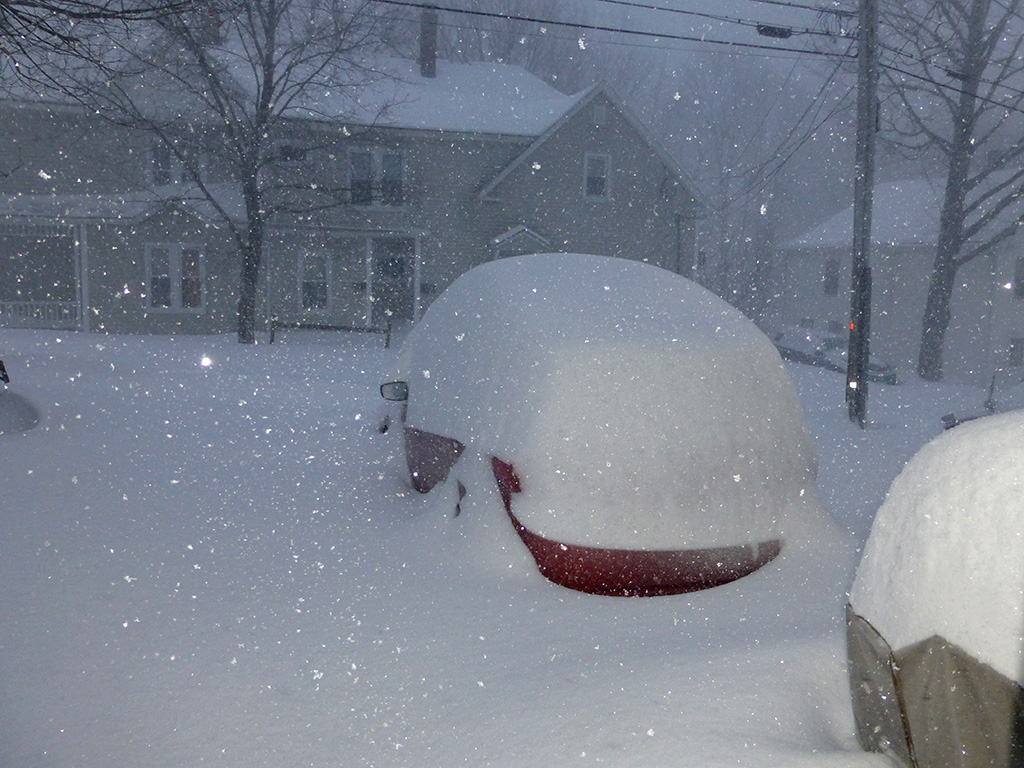
By 7:30 this morning, the total seemed quite sufficient, thank you very much:

P1020036

Click to view a larger size

But, I’m right in the middle of the worst band of the – cue trumpets – Blizzard of 2015, so at 2:30 in the afternoon, still the snow comes down at a good clip. That big lump is my car, which is normally not much taller than the shovel.

P1020051

Click to view a larger size

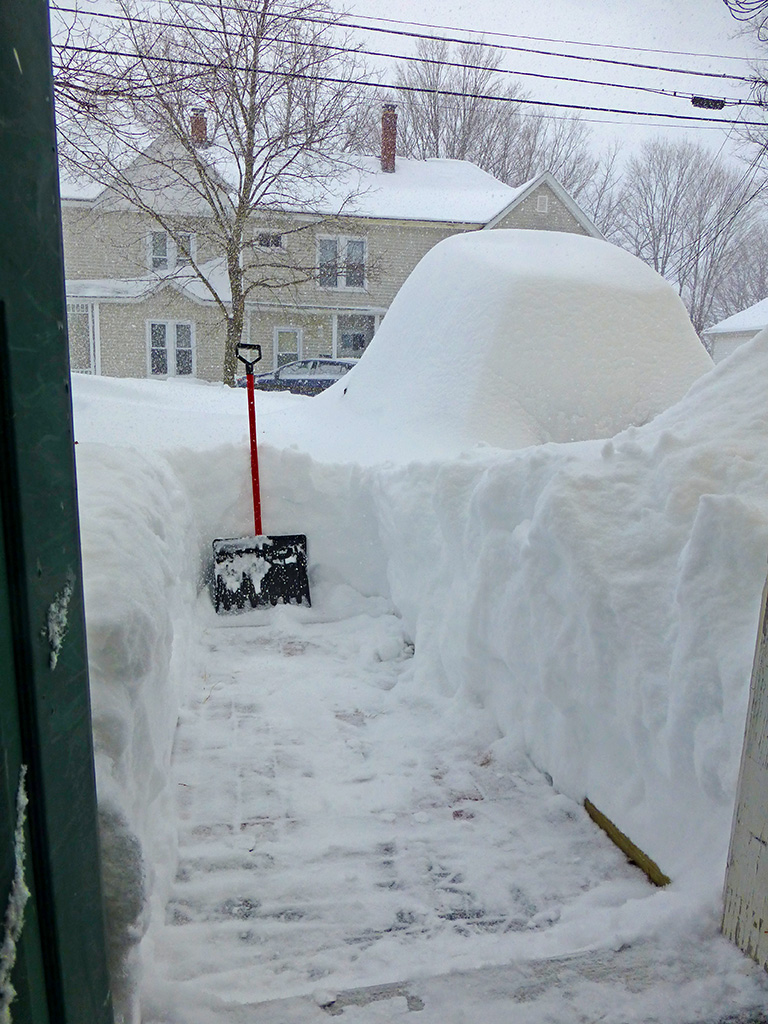
There may be yet another several inches of snow in store.

P1020054

Click to view a larger size

It’s possible the sky is broken.

NTSB, USN, USCG: Please call these people

I think the time has arrived for some urgent unsolicited advice to Indonesian authorities. This is not just supremely ridiculous, it’s embarrassing and maddening. Future editions of dictionaries might do well to reference this in their definitions of farcical.

A fresh attempt to lift the sunken fuselage of the doomed AirAsia plane from the Java Sea today failed when a wire rope snapped after the wreckage reached the surface of the water, Indonesian officials said.

Efforts to lift the fuselage or the main section of the Airbus A320-200, expected to contain remaining bodies of victims of the December 28 crash that killed all 162 people on board, have failed so far.

“The fuselage appeared at the surface, but the rope broke and it fell down again,” said Supriyadi, director of operations and training for Indonesia’s search and rescue agency.

Earlier, rescuers tried to lift the section with balloons, a procedure they also used to hoist the tail of the ill-fated AirAsia Flight QZ8501, en route from Indonesia’s Surabaya city to Singapore.

Yesterday, efforts failed again when sharp parts of the debris sliced through a strap connecting the fuselage to a giant balloon and the wreckage sank to the seabed once again.

Several bodies fell from the fuselage when the piece of wreckage sank yesterday.

It’s not even the entire fuselage, but a 43-foot section. The phrase ‘reckless and bumbling incompetence’ keeps coming to mind.

Too lazy to cook

Internal conversation:

“So…chicken livers sautéed with garlic & sage, some potatoes dauphinoise, and lemon-dill carrots tonight?”

“Nah, too lazy. Egg salad.”

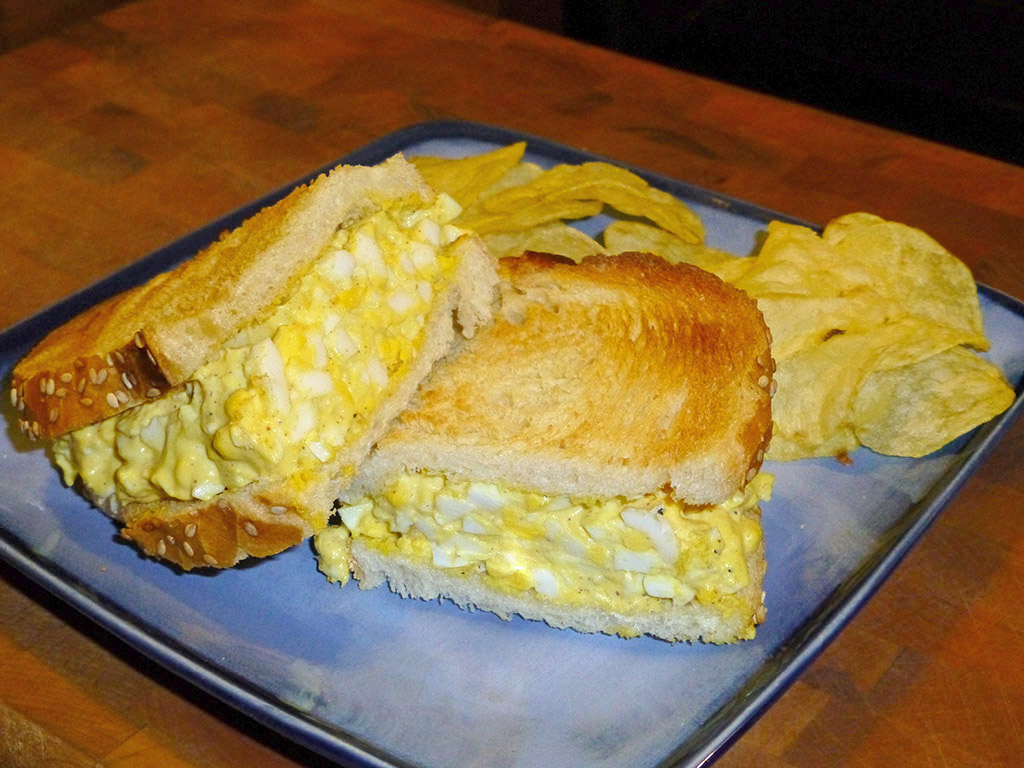
The eggs were laid just yesterday, so they were tough to peel, but add a little homemade mayonnaise, some salt and pepper, a squidge of spicy brown mustard, and some ground celery seed and the effort’s worthwhile.

Click to see a larger version


Logic-free thinking

I just found out that there are a lot of people who believe sourdough is yeast-free, and plenty of organisations and companies that encourage that belief by people who for whatever reason want to follow a yeast-free diet.

True sourdough bread does not contain yeast and instead utilizes a lactobacilli based starter culture.[1]  True sourdough bread is also baked at a lower temperature[2] for a longer period of time which protects the integrity of the cereal grains[3] and preserves the nutritional value[4].

[1] No. It’s lactobacilli and a variety of yeasts living in symbiosis, where the bacteria consume sugars in the flour the yeast cannot and the yeast consumes the fermentation byproducts of the bacteria. Lactic acid produced by the bacteria lends the sour flavour; the yeast produces the carbon dioxide that leavens the bread.
[2] Generally speaking, it’s baked at the same or just slightly lower temperature than other breads but indeed for a longer time because the crust browns more slowly.
[3] Integrity of the grains? Come now, they’ve been powdered.
[4] For any reason other than it sounds appealing?

Yesterday, I found that a local bakery that produces a decent sourdough – I’m partial to their sourdough rye – also fails to understand some basics:

The natural yeast itself also has important health benefits for your digestive tract (the good bacteria[1] survive in the center of the loaves where the internal temperature does not get hot[2]).

[1] Yeast is good, but it’s not a bacteria; it’s a fungus.
[2] The good bacteria do not survive. Lactobacillus sanfranciscensis is killed after just a few minutes at 140°F/60°C, and the centre of a sourdough loaf – most breads, for that matter – should reach around 200°F/95°C for a few minutes before it’s taken out of the oven. Take it out before that and the middle of the loaf will remain unset and gummy. Their loaves are not unset and gummy in the middle.

lactobacillus

Current temperature 140.1F

Edited to correct first link.

A rusty showboat

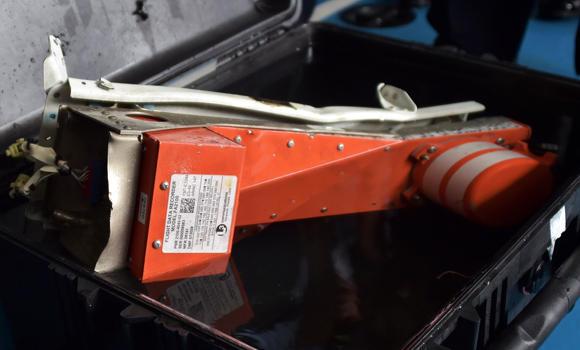
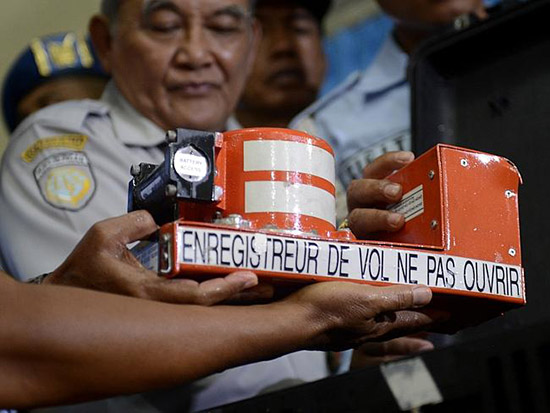
I’m confident that I’d be drummed out of the Indonesian military in a New York minute, because in both of these cases, I would probably be the lowly corporal shouting from the back of the press room, “Hey, chuckleheads! Yes, you! Stop taking the goddamned recorder out of the goddamned water! Jiminy Cricket on a velocipede!”

showboat1

indo2

showboat2

When a DFDR or CVR is immersed in water after an accident, it must be kept stored in water after recovery, and not pulled out and posed with every time a photographer is in the vicinity. Why? Because once immersed in water – especially salt water – the internal components are highly susceptible to corrosion, which begins the instant the recorder is taken out of the water. That’s why the NTSB’s FDR and CVR recorder recovery manuals both state:

4.5. If the CVR is recovered in water, it shall immediately be packed in water (fresh, if possible) and not be allowed to dry out.

This is not the first time I’ve seen this sort of grandstanding. It’s good that they finally found the two recorders in about a hundred feet of water, but novice air crash investigators need to stop boasting and playing about like this. This is real life, not some Dingleface update upstaging your friends’ dull lives. Treat it as such. If you don’t know the rules, find out about them. Hey, look, someone’s linked them for you a graf or two upstream.

Numbnuts.

A mouldy mouse by any other name…

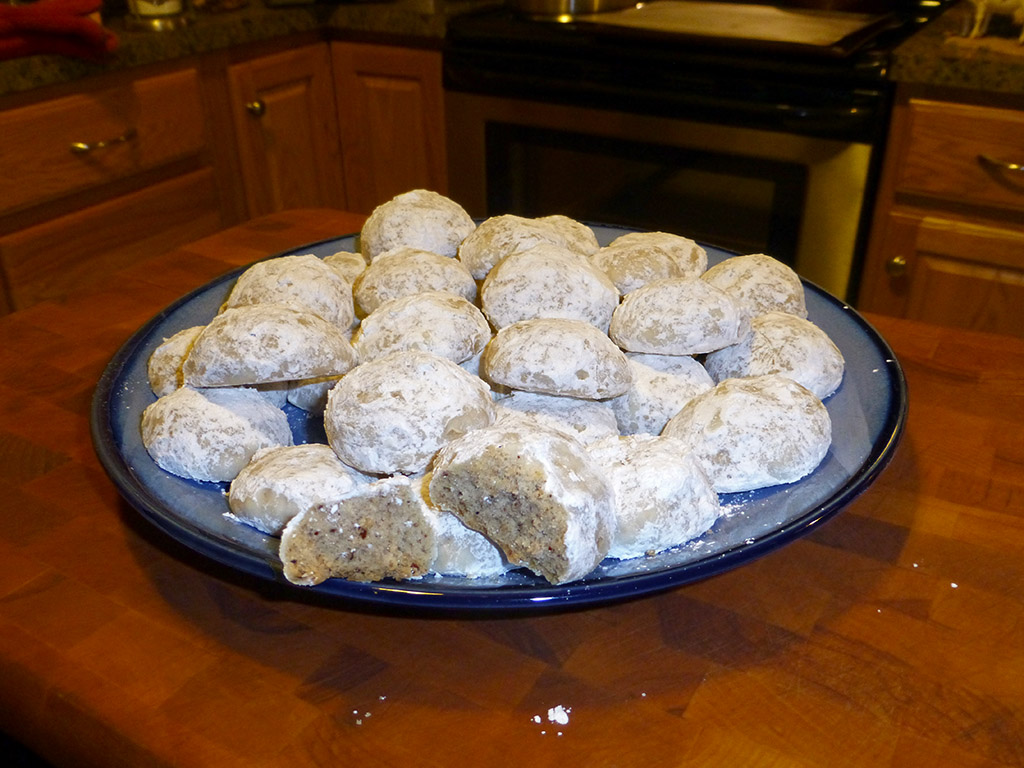
My massage therapist mentioned a couple weeks ago that she had a craving for those light-as-a-feather round crumbly cookies made with tiny bits of walnuts and dusted with sugar. She asked if I knew where she could buy some, but I’ve not seen them in the few decent bakeries around here – or anywhere else, for that matter. In fact, the only time I’ve seen them is at holiday gatherings, where they’re often right next to the pizzelle cookies. Neither she nor I knew their name, so I googled ‘Italian walnut cookies’ tonight and found all the other variants.

They are variously called…deep breath…Mexican wedding cookies, Mexican teacakes, Mexican wedding cakes, just plain wedding cookies, kourabiedes, Russian teacakes, kiflik, Armenian sugar cookies, Easter cookies, butterballs, bullets, mantecosos, pecan butterballs, nutballs, cocoons, vanillekipferl, mouldy mice, pecan dainties, bizcochitos, snowballs, pecan snowballs, vanilla snowballs, walnut snowballs, and snowdrops. In other words, most cultures have a version of this cookie. However, the one thing I didn’t find was an Italian name for them.

It is perhaps obvious to you that when a friend asks me about a hard-to-find baked product, the eventual outcome is foregone and inevitable, but I wouldn’t accuse mates of taking advantage of that fact. They can’t help it just as I can’t.

P1010997

Click to see a larger version

I can report that my mouldy mice are of a much lighter texture and more delicious than any I’ve ever had at a Christmas party. “Not too shabby” said I on tasting the first one. No, wait…”Holy crap!” was actually my first utterance, followed immediately by my shabbiness estimate. They melt in the mouth and are great with coffee. I’m sure she’ll be delighted with the box I’m bringing over tomorrow.

My version is an adaptation of King Arthur Flour’s recipe. I replaced their almond extract and almond flour with a scant half-teaspoon of freshly ground nutmeg and a cup of toasted pecans, cooled completely then chopped very finely in my mini food processor. I also bumped the vanilla extract up to two teaspoons. I inadvertently over-processed the pecans just a tiny bit, so they ended up slightly wet – but well short of pecan butter – and, as I suspected, baking therefore took about four minutes more than the maximum they state.

Distilled, the warm smell of pecans, nutmeg, and vanilla in my house right now would make a fine cologne, I think.

Cooking catchup

Catching up with some recent dishes I’ve made, from last night’s pea soup back to Thanksgiving dinner. Click any picture to view these in a gallery.

Less dizzy, less annoyed

I note that the Guardian has started the new year off properly by summarily abandoning its recently instituted practice of shifting images on the home page leftward by a few pixels and dimming them when you hovered over them, then shifting back and brightening when you moved away. I believe it was still doing that yesterday. Now they just use the dimming and brightening.

Good. Did they really think that the image equivalent of drunken swaying would entice more clicks? (“Look, I’m moving! Ooo, isn’t that interesting? Hic.“) All it did for me was to make me dislike their web design team and the people who approved their idiocy with the fire of at least…oh, I don’t know, a campfire or so.

Christmas breakfast

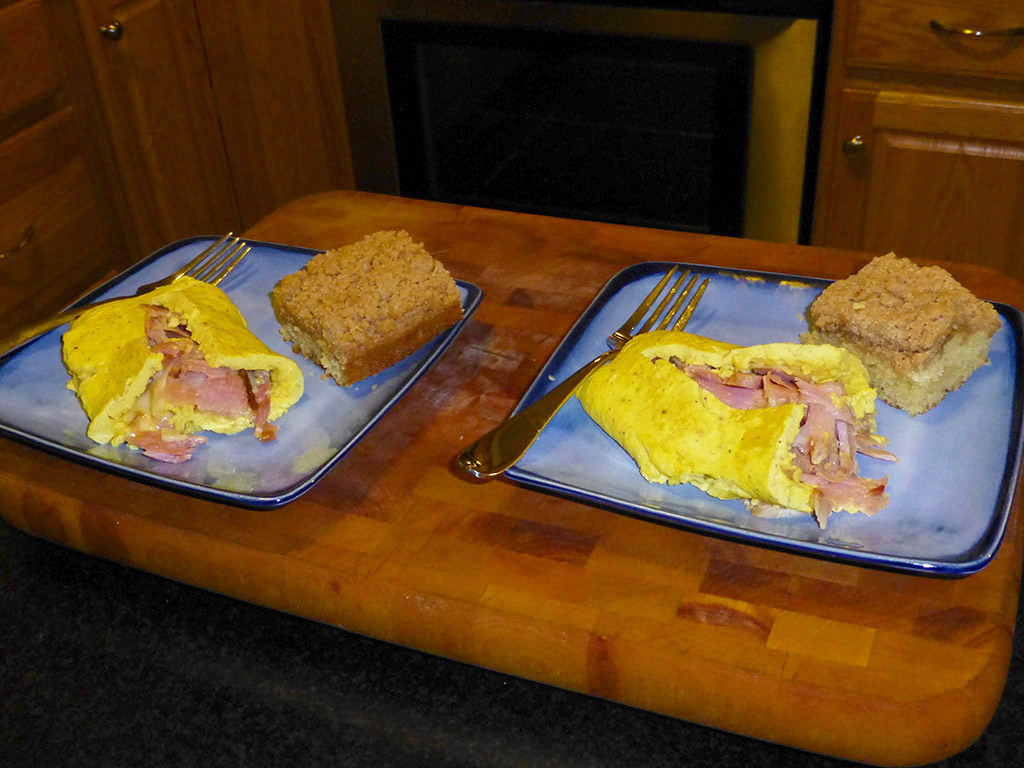
After Christmas Eve dinner of cider-baked ham, breakfast Christmas morning was a shared four-egg ham and cheddar omelette with Americanos and the always delightful cinnamon crumb coffeecake from the King Arthur Flour Baker’s Companion, recipe below.

Cinnamon Crumb Coffeecake
From the King Arthur Flour Baker’s Companion

Makes two 8-inch rounds, one 13 x 9-inch pan, or one 9- or 10-inch tube pan.

CRUMB:
2 1/2 cups (10 1/2 ounces) unbleached all-purpose flour
1 1/4 cups (8 3/4 ounces) sugar (caster sugar)
1/2 teaspoon salt
2 teaspoons ground cinnamon
1 cup (2 sticks, 8 ounces) butter, melted
1 teaspoon vanilla extract
Scant 1/2 teaspoon almond extract

CAKE:
8 tablespoons (1 stick, 4 ounces) butter, at room temperature
1 cup (7 ounces) sugar (caster sugar)
2 large eggs (2 oz. each with shells)
2 teaspoons vanilla extract
1 cup (8 ounces) sour cream
2 cups (8 1/2 ounces) unbleached all-purpose flour
1/2 teaspoon baking soda (bicarbonate of soda)
1/2 teaspoon salt
1 teaspoon baking powder
Confectioners’ sugar (icing sugar), for dusting

Preheat oven to 350 degrees F/175C. Grease two 8-inch round cake pans, a 9 x 13-inch pan, or a 9- or 10-inch tube pan.

TO MAKE THE CRUMB: In a medium-sized mixing bowl, whisk together the flour, sugar, salt and cinnamon. Melt the butter in the microwave or small saucepan and add the vanilla extract and almond extract to it. Pour the butter into the flour mixture and mix until all the butter is absorbed and you have a uniformly moistened crumb mixture. Set aside while you make the cake batter.

TO MAKE THE BATTER: In a large mixing bowl, cream the butter and sugar until light and fluffy. Add the eggs one at a time, and beat between additions. Scrape down the mixing bowl, then beat in the vanilla and sour cream.

In a medium-sized bowl, whisk the flour, baking soda, salt, and baking powder together. Add to the butter/sour cream mixture, mixing until evenly combined. Pour the batter into the greased baking pan(s). Crumble the crumb mixture over the top, until the batter is completely covered.

Bake for 20 to 25 minutes for 8-inch rounds, 30 to 35 minutes for a 9 x 13-inch pan, or 35 to 40 minutes for a 9- or 10-inch tube pan. Bake until a tester inserted in the center comes out clean. Remove the cake from the oven and cool on a rack; dust the top with confectioners’ sugar, if desired.