Every now and then, I do a search to see if someone has come up with a home method to make wafer sheets, which are tricky even for commercial bakeries, where heavy steel plates, high pressure, and steam are integral to the process. Because their manufacture is so specialised, I don’t hold my breath for a home method to appear, but hey, people are inventive, so I still check.
This time, I found a site that claims you can do it, and easily at that. Have a gander at this link:
“Huh”, I thought. However, right from the start, it all went wrong. At the top, “Health Benefit & Recipes”? Then “a 5 Step Model”, followed by a picture of waffles? What gives? Then there are completely unnecessary and obviously cut-and-paste boxes with large photos and lengthy descriptions explaining what butter and sugar are, for what must produce eight or nine feet of paper if you were to print this ‘recipe’. All the photos in that article are lifted from other sites, and the ingredients are bizarre. There’s no sugar or butter or wet eggs in wafers. To quote myself in 2012, “A basic wafer manufacturer recipe would be along the lines of 200g flour, 280g water, 1g bicarb (baking soda), 1g salt, and 1g vegetable oil, though some add things like dried milk, dried egg yolk, and/or corn starch.” My left eyebrow was a good foot above my forehead by this point, but little did I suspect the hilarity to follow.
For the coup de grace, go down the bottom of that page, where it explains how to roll out the dough and bake the sheets – along with a very large photo of an oven display showing 400F just to make sure you don’t get that part wrong. Now just look at that result at the bottom – why, it’s just like a commercially available wafer sheet. Precisely so, in fact. Bloody genius!
Ridiculous and transparently fraudulent and almost certainly spit out by a not-terribly-bright algorithm under not-so-close human supervision, sure, but what on Earth is the point of cobbling together this fake recipe? I’m still scratching my head.
The pair have a storied bromance, which began when Mr Trudeau visited the White House for a state dinner last year.
To quote Mad magazine: Blech. Ptui. Maybe that sentence above is only in the Americas variant of this BBC News story, maybe not. In any case, I remember fondly when the phrase ‘BBC News article’ meant a certain no-nonsense standard could be expected, that you’d never wince or grimace or roll your eyes at awful writing. That phrase means less than squat now that they so frequently exude the same sort of pandering drivel as just about every other news organisation. “C’mon, let’s get a little SEO boost with ‘bromance’!” What a shame.
We moved our offices into a new building a couple towns away this week, and I ended up with a substantially larger office – “All the more to decorate” thought I, rubbing my hands. A gallery of my new digs is below. I haven’t decided yet how to fill out one wall, but the other walls are pretty much as I want them. I still see trees and greenery out my window (two windows, actually), thank goodness, and there are wild turkeys at the new place, too.
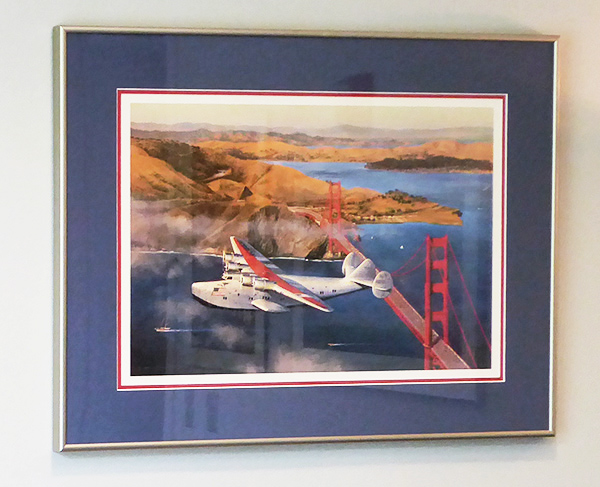
In the process, I finally got around to having my William Phillips “Clipper at the Gate” limited print framed at this little shop, and it came out pretty spiffy, with the frame and matting matched to the bluish silver of the aircraft, the deep blue of the water, and the red of the Golden Gate Bridge (actually called International orange) and the wing stripes. The aircraft is the Boeing B-314 flying boat, in this case the Pan American Airways California Clipper, NC-18602, which made regular runs between San Francisco and Hawaii – a nineteen-hour leg – before continuing to farther destinations.
Only twelve B-314s were produced by Boeing, all for Pan Am, but it was – and still is – considered the acme of flying boat technology. The initial six had a range of 3,500 miles with fuel capacity of 4,200 gallons and the second group of six could travel 5,200 miles with 5,400 gallons, both variants far exceeding the range of other aircraft of the day. Travel on the clippers was strictly deluxe, with ticket prices comparable to Concorde’s and meals catered by top-notch hotels.
The B-314 model on my desk, in the same 1:200 scale as the B-17 and B-747, is also of NC-18602. The “Fly to South Sea Isles” poster is a high quality limited edition reproduction of a 1930s Pan Am poster that was made about twenty years ago [some weeks after writing this, I found my Hansa Editions print was actually produced thirty years ago]. An original copy of the 1938 George Lawler poster – not the original painting, just a poster – recently sold for US$20,000 at auction, where the listing read:
One of the most iconic and desirable of all the early Pan Am flying boat posters, this image of the Boeing 314 Flying Clipper landing in a tropical lagoon captured, and continues to capture, the imagination of travelers. The location shown on the poster is an imaginary composite of several renowned bays throughout the South Pacific. It has been speculated that the view is Tahiti, Pago Pago and/or Diamond Head, however, the physical characteristics depicted do not coincide with the actual geography of any of these islands. Lawler most likely worked from photographs to derive a fantasy collage of a location infused with realistic details from various islands. It is rare to find this poster with text. We have found only two other examples at auction.
Edited to add: After I included this auction description, I did some research because the mountains in the poster seemed awfully familiar to me, and I now think Lawler had a specific place in mind when he designed that poster. The details here: https://finleyquality.net/flying-to-a-specific-south-sea-isle/
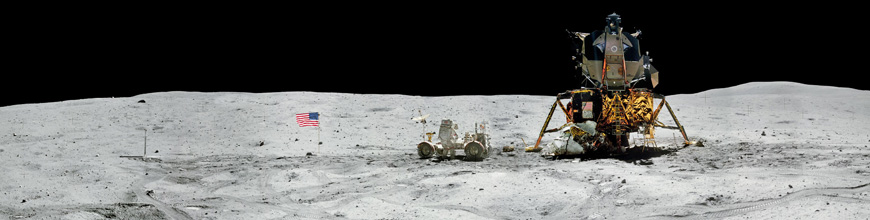
The tail end of the gallery shows in detail some of the photos and items on display. I had 16×20 prints made of the three high resolution Apollo photographs – done beautifully by Shutterfly and Snapfish, I’ll add. Of the three drawings of mine on the wall, just one, the woman holding a newborn Bengal kitten, is my original pencil drawing – the other two are from high resolution scans I made before presenting the original drawings to their subjects.
Click on any image to enter the gallery, and from there you can view a 1920-wide version of any photo by clicking this at the lower right (you may need to scroll down to see it):
Pan Am/Boeing/San Francisco corner
Apollo
Food photos and pencil sketches
16×20 photos of some of my flight jacket paintings may go here
1:200 scale models of my favourite Boeing aircraft
All Nippon Airways Boeing 747SR-81 JA8139 in “Snoopy Go!” livery, used to promote family ski vacations in Sapporo from 1996-1998
Sourdough boule in my kitchen
Jasper White’s Lobster & Corn Chowder
Crème caramel
My best mate
Woman with newborn Bengal kitten
Tracy Griffith; she asked me to create her first web site many years ago
Apollo 15 launch
Dave Scott during Apollo 9
Apollo 16 – John Young with the LRV
Apollo 17 Commander Capt. Gene Cernan, the last man on the moon, in 1/6th scale
Moon globe made using 15,000 Lunar Reconnaissance Orbiter photos; shows all unmanned and manned landing sites
Lunar Roving Vehicle
This photo is from the old office, but the Apollo 11 model’s still on my desk
What was inside the B-314; this was the centerfold of the 23 August 1937 issue of Life magazine
All Nippon Airways B-747 in “Snoopy Go!” livery
On the unfilled wall, I may put up 16×20 photos – approximately actual size – of two of the flight jackets I painted. This one is Rita Hayworth.