$66.11

This is one of the reasons that Market Basket thing was important:

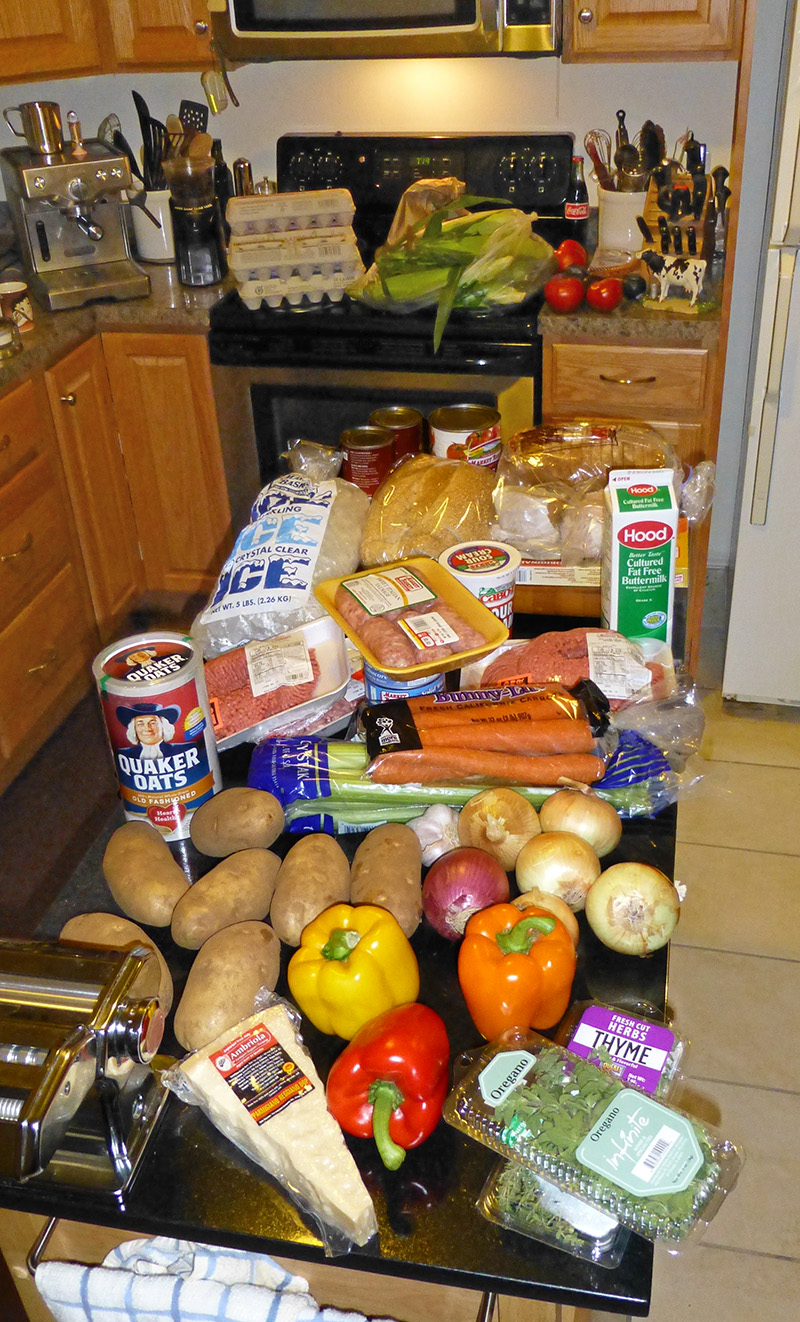
That’s about £39.83. On the kitchen island below is what I got for that today. It includes about a dozen pounds — weight, that is — of veg, six pounds of beef and pork, a pound of deli meats, and a one-pound wedge of Parmigiano-Reggiano — the real stuff, from Italy and everything, which I ran out of last week. That total would easily be above $90 at other supermarket chains in the area, with one or two likely exceeding a hundred dollars.

P1010317

Guess what I’m making a double recipe of tomorrow. The clue is in the peppers. (The answer: Comfort Diner Meatloaf.)

The five dozen eggs, the dozen ears of corn, and the four pounds of tomatoes in the background are from two farms in Harvard, Massachusetts. They were $19/£11.45 — no charge for the two dozen smaller pullet eggs that are perfect for use in recipes when you know that a large egg is exactly 2 ounces with the shell. They’re too small for Ann the Egg Lady to sell, so she sometimes throws in a couple dozen when I visit to buy the larger eggs.

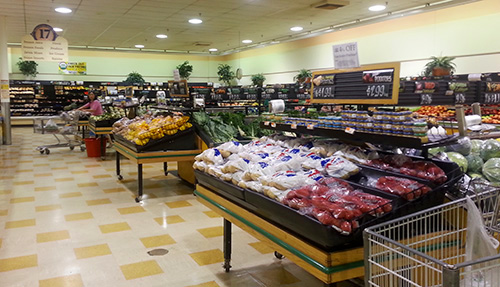
I went down every aisle in this Market Basket, #37 (of 71), and nearly everything was already fully stocked — 97% complete, I’d say — and this just sixty hours after the crisis resolution. I stopped to have a gander at the next Market Basket down the road and they were more like 92% stocked, with a noticeable amount of empty shelf space. That second MB is not even a year old, so I’m guessing they’re prioritising the stores that have been around the longest first. In any case, I think my analyst- and media-shaming estimate of under a week will be easily met at all the stores.

20140830_173120

The pork case in store #37

20140830_172400

Fruit and veg also fully stocked

My full disclosure statement is that two items I wanted were at neither of the two stores: ground veal and fresh basil. I don’t strictly need the veal for the meatloaf and I recently took delivery of a large bag of vibrantly green dried basil from The Spice House in Chicago, so no big deal.

I also drove past the Market Basket still under construction that’s just ten minutes from my house, happy that now it won’t end up a sad derelict and a painful reminder of what could have been. This wasn’t taken whilst moving, by the way; I was at a red traffic light.

P1010314

“She was a bloody airplane what couldn’t quite take off.”

P1010313

Farley Mowat’s The Serpent’s Coil remains, for me, the crème de la crème of sea tales, of which I’ve read a fair number. It’s the story of the Foundation Maritime company’s oceangoing rescue tug Josephine and its search for the crippled Liberty ship Leicester, bound from London to New York but left open to salvage claim when its crew abandoned her mid-Atlantic after an unintended encounter with a hurricane shifted its ballast irretrievably. This was a search without benefit of many of the things you might be thinking of because it was 1948. After they found it, they began to tow it to Bermuda. Awaiting them were two more hurricanes and not even a glimmer from a weather satellite, the first of which was still twelve years hence.

coil

To comparatively illustrate how good this book is, I can say that I’ve read it at least ten times, and that count will increase by one this holiday weekend. The Perfect Storm? Once. Junger’s was a decent enough book standing by itself, I suppose, but when compared to Mowat’s book, which I’d read years previously, I found it landlubber rubbish. In fact, I recall thinking this to myself several times as I read it: “Pfffft.”

From The Serpent’s Coil:

         Salvage men seldom use superlatives when they discuss a storm at sea — if indeed they can be persuaded to discuss it at all — but many of those aboard the Josephine have lasting memories of this night. One crewman came close to waxing lyrical about it — in a grim sort of way.
“She wasn’t no boat at all by then — she was a bloody airplane what couldn’t quite take off. I never seen nothing like it in twenty-seven years at sea. I got into Sparkie’s cabin and he was going crazy chasing his trunk around the room. Every now and then they’d change sides and the trunk would chase him for a bit. I got up on his bunk, jammed my feet against the deck, and braced my elbows between the bunkboard and the bulkhead. In between laughing my fool head off at Sparkie, I began to feel a wee bit peaked-like. Not scared so much as just plain cowardly. My God, she rolled! And pitched! When she come down off a crest she must have been putting her bows right under. I didn’t go on deck to see. I didn’t like it where I was, but I knew I wouldn’t like it any better up on top.” This was a rare outburst from a seaman of the salvage tugs.

Mowat’s preceding volume, The Grey Seas Under, a two-decade history of the Foundation Franklin salvage tug, is equally gripping and recounts its many hair-raising operations from 1930 to 1948. On the first edition’s back cover, he wrote:

I have gone out to sea on salvage jobs and when I was not paralyzed with fright I marveled anew at the men and ships who could do the impossible with such monotonous regularity and with such a diffidence of manner. I talked, and listened — mainly listened — to a score of seamen whose stories spanned half a century. It was, I think, the most fascinating and solidly satisfying experience of my not unadventurous life to become a part of the life of the salvage ships. But it has spoiled me forever when it comes to enjoying tales of derring-do at sea. For me the epics of naval warfare, of great lines, of tankers, and all the rest, now read like nursery tales beside the stories that I have heard about the somber, insignificant little ships that cheat the Western Sea.

I first read The Serpent’s Coil in front of a wood stove and looking out on a howling winter’s night on Cape Cod. It’s still summer-hot here now, but I fully expect to get chills this weekend.

I’m secretly pleased that these two volumes are not available as ebooks. Kindle’s nice, but I like the feel of a real book when it comes to old favourite page-turners.

The super market is back

Updated to include Arthur T. Demoulas speaking with his coworkers this morning.

Space included intentionally in that title. An agreement was approved by shareholders late last night:

Market Basket deal ends bitter feud

Despite what the article posits, I think it will be less than a week before everything is as it was. As to this:

It also may be difficult to get back customers who have left because of distaste for family drama or because they have come to appreciate other stores.

David Livingston, a supermarket industry analyst at DJL Research in Milwaukee, predicted 80 to 90 percent of customers will return. But he cautioned shoppers to prepare for a slightly different atmosphere, with the possibility of lingering tensions and uncertainty about whether a company suddenly saddled with massive debt obligations can keep prices so low.

“I just don’t think Market Basket will ever be quite the same,” Livingston said. “It’s like going through a divorce and getting a second family.”

Mr. Livingston, I presume you’re guessing, as analysts are wont to do, but I think that’s a load of horse potatoes in this case.

This fellow in another Boston Globe article has a better understanding of the situation:

“This is historic. It was an unprecedented situation, and it defies everything we thought we knew about how businesses are run and who has the power. Many scholars, myself included, are eating crow right now.”
— Daniel Korschun, a fellow at the Center for Corporate Reputation Management at Drexel University

I’m going food shopping after work and I’m sure the place will be more packed with people than I’ve ever seen. I think Market Basket will see unprecedented and perhaps astounding revenue in the months to come.

UPDATE: Arthur T. Demoulas speaking the morning of 28 August:


“There never was a good war or a bad peace.”
Benjamin Franklin in a letter to Josiah Quincy, 11 September 1783

The explosive guillotine in the Lunar Module

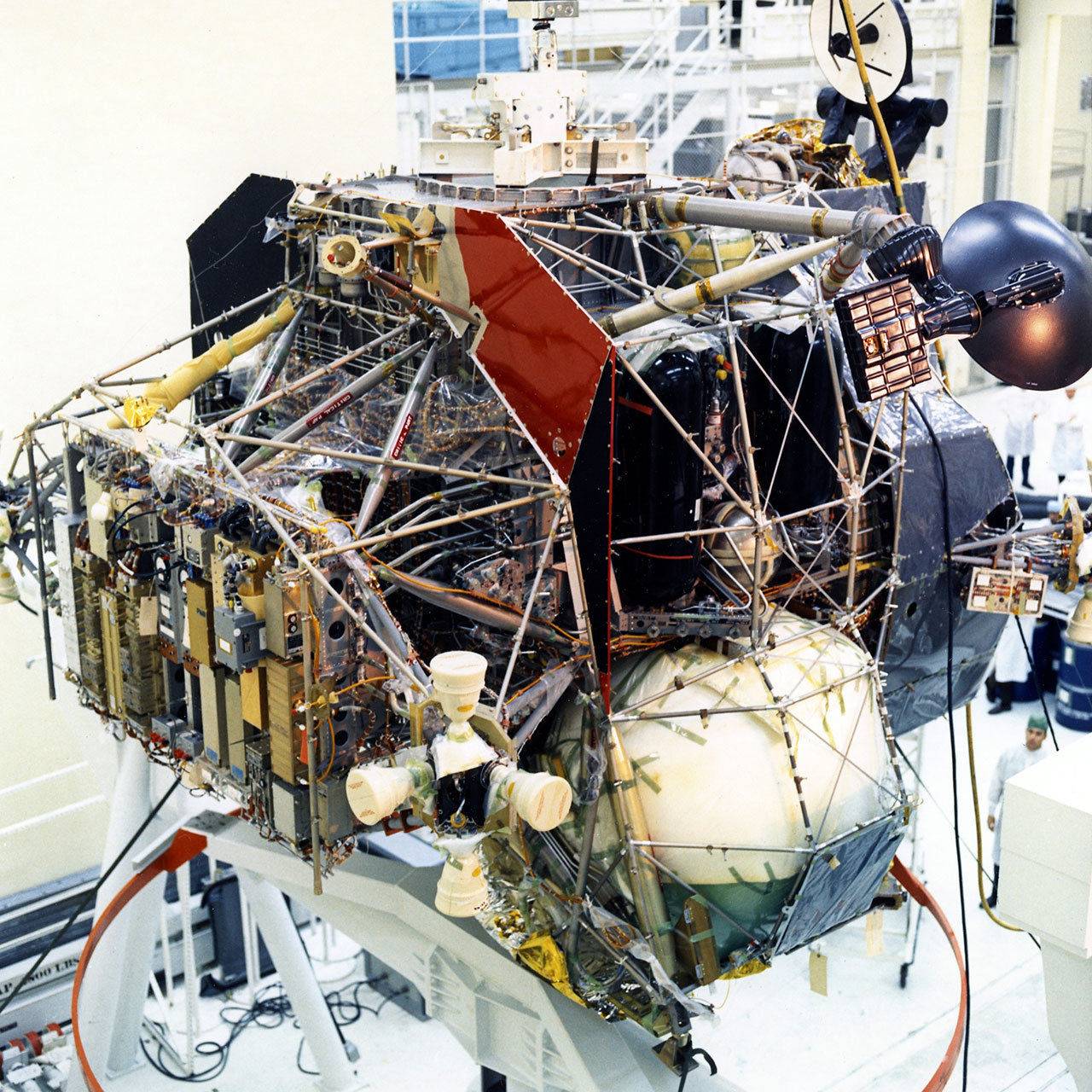
1968: Apollo 11’s LM-5 ascent stage under construction at Grumman in Bethpage, Long Island. The ascent stage without fuel weighed 2,445 kg/5,390 lb; double that with fuel. Click for a larger version.

You: “Did you say ‘guillotine’?”
Me [approximating John Cleese]: “Explosive guillotine, yes.”

August 2018 update: See also the companion article Don’t get me started, in which Apollo 17 LMP Jack Schmitt describes a mind-boggling workaround they could attempt if the ascent stage launch pyrotechnics failed to fire.

See also the comments at the end of this article for a photo of a guillotine housing, sent by a fellow who machined many of them at Grumman.

LM guillotine

In missions past and present, explosive devices feature in pretty much every spacecraft because they’re a safe, reliable way to ensure that processes start, items such as antennas are deployed, and connected assemblies that need to come apart are quickly and cleanly separated.

On the Apollo missions, over 210 pyrotechnic devices were in the Saturn V stack and the Command, Service, and Lunar Modules, used for everything from extending the LM landing gear to deploying drogue and main parachutes to ensuring fuel was at the correct side of a tank in zero G – for which the word ullage (in French, ouillage) was borrowed from vintners, to whom it means the headspace between the top of the wine and the container it’s in, whether a cask or a bottle.

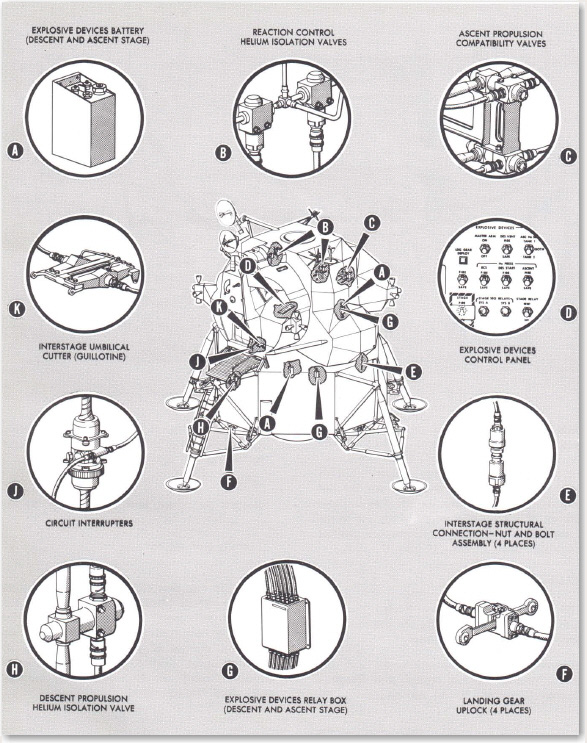
The Lunar Module had several devices on board:

ED Locations

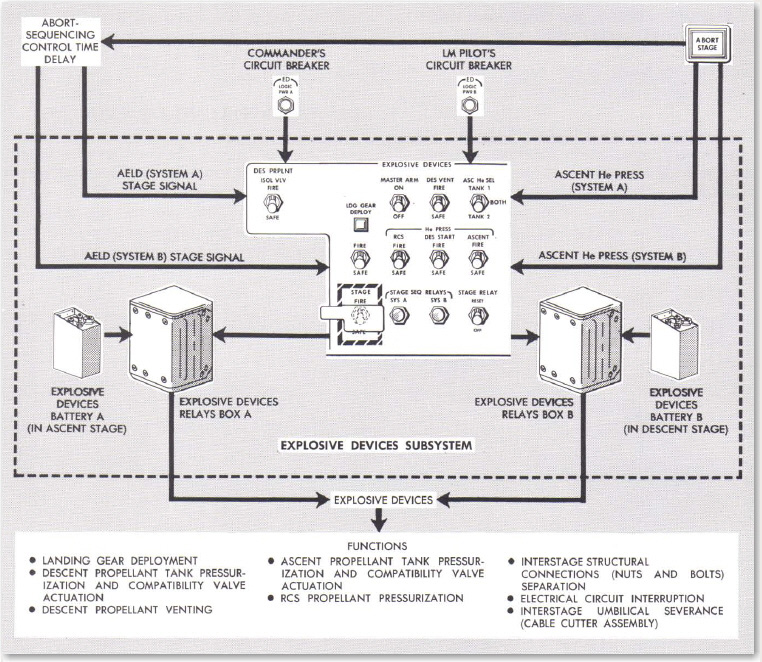
Control over them was through the Explosive Devices Control Panel:

ED Control Panel

All of these devices were essential, but particularly key were the devices set off to initiate separation of the ascent and descent stages of the LM when the astronauts departed the lunar surface. This was a three-stage process that took place in the tenths of seconds before the ascent engine was lit:

  • First, fire circuit interrupters to cut off electrical signals between the stages
  • Second, fire and shear the four explosive nut and bolt assemblies that affix the ascent stage to the descent stage
  • Third, using the explosive guillotine, slice through a thick bundle of umbilical cables and wires and a water supply line that run between the two stages

Though these devices were known to be generally reliable, a certain level of trepidation about them is understandable. Blowing up some high explosives to drive a big blade through wires doesn’t exactly sound like the most controlled process even though it actually was.

“Did you know when that unit was up on the moon, and the ascent stage was going to take off, they had all those wires – fourteen miles of them – running from the ascent stage into the descent stage, and it all had to be disconnected before you took off, or you didn’t take off? That’s all there was to it. You couldn’t use wire couplings that just pulled out when you gave it a good, hard yank. Do you want to trust a wire coupling to hold through a Saturn V liftoff and all that g-force and vibration? Uh-uh. Try flying a ship with a few loose wires. So, it was all solid connections, which is why we put a guillotine inside the descent stage: to cut all the wires. Everything had to be timed just right. The explosives had to trigger the guillotine and the blade had to cut through some pretty thick cables, and at the same time, the ascent rocket engine, which was never run before, had to start.”
– Bob Ekenstierna, LM descent stage construction supervisor at Grumman

In Chariots for Apollo by Pellegrino and Stoff, a somewhat sensationalist telling of the building of the Lunar Module at Grumman*, they speak of Joe Kingfield, the director of quality control. I won’t quote them directly since they went over the top with their narrative, but Kingfield had frequent nightmares about the liftoff from the moon that involved the guillotine and one or more of the explosive bolts failing. In his dreams, the ascent stage lifted off, but, still connected by miles of wire, dragged the descent stage along the ground and eventually crashed back into the surface. In later years, Kingfield still could not bring himself to watch the footage of the lunar liftoffs taken by the Mission Control-directed TV cameras on the Lunar Roving Vehicles of Apollo 15, 16, and 17.

*Not to be confused with the unimpeachable NASA volume of the same name by Brooks, Grimwood, and Swenson; web and epub links at the link. 2018 update: You can get a free high-quality scanned PDF of this book and many other official NASA histories – see the I got mine at the GPO bookstore post for the NASA Technical Reports Server links.

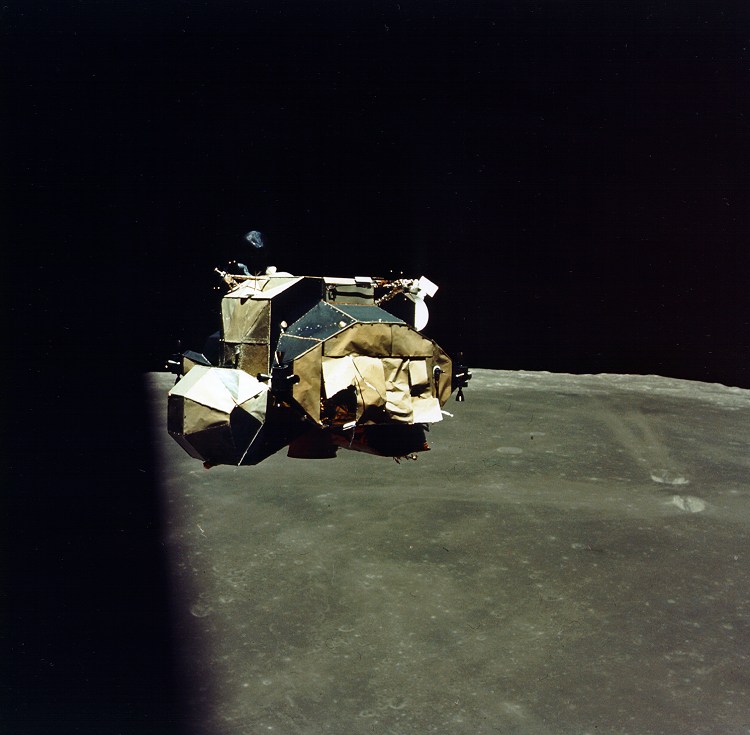
Charlie Duke, Lunar Module Pilot of the Apollo 16 Orion (the LM pictured in the Finley Quality Network banner above), said that the pyrotechnics for the ascent stage separation gave him brief pause just before he and Commander John Young lifted off from the moon. When the circuit interrupters fired, then the four interstage bolts at the corners were sheared, and finally the guillotine sliced through the umbilical and water lines, the entire ascent stage suddenly dropped an inch or so. Duke thought, “Oh, sh…” but did not have time to finish that thought as the ascent engine fired and abruptly took them away from the surface back toward Ken Mattingly awaiting their return aboard the Casper Command and Service Module in lunar orbit.

You can see a fair amount of the thermal protection fly off the ascent stage as it lifts off, which happened to all of the ascent stages to some extent. In addition, panels on the rear that provided thermal protection for the Aft Equipment Bay were damaged during the liftoff, but they had done their job already. Mattingly took this photograph of the Orion before docking:

AS16-122-19535

Apollo deniers like to point to this and other photographs of the Orion damage as ineluctable proof of chicanery, but what it really means is that they prefer extending and enhancing their apparently quite enjoyable fantasies to, say, reading the post-mission report (9th link in the background material):

At lunar lift-off, four vertical thermal shields (fig. 14-26) on the aft equipment rack were torn loose from the lower standoffs and remained attached only at the upper standoffs. This occurrence was observed from the lunar-based television.

The most probable cause of the failure was ascent engine exhaust entering the cavity behind these thermal shields. A cross section of the lower edge of the shields is shown in figure 14-27. Analysis shows that the thermal shield which extends below the support tube allows a pressure buildup on the closure shield which exceeds its capability. Once the closure shield failed, the exhaust entered the cavity behind the shield, resulting in a pressure buildup exceeding the capability of the vertical thermal shields.

In the lunar surface photographs taken prior to lift-off, some of the shields appear to have come loose from the center standoff (fig. 14-28). Excessive gaps between some of the panels are evident. Both conditions could be caused by excessive pressure in the thermal blanket due to insufficient venting during boost.

The corrective action will include a redesign of the thermal shield to eliminate the projection below the support tube, as shown in figure 14-27, and to provide additional venting to the blankets as well as additional standoffs.

This anomaly is closed.

Not one problem was detected in any of the pyrotechnics during any Apollo mission. The device designs used in Apollo were later adopted by the Shuttle program, with, for instance, the Single-Bridgewire Apollo Standard Initiator (SBASI) becoming the NASA Standard Initiator (NSI).

“This protanopia filter’s right up my street.”

I’m currently developing a theory that people who like this sort of photo filter might well have one of the several forms of colour-blindness. The first corollary to my theory is particularly handy in that it states:

Corollary 1: They might as well be colour-blind even if they’re not.

I had clicked over to that page to see a photograph of a ‘meatloaf salad’, but it was a non-specific link to the home page. I began to feel slightly queasy after just a page or two of scrolling into that bilious Smurf-toned world, and so closed the window, saying to no one in particular, “You know what? I can’t be arsed.”

I never saw the meatloaf salad, but I imagine it was along these lines

Toaster corncakes without the E numbers

I saw these in the store last night and was briefly tempted…for about a millisecond.

Cakes

They look appealing enough, but when I’ve given in to laziness and bought them in the past, I’ve regretted it. They’re far too sweet (first ingredient listed: sugar) and have quite an odd taste. They list artificial flavour in the ingredients, so I’m guessing it’s a miserable formula aimed at making soybean oil taste like the butter that ought to be in the recipe in the first place. Chemical trade name Butt•R•Not®, my imagination suggests.

Instead, I remembered a recipe for a homemade version in the King Arthur Flour Baker’s Companion, online recipe here, and made them this morning. The book version of the recipe suggested splitting, toasting, then applying softened butter and strawberry jam, so I tried them with preserves I had on hand from the good monks out in Spencer, Massachusetts, who also make my favourite blackberry seedless jam.

P1010290w

I don’t have a corncake pan, so I used a 9×13″ pan instead. You bake these until the bottom has some colour – see the upturned piece in the background – but the top has barely any so they don’t end up burning in the toaster.

I miss her

JuliaChild

Photo: Paul Child

It’s been just over ten years since Julia Child left us here to cope with a planet made considerably poorer by the lack of Julia Child.

I owe a lot to her. She’s responsible for my love of cooking and baking, not to mention at least some of my attitude toward life, more probably a large part. She had such a lively disposition, and a devilish habit of speaking her mind regardless of whether there might be consequences. She wasn’t snarky, she was impish. She was – and is – my hero.

I first started watching her when I was a kid, probably right around the time of this episode of “The French Chef”:

This sort of programme was still pretty revolutionary at the time. She probably presented ten times as much information on lobsters as anyone else on television had up to that point. Her thoroughness and breadth of knowledge fascinated me no end, and I remember thinking, “She is great. I want to be like her.”

The episode that really set itself firmly in my memory was when she made traditional French bread. When kneading, she would slam the dough onto the counter, raising great clouds of flour and clearly having a ball. When I did finally start making food for myself years later, that bread was what I remembered, and my first baking project was baguettes, using her detailed instructions in From Julia Child’s Kitchen, the first cookbook I ever owned. That they came out fantastically well guaranteed that I’d never stop, thank goodness. Had I failed miserably at that first attempt, there would be a more than middling chance that my life would be at least an order of magnitude poorer now. I didn’t fail because that’s how good she was at teaching and encouraging novices.

“The only real stumbling block is fear of failure. In cooking you’ve got to have a what-the-hell attitude.”

In years past, I saw her more than once just off Harvard Square, at the Church Street car park. Each time, I would wave and give a cheery hello, and she did the same. I never had one of her cookbooks with me, but I later wrote a letter of thanks to her and asked if she would sign my copy of The Way to Cook, which I included along with a postpaid box with which to return it. She did, and it is a treasured volume.

I miss her often. Whenever I do, I watch a few of the hundreds of hours of her shows that I have. She brings a smile every time.

A new rose was bred in 2004 and named after Julia Child. It is, of course, the colour of butter. A really good butter. She would have no less.

“Giving up butter means that in about two years you will be covered in dandruff.”


Boeing Belles

The latest addition to my office desktop Boeing gallery arrived in the mail today from Hong Kong. Now I have my three favourites, the B-17, B-747, and B-314, in the same 1:200 scale. You can click on any of these to see a larger size.

The detail is pretty good on the new model:

Especially given its size:

This Boeing Belle I painted years ago on one of my flight jackets – a little more eye-catching, I think, what with Rita Hayworth and all. The painting is about 16″x16″ on the back of the jacket and the lettering is done in Boeing’s logo style of the 1940s.

I took that photo of the painting in March so I could have Rita and the Mon Tête Rouge II on the back of my new phone, too, courtesy of Skinit.

a) doesn’t know his idioms, or b) is an arse

On Wall Street, shares in Bank of America opened 1.5% higher following the settlement.

Joel Conn, president of investment firm Lakeshore Capital, said it was because a “major cloud [hanging over the bank] has been lifted”

“Regulators wanted a pound of flesh, and they got it,” he added.

That phrase comes from The Merchant of Venice, of course, and is generally accepted to mean a legal but exceedingly unreasonable monetary demand – for example, every demand ever made by any payday loan shark company. To me, the penalty of US$16.7bn that Bank of America is paying for their culpability in snipping the brake lines of the world economy and causing it to slam into a concrete wall at 150mph, demonstrably hurting hundreds of millions of people, seems pretty darned reasonable, maybe too reasonable.

I would have said ‘a wrecking ball swung repeatedly at every branch and every executive’s home’ had they asked me what the price ought to be, so I think the answer could be that apologist Conn b) is an arse.

“Mr. Conn, I may choose to invest with your firm, but first, there’s the small matter of your name…”

Now, how shall I tag this? Oh, I know.

FQN upgrades

I just added the features you see above. By that, I don’t mean to imply I expended much effort – I merely enabled them in the WordPress Jetpack options, along with the comment spam filter that I had thought was turned on by default. You’ll see the Related section only if you click on a post’s title or the “Leave a comment” link.

The Email button is slightly quirky in that I created the code behind it as a mailto: link so it will be you sending from your own email client rather than an email sent from this site, which is the behaviour of the WordPress inbuilt Email button. The consequence of me customising this is that it also displays a blank window when you click Email. Just click the back button to return to the page you were on.

I had the option of adding Fnooter, Dingleface, and other anti-social self-destruct buttons as well, but I would sooner replace my Apollo 16 Orion banner up top with a gallery of Donald Trump weasel photos than see their logos on my site.

Some are already touched in the head

I am sure this paragraph has touched all the internet users, its really really nice post on building up new blog.

Comment spam, of which the above is the eighteenth example I’ve seen, seems to arrive chiefly in the middle of the night and has the strangest links. This one was in reply to the meatloaf post and the poster”s “name” was a link to a YouTube video on how to move to Hawaii, whose description there was written by a native English speaker and included a link to buy her ebook on the topic – the end goal of the spam, I’m sure. Actual Spam® has been quite popular in Hawaii since WWII, so perhaps she’s just doing her bit to transition it to new vistas.

Such garbled comment spam – there’s much worse, such as “No subject what design you would like louboutin men” – means they’re too lazy to compose it themselves and are using an automated service of some sort to insinuate their links into others’ blogs, said service provided by someone whose second or third language is English (ish). WordPress blog comments are moderated by default, with comments appearing immediately only if the person has been previously approved, and I imagine authors with any wits about them keep that setting, so I think there’s an awful lot of pennies-per-hundred-posts being spent foolishly to shift electrons back and forth without any particular aim – except perhaps to amuse me in a small way.

Now I sit and ponder which of the twenty-five or so grafs in my meatloaf post they were talking about. Was it the one about the ketchup? I’ll bet it was the ketchup.

Close, but no cigar

At the old place last month, I wrote:

Jiminy Cricket, a real cracker of a lightning strike perhaps 100-200 feet away — no more than that because the flash and bang seemed simultaneous to me — just dismounted and remounted my external USB drive.  There was no power outage or reboot or dimming of lights or any other effect that I could see, so I’m thinking some of that charge came through here to the living room.

I hear multiple fire engine sirens now.  

Turns out I was pretty close. I did not go outside that day to gawk, but I just learned that the bolt struck a house precisely 300 feet from mine, setting fire to the attic. A family member of the local fire chief first spotted the blaze and, due to its intensity, seven neighbouring fire departments provided mutual aid to the town, four at the fire and three covering the station. Possibly a teensy bit of overkill, but actual honest-to-goodness structure fires are kinda rare, you know? Everybody wants to have a go.

Memphis Belle flies again

After writing about B-17s and the 1990 “Memphis Belle” film the other day, I looked at this video once more, remembering that my takeoff from the National Warplane Museum grass strip featured the same wide leftward swing of the B-17’s tail into the wind that’s in the sequence starting at 2:28 – rather exciting when you’re inside the aircraft:

I lamented that the DVD I have, from the following year, is in that old “widescreen, but not – ha ha!” format, where there’s black stripes not only top and bottom but left and right, just as you see when you play the above, so the actual resolution of the video is horribly limited, to put it mildly – maybe one-quarter of full HD quality. It doesn’t look very good on my 42″ set, where it’s reminiscent of those first postage-stamp videos Windows 3.1 could play. But then I noticed in the YouTube recommended video list Memphis Belle – Take Off – Available May 6, and was pleasantly surprised to find out that the film was released on Blu-ray just a few months ago. This weekend, I’ll be able to watch it properly for the first time since I saw it in the cinema.

Comfort Diner meatloaf

Click for a larger version

Printing tip: At the bottom of each article on the site, a print/PDF/email function allows you to print or save a PDF of just the body of the article without any web site formatting. Scroll to the end of the article and find these icons: In the print dialog, you can click any element you don’t need to remove it from the printed/saved version.

parislights wanted to make this again and asked that I repost the recipe, so here it is…

This recipe from Manhattan’s Comfort Diner, with its unusual use of oats instead of bread crumbs, produces a delightfully soft-textured meatloaf that’s miles away from the mundane and typical dense-pack meatloaf that I find somewhat unpleasant.

The original recipe from The Comfort Diner Cookbook is below. Note: My changes to the recipe, which are substantial and I think important, are immediately below it.

Mom’s Meatloaf

Ingredients:

  • 3 tablespoons olive oil
  • 2 garlic cloves, minced
  • 1 cup finely diced white onion (1 medium-size onion)
  • 1 cup finely diced celery (2 to 3 stalks)
  • ¼ cup finely diced green bell pepper (from 1 bell pepper)
  • 1 tablespoon dried basil
  • 1 tablespoon dried thyme
  • 1 tablespoon dried oregano
  • 2 large eggs
  • 1 cup whole milk
  • 1 cup plain whole oats
  • 1 pound ground beef [80-85% lean]
  • ½ pound ground veal (if you don’t want to use veal, just increase the ground beef to 1 ½ pounds)
  • ½ pound ground pork
  • ½ tablespoon table salt
  • ½ tablespoon freshly ground black pepper
  • ¼ cup Worcestershire sauce
  • ½ cup canned diced tomatoes, drained
  • ½ cup ketchup or canned diced tomatoes, for topping

Directions:

  1. Preheat the oven to 325F/160C. In a large sauté pan on medium heat, warm the olive oil, then add the garlic, onion, celery, bell pepper, basil, thyme, and oregano. Sauté the vegetables for 3 to 4 minutes, until they begin to soften.
  2. In a bowl, whisk together the eggs and milk. Add the oats.
  3. In a large bowl, combine the meats well by hand. Season with the salt and pepper. Pour the liquid mixture over the blended meats and mix thoroughly to combine. Add the Worcestershire sauce, tomatoes, and sautéed vegetables. Mix well.
  4. Place the mixture in a 9×12 baking dish and form it into a long, rounded loaf. There should be at least 1 inch of space around the loaf to allow fat to run off.
  5. Spread the ketchup or diced tomatoes evenly on top of the loaf, and bake for 50 to 60 minutes, until firm and cooked through.
  6. Remove the meatloaf from the oven and allow to cool for 2 to 3 minutes before serving.

Here are my changes and baking notes:

  • Change: The herbs from dried to chopped fresh (I like the grassy note you never get from dried) and the peppers from green to a mix of sweeter bell peppers like red, orange, and yellow
  • Double: The onions and the herbs; you’re going to caramelize the onions, meaning two cups will reduce down to maybe two-thirds of a cup, and fresh herbs aren’t as intense as dried
  • Triple: The peppers (I use ¼ cup finely diced of each of the three colors)
  • Lower: The milk to 2/3 cup or the mixture is almost too sloppy to free-form.

Here are the veg and herbs for the double recipe that I usually make. This amount cooks down to about three cups in the end.

Sautéing the veg substantially changed:

  • Caramelize the onions in the olive oil on a medium-high heat to a mahogany color, stirring frequently so they don’t burn; I double the quantity because they shrink to almost nothing. This is going to take a while – don’t believe the majority of TV chefs and recipes that tell you caramelizing onions takes 10 or 12 minutes, because someone else did it for them and they haven’t done it themselves for many years – or they’re just lying because no one wants to hear it takes half an hour. In any case, it’s worth your time.*
  • Add the celery and diced peppers when the onions are about 2/3 done
  • Add the garlic only in the last couple of minutes to avoid burning it
  • Add the herbs to the sauté only in the last minute
  • You may find that the mix gets a little too dry during this extended sauté – if that’s the case, add a bit more oil or some oil and butter

*There is a method out there that uses baking soda to supposedly speed-caramelize onions, but I found it saves only a few minutes. Worse, even the tiniest quantity seems to break the onions down so much that you end up with onion mush…nicely colored, sure, but mush. It’s a cynic’s view, I’ll admit, but I think some of the sites propounding this method just might be using traditionally caramelized onions in their photos, because no one wants to see a mound of mush.

This is what your elixir will look like after sautéing. Your house smells good now, too, doesn’t it?

Tips:

I usually combine the milk, eggs, and oatmeal in a bowl before I start sautéing the veg and herbs. By the time the veg are done, the oatmeal has soaked up a good bit of the liquid, which makes for easier mixing.

You may need to adjust the seasoning, so make a small, thick patty from an ounce or two of the finished mixture and sauté it over medium heat, turning frequently, to an internal temp of 160F/72C so you can safely taste it. E coli is hardier than some critters and lives right up to 150F/65C, so for this recipe, a probe thermometer should be your close friend. The right internal temperature is especially important in the finished loaf. I use a TempTest 1, a sort of compact version of the same company’s more well-known Thermapen, but much cheaper ones like their Super-Fast pocket model, an Oxo instant read you can pick up at Bed Bath & Beyond, or this Taylor from Amazon – the one I use at my office – are similarly accurate, just not as fast as the more expensive models.

If you make two loaves at a time as I usually do, your mis en place is probably going to take about 35 minutes if you’re fairly proficient – 45 if you’re also making mash from a boatload of potatoes. Let’s call it an hour if you further add a passel of carrots. There’s a helluva lot of stuff to peel, dice, and slice when you make two loaves and a couple of sides.

Baking changes:

Line a pan with heavy duty tinfoil and put a fairly close-mesh wire rack in the pan. Fold a piece of heavy duty tinfoil to the size of the loaf you intend to form (about 10×5″) and place on the rack. When you put the loaf on this, it will stop the mixture squidging through the rack underneath but will also allow the fat to drip off into the lined pan below as the meatloaf cooks. This way, it’s not swimming in its own fat at the end.

If the mixture is on the loose side – and it almost certainly will be – you can refrigerate it for a few hours or overnight before forming, or be brave and form it anyway, then get it out of the oven at about fifteen minutes and, using a couple layers of food prep gloves to avoid burning yourself, push the sides in to get its height back. I’ve done that more than once, but I don’t recommend it.

These days, I always do all the prep one evening, chill the finished mixture overnight, and bake it for dinner the next night after a day of delightful anticipation. I think the finished flavor is improved when the ingredients have plenty of time to insinuate themselves upon each other overnight, but the real bonus is that all you have to prep the next night is your vegetable sides. It’s a very satisfying method.

For this double recipe, I refrigerated the mix overnight to firm it up nicely, then packed half at a time into a loaf pan and unmolded onto the foil islands on top of the wire rack like so. When the mixture is well-chilled beforehand, the loaves don’t slump at all in the oven.

The meatloaves on their foil islands shortly after going in the oven, holding their shape nicely after chilling overnight

In my experience, the 50 to 60 minutes in the recipe well underestimates the baking time. It’s more like 80 to 90 minutes when you have a properly tall loaf. Just use an instant-read thermometer to ensure the very middle of the loaf is 160F/72C. Any little critters that may have been along for the ride will be pushing up teeny-tiny daisies by then.

I don’t paint the ketchup on top until baking is about three-quarters done, when the internal temperature is past 120F/50C (don’t forget to wash the thermometer probe afterward). This way, it still darkens and thickens nicely, but doesn’t form the almost burned crust of the original recipe. The result:

Click for a larger version

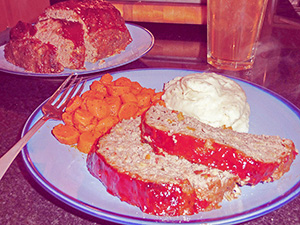
Sides that go well with this (they’re all in that picture at the head of the article):

  • Julia Child’s garlic mashed potatoes, recipe here (scroll halfway down that page); even without the garlic sauce, mashed done her way is the best way. The key is the drying of the potatoes over low heat after ricing or mashing and before adding the butter and cream. (Sometimes, instead of the slow braising of the garlic in that recipe, I cut the bottoms off two whole heads of garlic, drizzle with olive oil, wrap in foil, and roast in a 400F/200C oven for half an hour, then simply squeeze the tamed and softened cloves into the mash.) Keep tasting the mashed as you add salt and pepper until it makes you go “Mmmm.”
  • Carrot coins braised in butter, just barely bubbling on medium-low heat until tender, then glazed with a touch of brown sugar and garnished with a handful of the carrot’s close cousin, parsley. I usually peel and slice about 3 pounds, which needs two sticks of butter to partially cover the carrots; stir it occasionally as it braises. Serve with a slotted spoon so you don’t have a puddle of butter on the plate.
  • Alton Brown’s Better Than Granny’s Creamed Corn, recipe here. Be sure to add plenty of freshly ground pepper at the end, tasting continually – you’ll know it immediately when you’ve hit the sweet spot.

What do do with leftovers: Heat thick slices and serve on lightly toasted whole wheat slathered with grainy mustard and mayo.
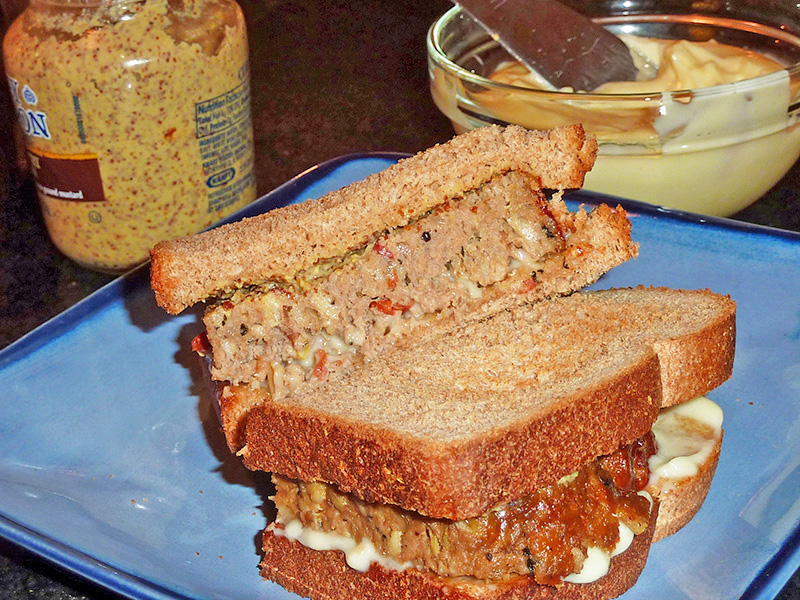
meatloaf 3

Feeling ambitious? Make some of this for your sandwiches:

mayo

Homemade Mayonnaise

All you do is whisk together these six things in a medium sized bowl (tip: wet a kitchen towel, form it into a circle, and place your bowl onto it for stability while whisking):

1 egg yolk
1 teaspoon water
½ teaspoon salt
A few grinds of white pepper
1 ½ teaspoons lemon juice
1 teaspoon apple cider vinegar

Then, using a Pyrex glass measure with pouring lip or something similar, whisk in 1 cup of oil (I often use canola), by drops at first to start the emulsion, then a thin stream, then a thicker stream, whisking briskly all the while. Then you adjust seasonings as necessary. And you look at the clock and just four or five minutes has passed since you started.

It almost seems too simple to produce something so tasty and useful. In fact, it’s so good and so easy that you may look out the window to see if the Commercial Mayonnaise Police are outside, waiting to break your door in whilst shouting, “What’s all this, then?!”

If you’re familiar with Trader Joe’s mayonnaise, this is much the same in flavor. If you prefer the taste of Hellman’s/Best mayonnaise, you can cut back on the lemon juice and add some mustard powder.


Edited November 2018 to add this even easier method that you can use if you have a stick blender:

2-Minute Stick Blender Mayonnaise

In a jar just wider than your stick blender, place:

1 egg yolk
2 teaspoons water
1/2 teaspoon table salt
1 teaspoon apple cider vinegar
1 1/2 teaspoons lemon juice (if you like a little less tang, lower this to 1 teaspoon)
1/4 teaspoon mustard powder or a teaspoon of mustard
A few grinds of white pepper or black pepper

Carefully pour one cup of neutral vegetable oil like canola on top of those.

Place the stick blender all the way on the bottom of the jar, making sure it encloses the egg yolk.

Pulse the stick blender for a second or two, then wait a second or two. As you repeat this, you will see the emulsion start to form at the bottom. Repeat this pulse-wait cycle eight or ten times. At this point, you are likely to have some oil still sitting on top. Slowly raise and lower the blender to incorporate the rest of the oil.