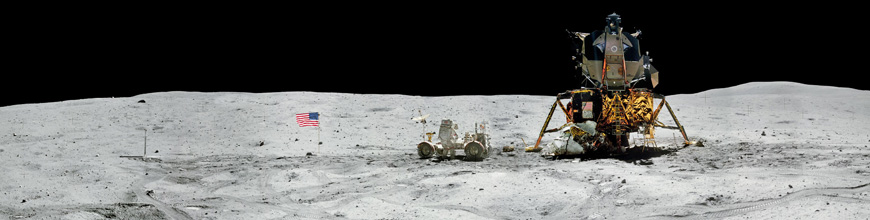
I added a new 12×36″ enlargement to my refreshed hallway gallery today, a 1:3 aspect ratio crop of a high-resolution scan of the photo of the first flight of the Wright Flyer on 17 December 1903 at Kill Devil Hills, North Carolina.
Click for a larger version
Orville is piloting and that’s Wilbur at the wingtip. John Daniels, one of the five witnesses to the flight, took the photograph with Orville’s pre-positioned camera – so awed by what he saw that he almost forgot to squeeze the bulb to capture this image on the 5×7″ glass plate negative.
From the Flyer to the Apollo 16 Lunar Module Orion above it was a span of just sixty-eight years and four months.
The full-size first flight image from the Library of Congress can be found here – be aware that it’s 27MB.
Edited to add: The comments here include a discussion in some detail of the soon-to-be-released film “First Man” and HBO’s 12-part 1998 series “From the Earth to the Moon”.
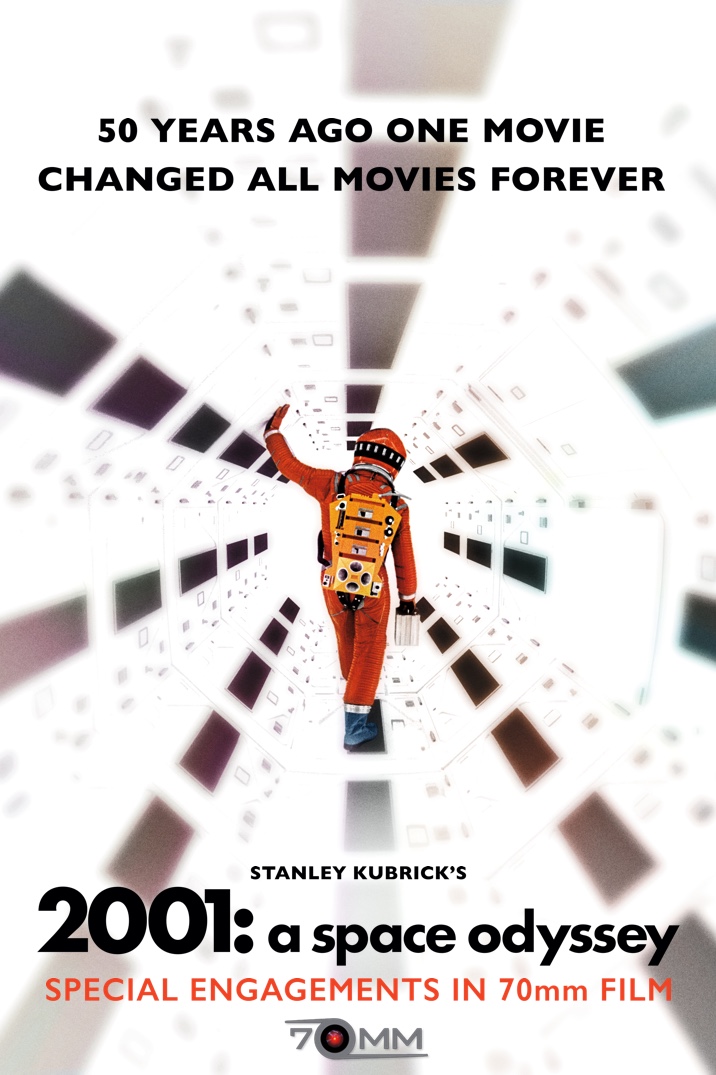
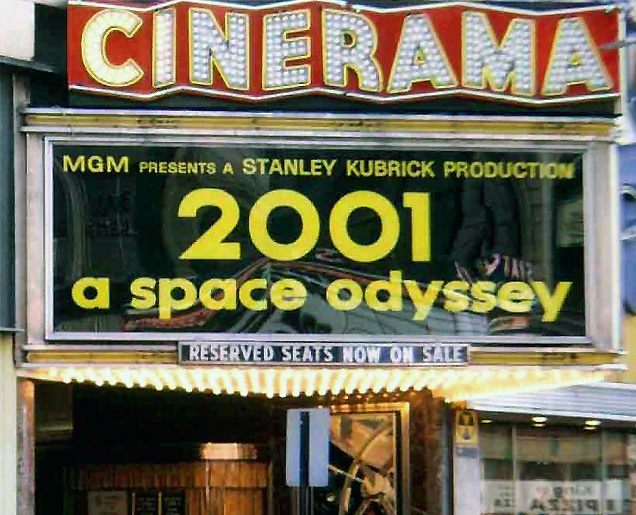
This week, at an IMAX theatre with 70mm film equipment, I’ll see 2001: A Space Odyssey in a theatre and in 70mm for only the second time in my life. I was a kid the first time, here:
The marquee of the RKO Boston Theatre, April 1968
I believe I’m in for a treat:
“For the first time since the original release, this 70mm print was struck from new printing elements made from the original camera negative. This is a true photochemical film recreation. There are no digital tricks, remastered effects, or revisionist edits. This is the unrestored film – that recreates the cinematic event that audiences experienced fifty years ago.” – Christopher Nolan
US 70mm film screenings are listed here. UK and Ireland listings here.
The excerpt below is from the site of Apollo 17 Lunar Module Pilot and geologist Harrison “Jack” Schmitt, and it’s the most…well, invigorating description of a jump start I’ve ever read.
This goes hand-in-hand with my article on the explosive guillotine in the Lunar Module because Schmitt describes an emergency scenario that Apollo crews planned for and practiced in which the launch sequence has failed: The guillotine has not fired, the four explosive bolts holding the two stages together have not exploded, and the ascent engine has not started. This is one of several contingency methods mission planners worked out.
Bear in mind as you read Schmitt’s explanation that this would be happening after they had tossed their Portable Life Support System backpacks out onto the lunar surface to save weight during the ascent, and after they had closed up the LM and repressurized the cabin in preparation for departure from the lunar surface.
It’s not often I find something about Apollo I’ve never heard before, and this one is boggling. I bolded the last bit of the excerpt because that’s the point when the ramifications sank in and my eyebrows shot off.
Wednesday, November 8th [1972], brought on our last full Lunar Ascent Mission Simulation involving Mission Control in Houston. Six weeks hence, we hoped we would be undertaking the real thing and departing the Moon at the conclusion of a highly successful exploration effort. This “Sim” required over three straight hours in LMS2, including the debriefing with SIMSUP (Simulation Supervisor). Failure or degradation of the primary guidance or engine ignition subsystems constituted the primary concerns addressed in Ascent Simulations. We particularly worked through several scenarios involving failure of the various software-initiated means of igniting the Ascent Engine.
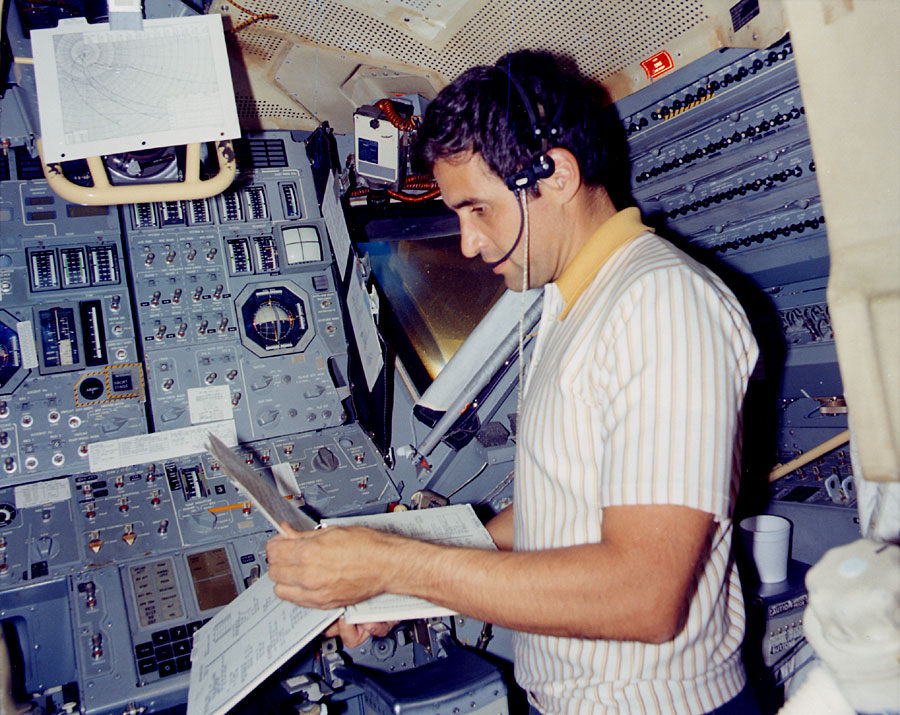
Schmitt in Lunar Module Simulator 2. NASA photo ap17-KSC-72PC-539
We did not have a great deal of concern about our Challenger Lunar Module, like all the others before it, having just one Ascent Engine, because, in fact, it was at least two engines that just looked like one. Only the solid metal fuel and oxidizer injector ring and the exhaust nozzle below that ring did not have identical, that is, “redundant” components that would function even if a primary component failed. No one could imagine a failure mode for these non-electronic and solid pieces of hardware.
If all internal Ascent Engine ignition options actually failed, and many such options existed to fall back on, we also had a set of jumper cables that could be used as a next to last backup to ignite the Ascent Engine. These were called the “ED/APS Emergency Jumper Cable” and would use power from an independent Pyrotechnic Battery in the Descent Stage to open the engine’s fuel and oxidizer valves and fire the pyrotechnic cable and bolt cutters that would simultaneously separate us from the Descent Stage.
To use the second of these cables, however, one of us would need to egress Challenger in order to access a regular Descent Stage battery. Integrity checks of our suit would determine which one of us would perform this emergency EVA. If Cernan’s pressure suit did not pass its pre-egress checks sufficiently to permit egress with the jumper cables, we would change positions in the cabin, a tough task on its own. As we would have already jettisoned our Portable Life Support Systems, it would be necessary to use the OPS (Oxygen Purge System) we had retained to support the EVA that Evans would perform to retrieve film canisters from America’s Scientific Equipment Bay after leaving lunar orbit for home. The 8000 psi oxygen bottle in the OPS could provide a maximum of 30 minutes of oxygen and air-cooling once activated. There would be no water cooling, however, without a PLSS.
With the Challenger’s cabin depressurized, the winner of the integrity check contest would take one end of the pair of cables out the hatch and down the ladder and move to QUAD III where a battery could be accessed. He would then tear away the Kevlar covers and attach the color-coded pair of cables to the positive and negative terminals of a battery and then return to the cabin. At the optimum liftoff time for ascent into a rendezvous sequence with Evans, Cernan would attach the cables to two circuit breakers near his left shoulder. This action would supply instant power to the two sets of hypergolic (ignite on contact) hydrazine and nitrous oxide valves in the Ascent Engine. Once power reached these valves, they would open and lock open. With opening of these valves, a signal would go to the cable and bolt cutters. We would be instantly on our way into lunar orbit, still in an un-pressurized cabin, dragging our jumper cables behind us. Once back in lunar orbit, we could clear and seal the hatch and pressurize the cabin.
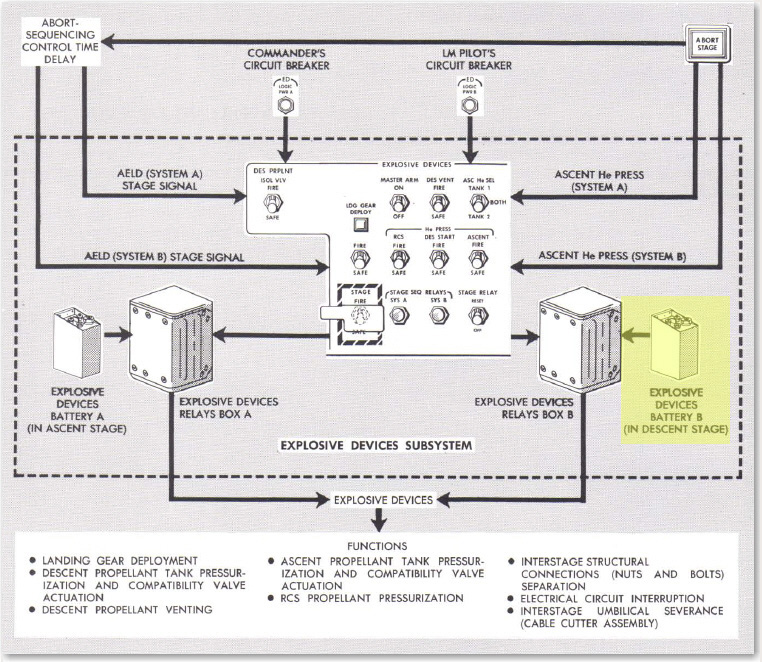
The aim of this emergency EVA was to bypass relay boxes, internal wiring, and the Explosive Devices control panel in order to get power directly from a descent stage battery.
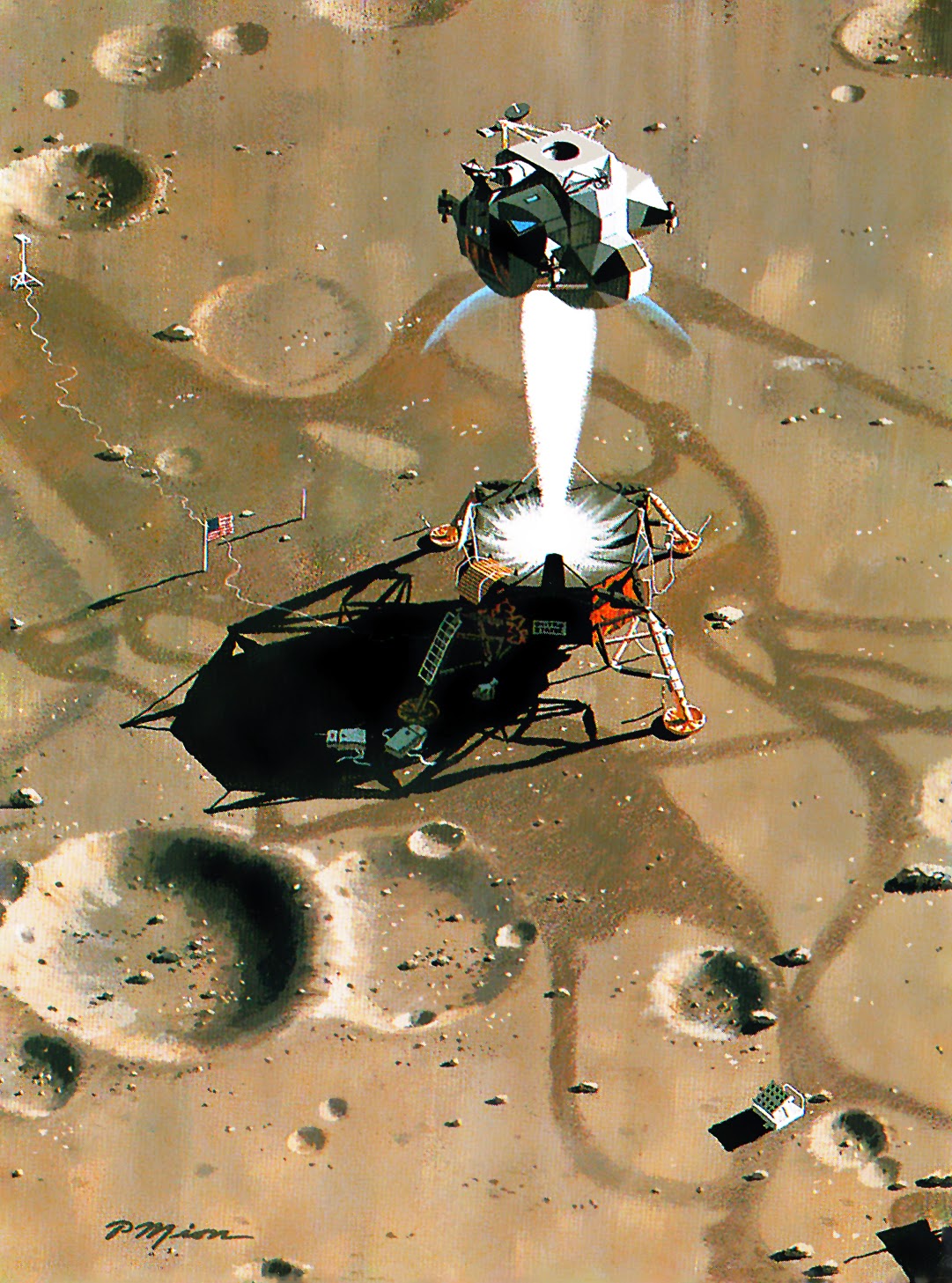
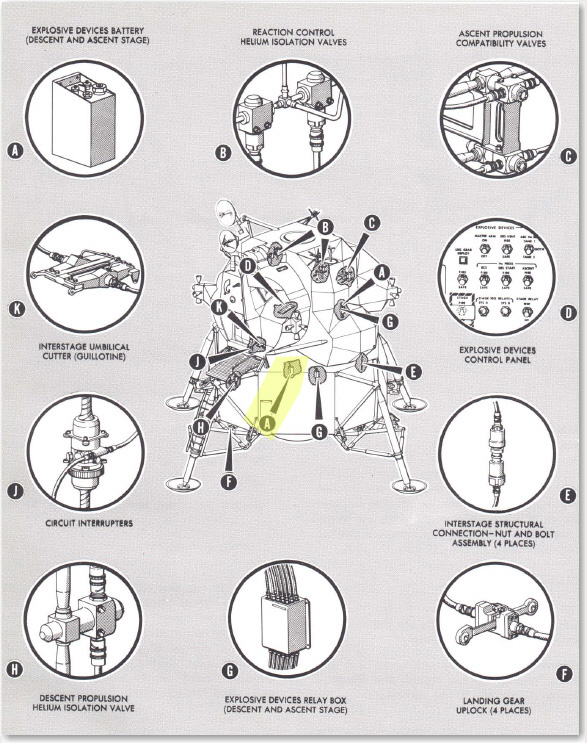
The descent stage explosive device battery, aka the pyro battery, in question was near the front, highlighted here. This procedure bypassed that in favor of a regular descent stage battery.
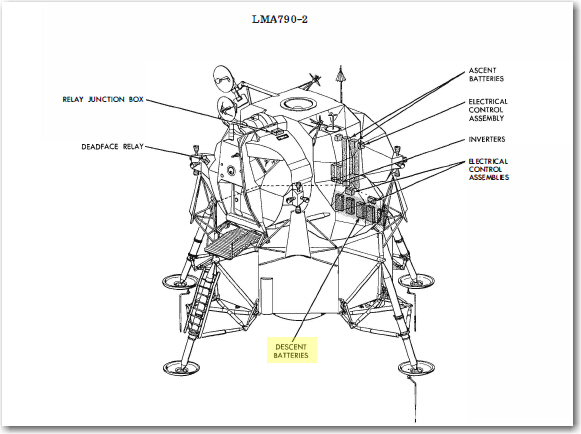
In later LMs, Apollo 17’s included, five descent stage batteries were at the back of the LM, shown below in an illustration from the Lunar Module LM 10 through LM 14 Vehicle Familiarization Manual [link to PDF]. Two of the five had low voltage taps; the jumper cable would be affixed to one of those.
I’m glad they never had to do this, but it actually sounds like it would work. You might think, “Yeah, except for all the cardiac arrests and such”, but you have to remember that these guys were cool customers. Witness the fact that they practiced for this instead of climbing out of the sim and seeking the nearest bar posthaste when told of the method.
Schmitt says this method was the “next to last backup”, which makes me wonder intensely what on Earth Moon the last backup was. Spit and baling wire?
Edited 24 August 2018 to add: The entire emergency EVA procedure is detailed in Apollo Operations Handbook/Lunar Module/LM 11 and Subsequent/Volume II Operational Procedures, available on the Apollo Lunar Surface Journal site. See section 5.4.25 Loss of ED Sub-system.
I think I found the answer to my “What’s the last backup?” question there: The other choice was to quickly get to the rover – in the case of Apollo 17, parked about 158 meters away for best liftoff camera coverage – start it up, drive it back to the LM, and hook up to one of its batteries. Now that would really be a jump start for the ages, but I think far less preferable considering there was just 30 minutes of oxygen available in the OPS.
This silly little Amazon Treasure Truck notice popped up on my tablet earlier tonight:
Amazon knows I live in Massachusetts, right next to one of the most prolific and sustainable lobster environments in the world, but maybe they don’t also know that, for a few weeks now, the Market Baskets around here have been selling live lobsters for US$4.99 a pound, as is their wont in the summer. Yes, you’ll have to buy about three pounds of lobsters to net a pound of meat, but that’s still only $15. And it’s fresh.
I know there are some lobster farms in Asia – rock lobster, because other species don’t survive farming attempts – but wild-caught is what you get here. No need to farm:
I think the wholesale price is what’s represented in the chart, so you can see that Market Basket has a mighty slim profit margin when they drop lobster down to $4.99, unlike other area supermarkets that continue to price theirs at up to $9.99 a pound (pffft!).
120 million pounds of lobster is the equivalent of eighteen fully-fueled Saturn Vs. As is the case with size of Wales or Olympic swimming pool comparisons, this helps the reader not one whit, of course, but at least the writer is amused. And now craving lobster, so there’s my comeuppance.
At Market Basket, ten bucks for this much lobster, two for the tarragon; maybe ten cents for the Luzianne sweet tea
I refer you to the 31 July 2018 “Built to Burn” episode of 99% Invisible, podcast and transcript here.
I think this and McPhee’s “Los Angeles Against the Mountains” are vital to the proper understanding of wildfires, especially in the western United States. You can’t build developments in guaranteed wildfire zones, take no preventative measures, even the simplest and most effective, to protect the homes – the topic of the 99PI episode – and blithely expect nothing dire will ever happen. A few embers from a fire that never actually reaches your house can easily ruin everything.
“One of the very frustrating things that I had experienced this past summer, particularly from the California fires, is the continued sense of fatalism: ‘Oh, well, there’s nothing that could be done.’ Well, no. The bottom line is that we can do something; it just doesn’t have anything to do with controlling the wildfire.”
Watching news footage from the California fires, something stands out, especially if you’ve spent a lot of time with Jack. Once you get over the shock of seeing neighbourhoods reduced to ashes and the drama of firefighters talking about how there was nothing they could do to stop the flames, your eyes shift to something else: the green trees, untouched by fire, surrounding the burnt-out homes.
From this week: Lake Keswick Estates in California; click for a larger version
From this week: Lake Redding Estates in California