
An affinity for the little-known

I watched with keen interest art historian Dr. James Fox’s new four-hour BBC Four series “Age of the Image” in recent weeks, then immediately devoured his just as excellent “A History of Art in Three Colours”. A few more of his series await me thanks to MVGroup.

Fox has a way of holding the viewer’s attention and a love of highlighting smaller but key points often overlooked that remind me somewhat of John McPhee’s writing and of Professor Iain Stewart’s BBC documentaries “Journeys Into the Ring of Fire”, “Rise of the Continents”, and others.

I happen to be in the midst of rereading McPhee’s 1967 book Oranges at the moment, so I can share an example that’s fresh in my memory of what I’m talking about. The book was one of McPhee’s first – bibliography here – and is a horticultural, commercial, and social history of the orange. I believe I just heard one of your eyebrows arching up at the thought of an entire book about oranges and pomologists (fruit scientists), but see here: It’s entertaining, informative, funny, sometimes surprising, and thoroughly deserving of the occasional reread. Plus it’s fairly short.

Early on in Oranges, he explains the basics of growing citrus, which are odd enough to start. Once you’re armed with that knowledge, he then proceeds to blow your mind a little later.

    Most citrus trees consist of two parts. The upper framework, called the scion, is one kind of citrus, and the roots and trunk, called the rootstock, are another. The place where the two parts come together, a barely discernible horizontal line around the trunk of a mature tree, is called the bud union. Seedling trees take about fifteen years before they start bearing well, and they bristle with ferocious thorns. Budded trees come into bearing in five years and are virtually free of thorns. In Florida, most orange trees have lemon roots. In California, nearly all lemon trees are grown on orange roots. This sort of thing is not unique with citrus. With the stone fruits, there is a certain latitude. Plums can be grown on cherry trees and apricots on peach trees, but a one-to-one relationship like that is only the beginning with citrus. A single citrus tree can be turned into a carnival, with lemons, limes, grapefruit, tangerines, kumquats, and oranges all ripening on its branches at the same time. Trees that are almost completely valueless for their fruit seem to make the most valuable rootstocks. Most of the trees on the Ridge are growing on Rough Lemon—a kind of lemon whose fruit is oversized, lumpy, ninety per cent rind, and all but inedible. As a rootstock, it forages with exceptional vigor and, in comparison with others, puts more fruit on the tree. Bitter Oranges, or Sour Oranges, the kind usually associated with Scottish marmalade and with Seville, make an outstanding stock in certain soils, notably on the banks of the Indian River.

    Citrus scientists have difficulty finding the property lines between varieties and species and between species and hybrids. One astonishing illustration of this came as the result of an attempt, at the United States Horticultural Station in Orlando, Florida, to grow a virus-free Persian Lime. This is the kind of lime, almost perfectly seedless, that goes into everybody’s gin and tonic. About fifteen years ago, many Persian Lime trees in Florida were affected by a virus that was drastically shortening their lives. The most common way to create a virus-free strain of a citrus fruit is to plant a seed, since a parent’s virus is not transmitted to its seedlings. Persian Limes contain so few seeds, however, that the researchers—Philip C. Reece and J. F. L. Childs—cut up eighteen hundred and eighty-five Persian Limes and found no seeds at all. So they went to a concentrate plant and filled two dump trucks with pulp from tens of thousands of Persian Limes which had just been turned into limeade. Picking through it all by hand, they found two hundred and fifty seeds, and planted them. Up from those lime seeds came sweet orange trees, bitter orange trees, grapefruit trees, lemon trees, tangerines, limequats, citrons—and two seedlings which proved to be Persian Limes. Ordinarily, a citrus seed will tend to sprout a high proportion of something called nucellar seedlings, which are asexually produced and always have the exact characteristics of the plant from which the seed came. The seeds of the Persian Limes, however, sent up a high proportion of zygotic seedlings, meaning seedlings which arise from a fertilized egg cell. If zygotic seedlings come from parents which are true species, the seedlings will always quite obviously resemble one or the other parent, or both. If zygotic seedlings come from parents which are hybrids, they can resemble almost any kind of citrus ever known. The Persian Lime itself is probably a natural hybrid. The trees that grew from Reece’s and Childs’ lime seeds are still young, and they copiously produce their oranges and lemons, grapefruit and tangerines every year. The lemons are a type that are not grown, except perhaps in a laboratory, within three thousand miles of Orlando. However, most pomologists who are familiar with this story think that it has only one truly remarkable aspect. They think it is fairly phenomenal that, out of two hundred and fifty seeds, Reece and Childs got two Persian Limes.

 
McPhee has taught his “Creative Nonfiction” course at Princeton every spring since 1975; last week, he and the students moved online.

Comfort food all the way

Click for a larger version

I wanted to have some biscuits on hand for breakfast and decided to try a different recipe this morning. They came out well – even the ones in the row on the left cut from the second gentle gathering and rolling of scraps. It’s not at all surprising because King Arthur Flour recipes have never disappointed me. I usually make Flying Biscuits from the cookbook by the café of the same name I often visited at Candler Park, long ago when they had just three restaurants around Atlanta. King Arthur Flour calls the ones I made today simply Baking Powder Biscuits. I followed their advice to use buttermilk instead of milk. Like most baked goods, biscuits freeze nicely and thaw quickly, so that’s where five of them are now.

Because you could probably call me an old geezer without me grimacing too much, and because I have a history of getting influenza and pneumonia at the same time – five days in hospital over Christmas 1997 and a much less severe episode stopped by speedy application of Tamiflu and antibiotics in 2016, when the vaccinations I had for both did not cover the strains I caught – I got permission to start working exclusively from home on 9 March and have self-isolated since then, encountering just eight people through yesterday, all at a distance. My company activated its remote work plan a week later on 16 March at noon.

Edited 23 March to add: The state of Massachusetts has followed suit a week later, shutting down non-essential businesses and issuing a “stay at home” advisory from 24 March through 7 April.

It’s easy to fall into the trap of monitoring the news minute-by-minute, so I’ve been trying to limit that to no more than thirty minutes once a day. I’ll admit I’m not successful every day, but I am certain that a normal work day followed by cooking, baking, reading, and watching shows and films from the many thousands of hours in my media collection are far healthier ways of spending my waking hours, and I remain pleased that I’ve never joined any antisocial media network. I wince at the endless hours of feverish scrolling a lot of people must be putting themselves through. During work, the twenty-one hours of live music from Transatlantic Sessions that I have makes for a mellow background. It occurs to me that this would be a fine time to bring out the data DVDs I have of the earliest series of The Great British Bake Off from a decade ago.

As far as cooking and baking go, in recent days I’ve made, along with a few other things, six quarts of my hybrid French onion pot roast beef stew, six quarts of split pea soup, corn bread, Nancy Silverton’s La Brea Bakery bran muffins, banana cream pie partially based on a recipe from McEwen’s Restaurant in Memphis, and these biscuits – see the title of this post for the rationale. Slow-cooked bacon and some freshly-baked bread are on the horizon. I may make the simple but quite excellent River Cottage basic white loaf recipe or, if I’m more ambitious, I’ll refresh my sourdough starter, which will take a few days, to make a boule. Some of those recipes are here on the site – search at the magnifying glass under Mark Twain there on the left or, if you’re on a phone, search is at top right.

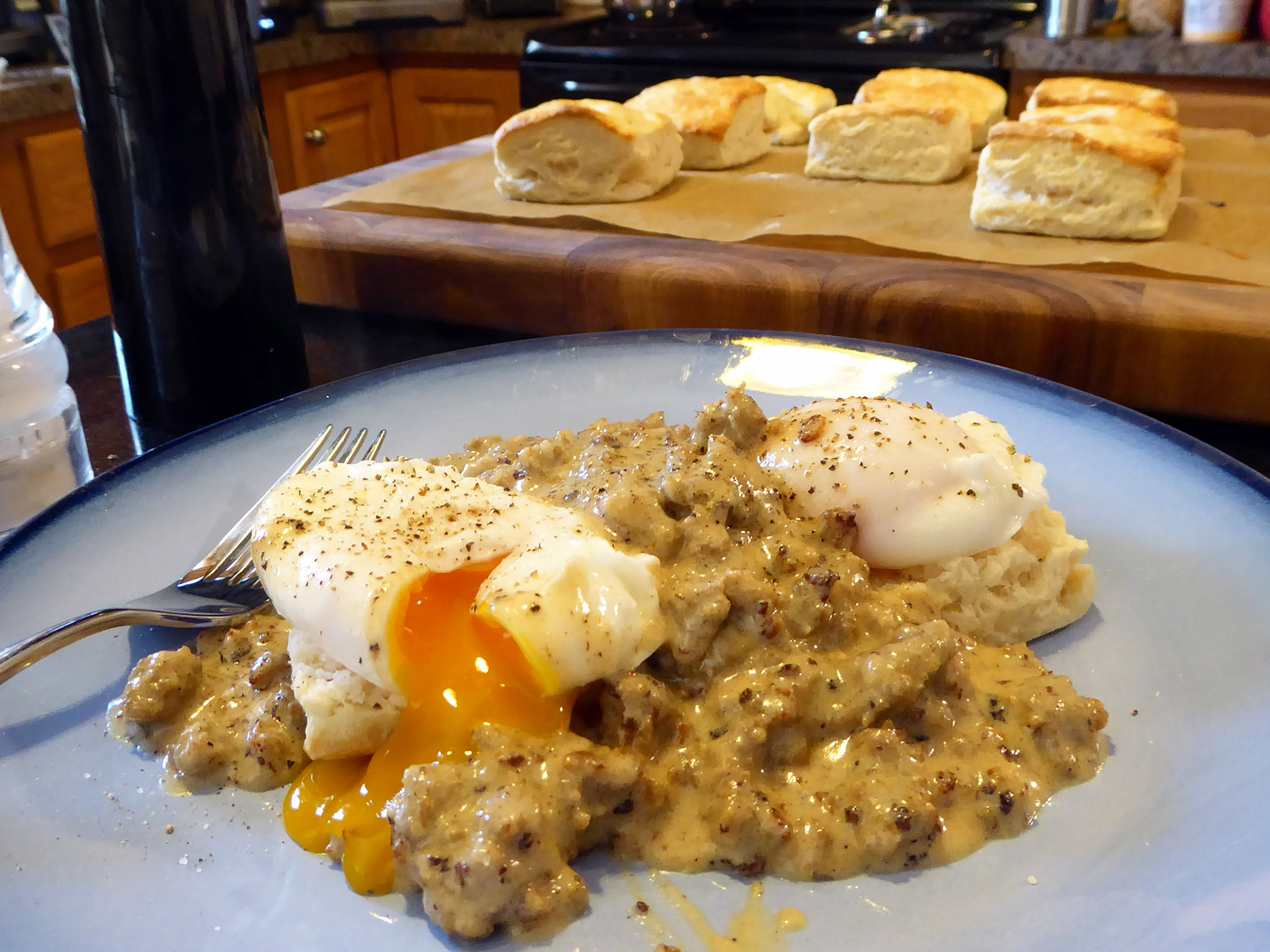
Today’s breakfast was poached eggs and sawmill gravy on a split biscuit:

Click for a larger version

Edited 23 March to add:

Sausage, egg, and blackberry jam biscuit beats sausage, egg, and cheese