Better than no clams

Before picking up the repaired Boop standup this week, I was disappointed to learn that J.T. Farnham’s closed for the season on Christmas Eve, but the nearby and year-round Woodman’s, more touristy but in relative terms quiet as a ghost town in late December, is a helluva lot better than no clams. Their combination plate of clams, buttery soft scallops, shrimp, cod, onion rings, and fries (US$31.99) was huge, nearly three times what you see here, so I saved some and had the leftovers just now.

The informative part of this post: I usually reheat fried food in a convection toaster oven at 225F/110C for 30 minutes, more or less, after taking it out of the fridge an hour ahead. The fan heat at a low temperature restores a good amount of the crispness without drying the food out. To be sure, it’s not like fresh, but it’s half to two-thirds of the way there – again, better than no clams at all.

Betty back from surgery

Click for a larger version

A little tube repair, a fresh partial vacuum, a whiff of argon, and she’s good as new.

It’s been about twenty-five years since I found this hand-crafted wooden standup in a little seaside Marilyn Monroe/Betty Boop/Elvis memorabilia shop – at an irresistible post-season 50% discount. I imagine whoever made it back then would be pleased to know she’s alive and kicking.

It’s nice to have her aqua glow back in the kitchen.

Here’s a nifty clip from Betty Boop’s Bamboo Isle (1932):

Her hula was rotoscoped from the dancer in the opening sequence of the same cartoon performed by the Royal Samoans:

The full cartoon can be viewed here.

Hollandaise at will

Click for a larger version

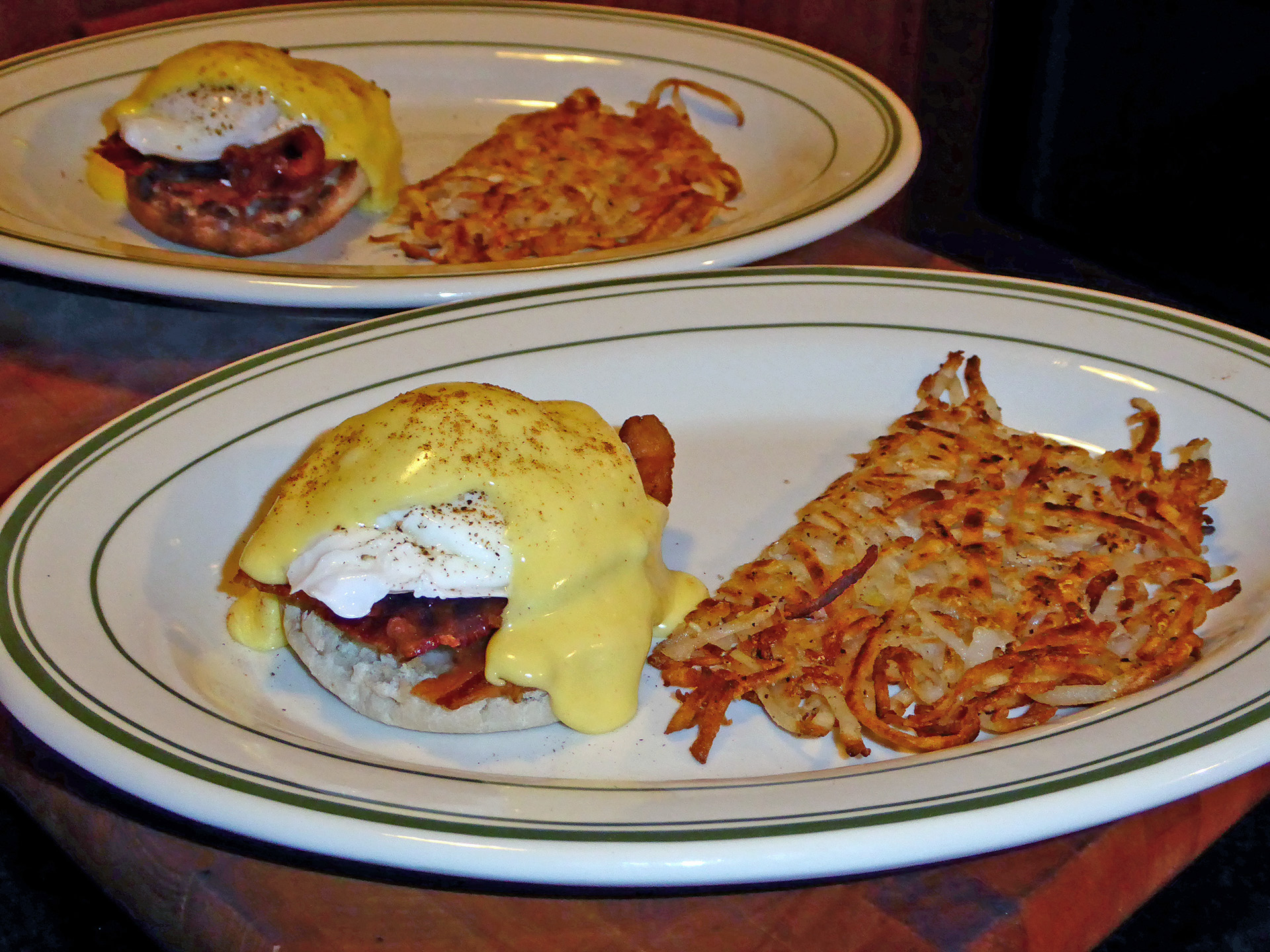
An email recipe link from ThermoWorks this morning inspired a breakfast-for-dinner tonight of Eggs Benedict with slow-cooked bacon and hash browns. Their article includes a fast and easy method for Hollandaise sauce using an immersion blender, room temperature yolk, and heated butter. This cut-in-half version is plenty for four tablespoon-and-a-half servings on poached eggs:

In a container a little wider than the head of your immersion blender – a two-cup Pyrex measure in my case – place the following:

  • 1 egg yolk
  • 1 teaspoon water
  • 1 teaspoon lemon juice
  • Pinch of salt
  • Pinch of cayenne pepper

In a small pan, preferably with a pouring lip, melt 1 stick/4 oz./115 g butter and get it up to about 200°F/95°C. While running the immersion blender directly on the bottom of the yolk container, pour the hot melted butter into the yolk mixture in a thin stream and it will pretty quickly emulsify into Hollandaise. You may need to move the head of the blender up and down a bit to get it all to mix well, and you can finish with a small whisk if needed.

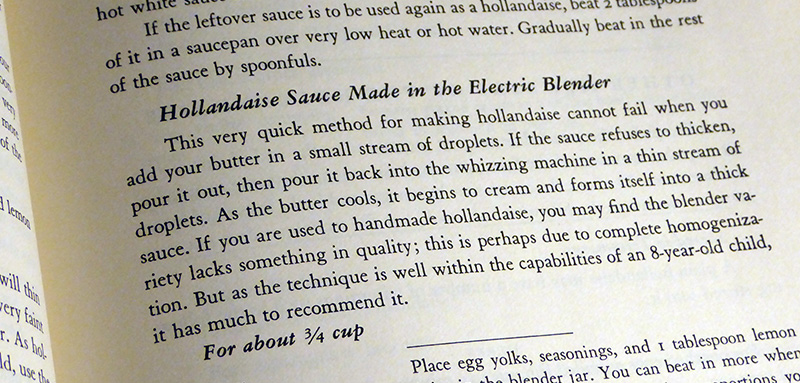
A side note on the claim in the linked article that “J. Kenji López-Alt has come up with an ingenious solution to all of these problems [of making Hollandaise]”: Utter piffle. While I don’t know if Julia Child invented the method, I do know it was in her Mastering the Art of French Cooking, Volume 1 under the title “Hollandaise Sauce Made in the Electric Blender”. The recipe employed a regular blender because immersion blenders weren’t available to the home cook in 1961.

Edited to add: I did not know the ThermoWorks blog was, like The Finley Quality Network, on WordPress, but so it seems to be. That means they got a pingback from this post of mine, and they’ve graciously adjusted their article and added a comment at the end after reading my post. I tip my hat westward.

Above that recipe, she instructs how to revive leftover Hollandaise. Many recipes you’ll find say, “Nope, can’t do that – use it or lose it.” More nonsense.

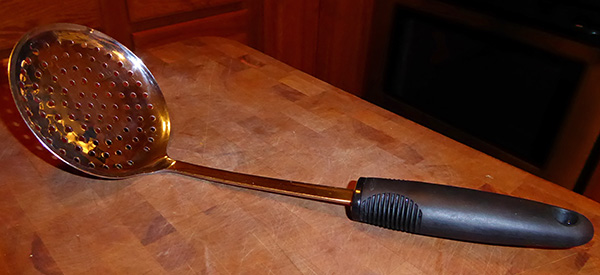
Also, I would advise against using the type of strainer they show in the article to drain the watery part of egg whites before poaching. I once tried that type with eggs that were only a couple days old – which therefore had pretty firm whites – and most of the whites went straight through. Instead, I use this perforated skimmer that happens to balance against the side of the sink perfectly. After draining, I place each egg into its own glass prep cup so they’re all ready to go in the water at the same time.

Test puffs

Before doing the main batch, I did a couple of test profiteroles to ensure that using a #40 disher instead of a piping bag wouldn’t cause problems. They look pretty good to me – nice and crisp, too, after being slashed on the side and left in the turned-off oven for five minutes to dry the inside.

These are big enough that after I pipe the banana custard in, I can then slip the strawberry slice in through the side slash as a sort of surprise, with just chocolate ganache on top. (They are better with a good quality strawberry slice than without.) I made the ganache with bittersweet chocolate, double cream, butter, vanilla, and a tablespoon of rum.

It’s like Christmas in December

Click for a larger version

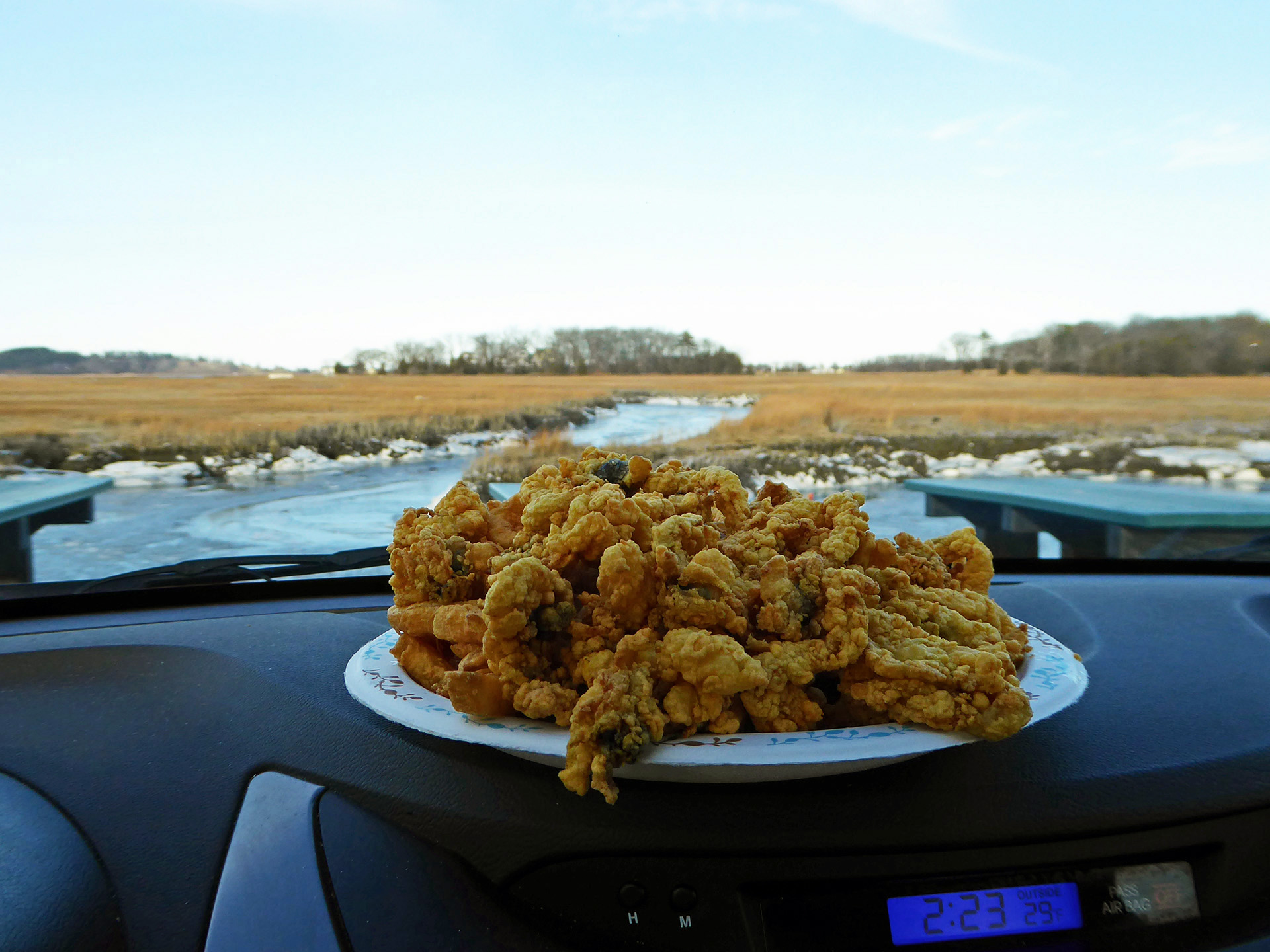
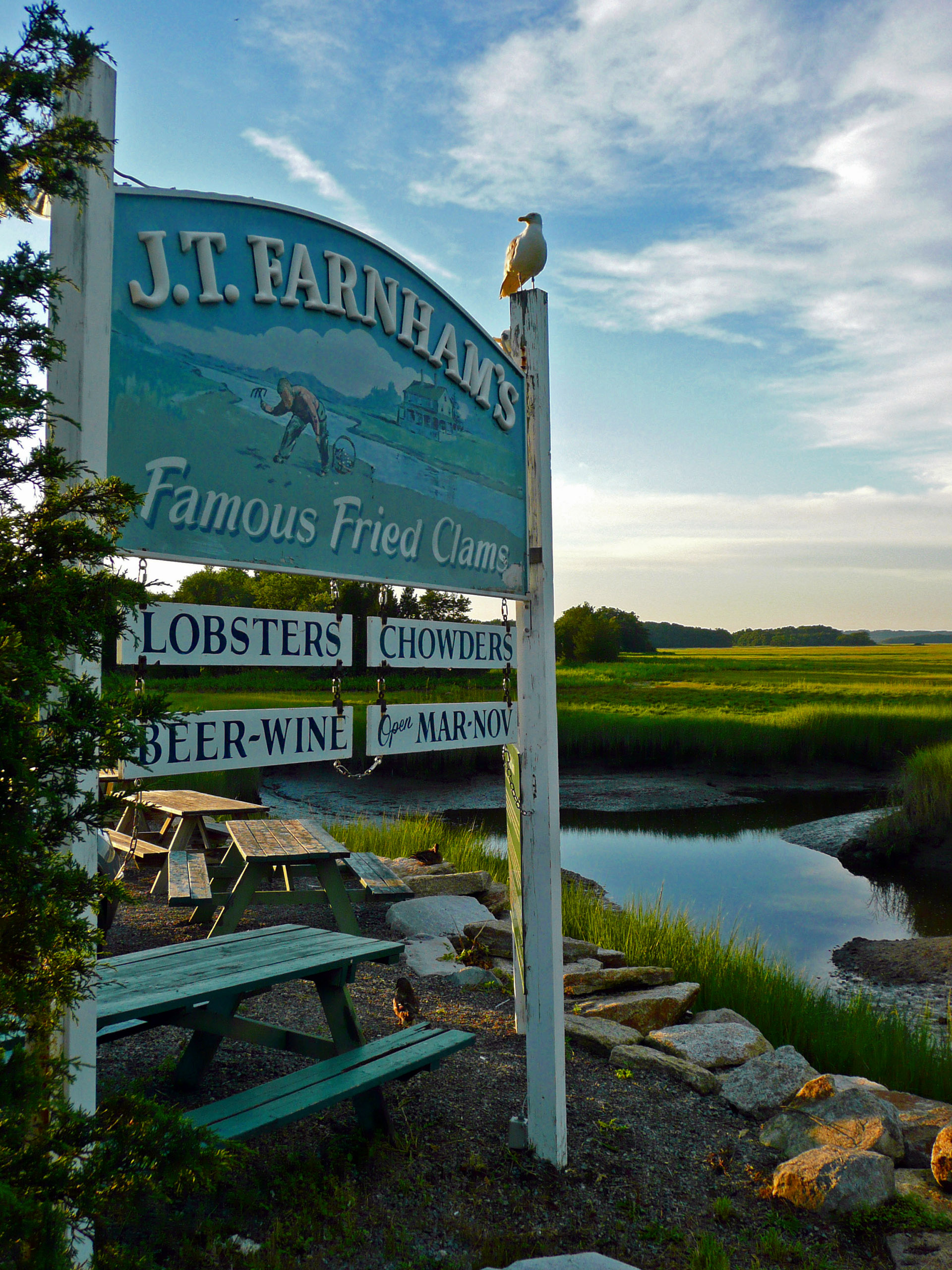
I was a fair bit off in my fried clam estimate the other day – it was more like thirty clams on the clam plate today, which was the same US$28 as last time at J.T. Farnham’s. The total was $72 for that plus the lobster roll and quart of seafood chowder that I brought home – four meals in all.

It was strange to see ice on the salt marsh and 29°F/-2°C on the outside thermometer, but the food was no less delicious than on a hot night in July.

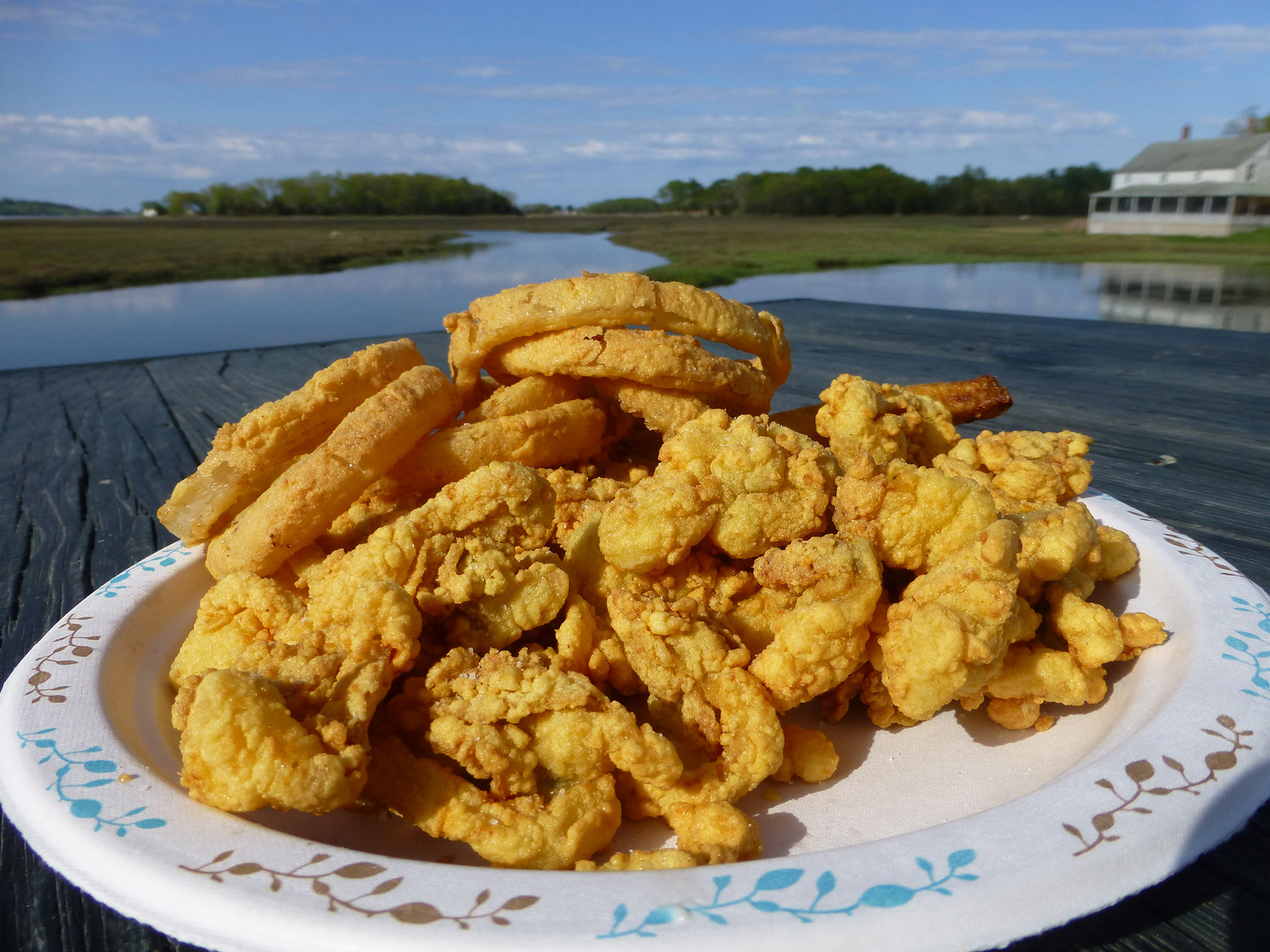
A more traditional view from one of the picnic tables at Farnham’s in May 2014:

Click for a larger version

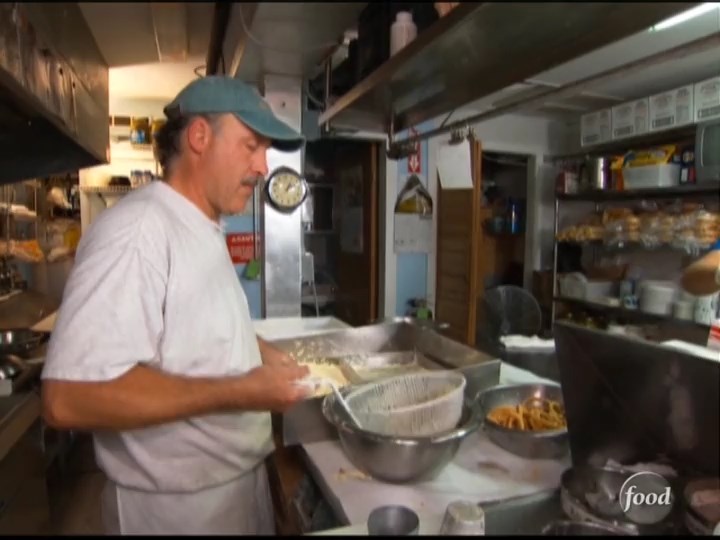
Click below for a behind-the-scenes video at Farnham’s – please excuse the Fieri:


Fire power

Click any image for a larger version

From Sacramento FD, 15 December 2017: Sacramento Engine 316 as part of California OES Strike Team 4805c, preparing to depart Ventura Base Camp for a day on the fire line. The Thomas Fire is now 252,500 acres, with 35% containment and 8,369 personnel assigned.

Hundreds of units are visible in their photo from the Ventura County Fairgrounds. Other totals as of 15 December: 1,012 fire engines, 62 water tenders, 32 helicopters, 158 handcrews, 78 bulldozers, plus other firefighting aircraft.

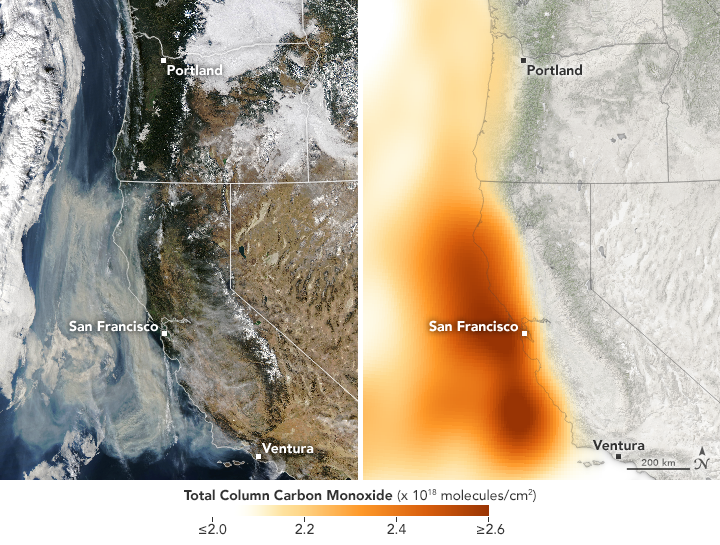
In the MODIS natural colour image below, smoke from California wildfires stretches north past the Oregon border. The southern half of Vancouver Island is visible at the top and the lower edge of this image is about 175 miles south of the Baja California border. Acquired by NASA’s Aqua satellite on 11 December 2017.

Aqua’s Atmospheric Infrared Sounder (AIRS) shows CO concentration on 11 December 2017. “Column” refers to the 5km-high column of air that’s measured and 1018 is one quintillion.

Further details on these Aqua images here.

Plus ça change, plus c’est la même chose

“It could probably be shown by facts and figures that there is no distinctly native American criminal class except Congress.”

Mark Twain, opening chapter 8 of Following the Equator, 1897

Also in that chapter, the life of the extinct moa – possibly slightly exaggerated:

The Moa stood thirteen feet high, and could step over an ordinary man’s head or kick his hat off; and his head, too, for that matter. He said it was wingless, but a swift runner. The natives used to ride it. It could make forty miles an hour, and keep it up for four hundred miles and come out reasonably fresh. It was still in existence when the railway was introduced into New Zealand; still in existence, and carrying the mails. The railroad began with the same schedule it has now: two expresses a week-time, twenty miles an hour. The company exterminated the moa to get the mails.

Thanks to Betty Boop, fried clams

The tube on my Betty Boop standup cracked at the base the other day, so I found a neon shop online that’s closer than the last one I used in Maine and got a reasonable quote for repair. There was no address on the web site, just “North Shore”, but I got directions from the guy and it turns out he’s not even five miles away from J.T. Farnham’s in Essex, and I just found that Farnham’s has extended their season through December this year instead of November. So it’s fried clams for lunch on Sunday and prolly a quart of seafood chowder to bring home. Maybe a lobster roll, too, if I’m feeling a bit peckish. Must remember to bring cash. Can’t wait.

I took this photo in August 2008:

Lobsters in space

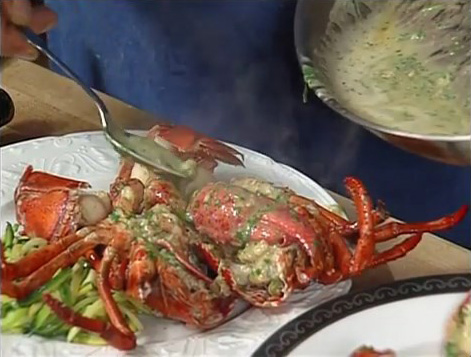
Perhaps a visitor can answer this question: Why is it that nearly every time I see whole lobsters awaiting prep on UK cooking shows, they’re uncooked but stone-cold dead? I just saw this again in the ongoing series 10 of MasterChef – The Professionals, screenshot of the daisy-pushing critters above. Because I’m so used to lobsters tootling about in my kitchen and giving me the tail-flapping, two-claw salute when I pick them up, it gives me the willies to see a passel of them lying on the work surface dead as doornails, but perhaps there’s a rational explanation that will calm me.

I could understand par-cooked, but they’re definitely raw – their colour alone tells you that. You couldn’t sell a dead, raw whole lobster here. I’m not sure if it’s against the law – it probably is – but that doesn’t matter: No one would ever buy one. My only thought is that perhaps they dispatch them moments before filming begins in order to spare sensitive viewers. That better be it – I’ve smelled lobsters that have been dead for a little while. Firing them into high Earth orbit or, better yet, the Sun, would be a better option than eating.

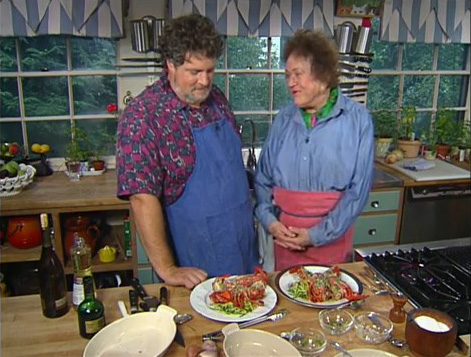
On the topic of how to deal with live lobsters on TV, here’s an excerpt from Bob Spitz’s Dearie: The Remarkable Life of Julia Child regarding chowder and lobster guru Jasper White’s appearance on In Julia’s Kitchen with Master Chefs in 1994:

Julia insisted that Jasper White make his pan-roasted lobster. It was his signature dish, steeped in cognac and butter, and a perennial favorite of hers, perfect for the home cook, but there were problems before filming even began. Weeks before, during a cooking demonstration on Today, Katie Couric shrieked when a chef killed a lobster. It brought media attention to the process of killing lobsters and PETA jumped on it right away. The organization’s power made [producer] Geof Drummond nervous. “He prefers we don’t kill it on television,” Julia explained to White, sitting in her garden during a break.

“That’s fine,” White said. “We can kill it before we start filming.”

Julia shook her head. “Then we’re not teaching them anything.” She got up and walked around the yard.

“Julia, there are other lobster dishes to be made. I could do lobster quenelles that start with cooked meat.”

A decision had to be made in the next couple of minutes. Finally, she said, “Fuck ’em! We’re going to teach people the right way to do it. Fuck PETA, fuck the animal-rights people!”

Together, they concocted a way to sidestep a possible outcry. As the lesson began, Julia stood gazing at White and his lobster. “So, dearie, how do we start the dish?” she asked.

“First we cut up the lobster,” he said.

Everything had to do with the expression on Julia’s face. She kept it glassy-eyed, completely impassive. For all anyone knew, she might have been watching a mother diapering a newborn, as White dispatched the crustacean. He had a Chinese cleaver the size of a scimitar and he wielded it like a cartoon character. His hands were a blur—swoosh, swoosh, swoosh! Presto: the lobster lay in pieces on the cutting board.

No one uttered so much as a sigh.

“Then we’re not teaching them anything.” My hero.

From that episode:
70-second eggs

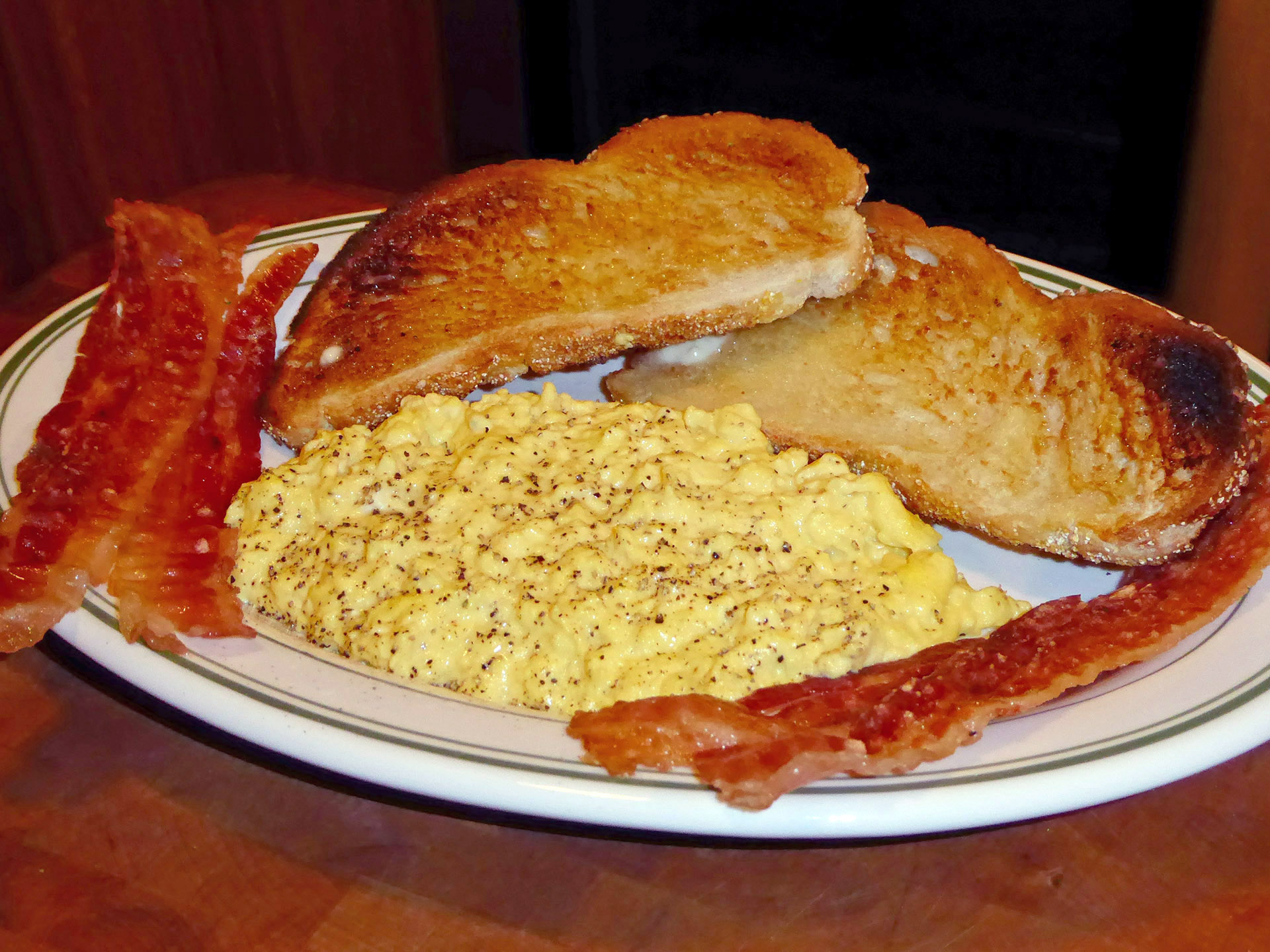
Three minutes start-to-finish, 60 or 70 seconds in the pan – here are the soft, small-curd scrambled eggs as discussed below the crunchy eggs post and quoted below.

Click for a larger version

1. Warm a plate.
2. Set a pan on medium-high heat.
3. While it’s hotting up, whisk your eggs – I use three eggs, salt, pepper, and a tablespoon of cream. The cream lends a nice silkiness to the interior of the finished scramble. Start your toast.
4. When the pan’s hot, toss in a butter pat (a teaspoon or so), quickly swirl it around, then just when it’s melted, in with your eggs so the butter doesn’t burn.
5. Use a small whisk – with silicone-coated wires if you use a non-stick pan as I do – to keep the eggs moving constantly. This keeps the curd size small and prevents the eggs from drying out on the bottom.
6. In about 70 seconds (if I recall correctly), when they’re still quite soft and a little wet – or, a little before you see your preferred texture – get them off the heat.
7. Immediately stir in a tablespoon, more or less, of sour cream – or crème fraîche if you’ve got it – to halt the cooking and add a pleasant slight tang. Transfer to your warmed plate.

One job – they had one job

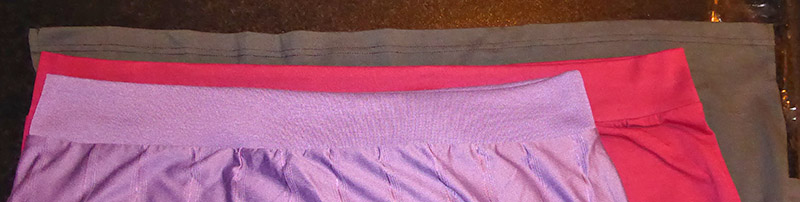
Here we see the problem inherent in mail-ordering shirts. The collar labels on these three claim they’re all the same size. The middle one fits well while the other two would have me mimic, respectively, a pup tent and a rather tightly-wrapped mummy.

I have sent words – restrained ones, I thought, considering the alternately grumbling and growling noises I seem to be making.

Excuse me while I fetch my eyebrows.