The loons are a few weeks late this year

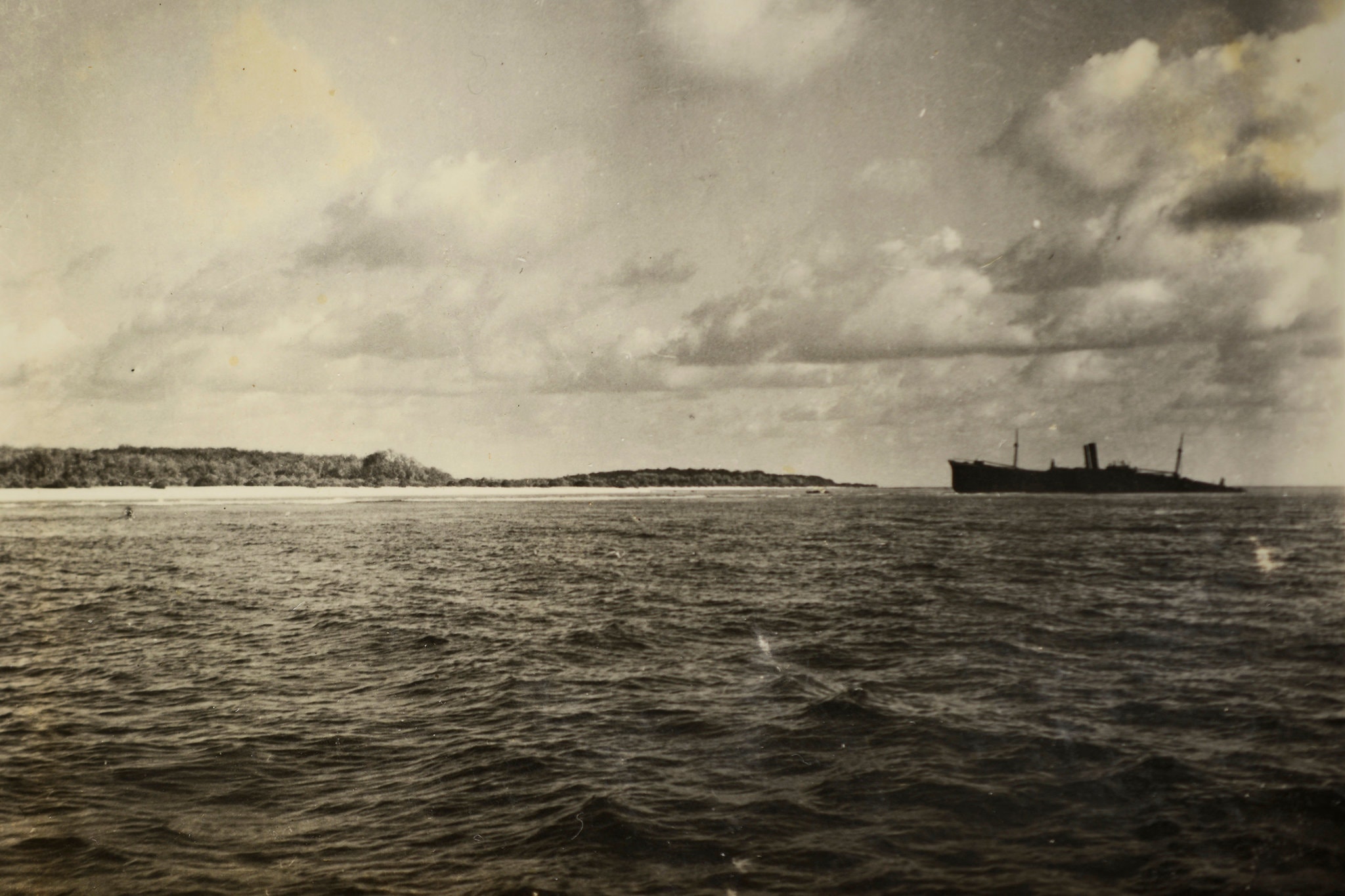
Is there absolutely no public or media memory of previous ridiculous Amelia Earhart theories and corresponding failed searches tied to the flimsiest of evidence? I mean, most of it emanates from the same guy at the same organization seeking to perpetuate itself year-on-year. Last time it was the History Channel that got hoodwinked by some new guys, now the National Geographic Channel has laid down a wad of cash and gotten Titanic guy Robert Ballard involved, all on the “strength” of the picture below touted by the usual suspect. An Electra landing gear? Come now. This photograph has been hawked as showing a landing gear and proving Earhart crashed at this island for many years. I don’t care what “classified technology” has been used this time – it’s an 80-year-old old photo, fercripesake. Could’ve been a squashed bug on the original negative for all we know. Sorry, but I’m not buying it this time either.

You might think that the New York Times is only writing about this new search because of Ballard’s involvement, but they, like everyone else, most often file breathless copy every time some guy – usually the same guy – excitedly says stuff like, “This lip balm case cannot have come from anyone but Amelia Earhart. You see? Case almost closed!” And the Times foregone-conclusion headline this time – like every other time – is maddening: “Finding Amelia Earhart’s Plane Seemed Impossible. Then Came a Startling Clue.” It’s not startling at all. The photo’s been shopped around since at least 1992, maybe earlier, with a new analysis we’re assured is of the highest tech done on it every few years. (“Hey, let’s try Image → Adjustments → Shadows/Highlights!”)

So once again, the media reword the press release en masse and ad infinitum and we’re off on another news cycle of steaming horse potatoes. It’s like Mars One, except that one at least died the undignified death it deserved. People don’t seem to realize that this Amelia Earhart malarkey is on a perpetual repeat cycle, with several different decades-old theories presented in an annual rotation. Another old theory they hope everyone’s forgotten about will be trotted out next year when they need more contributions. (“Whattaya think, maybe do the kinda sorta matching rivet pattern thing again this year even though it doesn’t really match and it’s the wrong aluminum manufacturer?” “No! Too soon.”)

Click this image and tell me that’s definitely for sure no doubt an Electra 10-E landing gear sticking out of the water at the left – which, I should add, no one noticed or investigated the day the photo was taken. I triple dog dare you.
In case you’re interested, here’s an IRS Form 990 for the non-profit that promotes this hooey, generally most visible around July of each year. There are just two salaried employees (line 15), the founder and his wife, and they’re paid handsomely. This group was founded in 1985 and is ostensibly devoted to historic aircraft recovery. They’ve collected millions of dollars in contributions, paid themselves quite a large chunk of that money (“Thanks, me!”), and have yet to recover any aircraft. This strikes me as being almost indistinguishable from a comfortable retirement plan.

The founder: “Amelia’s fame is like a faucet I can turn on and off with a press release.” And yes, he knew he was saying that out loud and in public.

The ringmaster

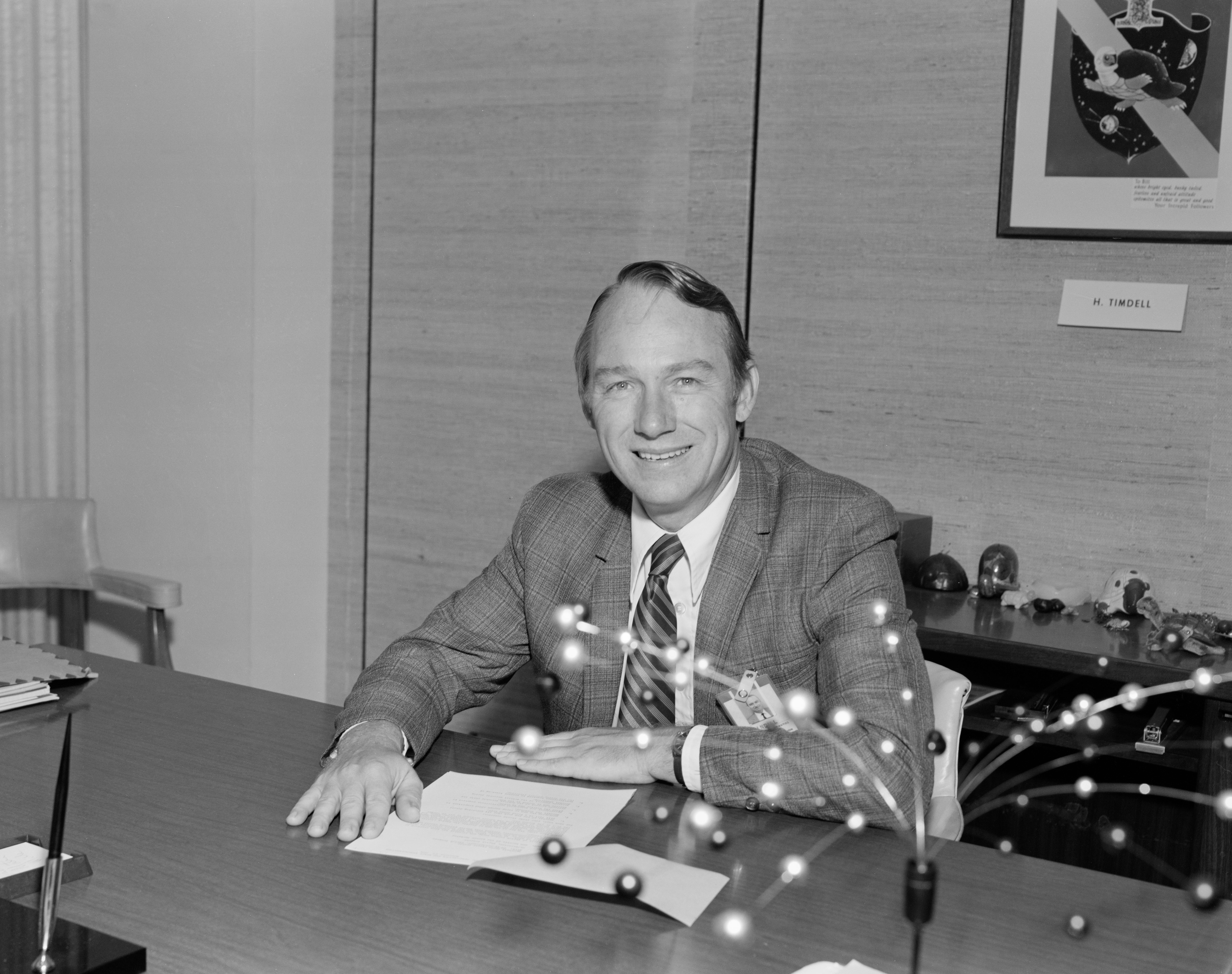
Bill Tindall, NASA photo S72-36978; click for a full-size version

In The thousand-ring circus article last month, I mentioned that it was difficult to find photos of NASA engineer Bill Tindall bigger than a postage stamp. Well, that long-time dearth of pictures ends today and here with ten large photos of him above and in the gallery at the end of this post, all thanks to the the friendly folks at the Johnson Space Center History Office. One of the photos I included in the first article, a screenshot from the “Navigation Computer” episode of the “Moon Machines” series, seemed like it might be an official photo, so I wrote to JSC historian Jennifer Ross-Nazzal with a link to the article and asked if that was indeed a NASA photo and if it might therefore exist in an online repository.

They couldn’t find it in any of their image repositories, and so went to the trouble of searching the JSC negative library. There they found several negatives, including the one I asked about (the uncropped original above), generously had all of them digitized, and sent them to me. My virtual hat is off to them for their help.

In the previous article, I theorized that the “H. Timdell” [sic] sign on the wall behind him was perhaps an egregious misspelling of his name from some conference he attended, but I think I was wrong. This uncropped original of that 1972 photo plus the next photo in the series (included in the gallery below) reveal that the tag is centered under a framed picture indicating his membership in the rather exclusive Interstellar Association of Turtles – Outer Shell Division – usually limited to astronauts. Details on the member challenge mentioned in the text at that link that could not be answered in polite company are on the back of that card (in the second image) and described in further detail here (it’s pretty tame).

The inscription at the lower right of the picture frame is a little out of focus, but I believe it reads as follows:

To Bill,  
whose bright-eyed, bushy-tailed,
fearless, and unafraid attitude
epitomizes all that is great and good.
                   Your Intrepid Followers

Now that might have been presented to him by lots of people – say, the entire astronaut corps – but that “Intrepid Followers” leads my mind immediately to the crew of Apollo 12, whose Lunar Module was called Intrepid. And Apollo 12 Commander Pete Conrad was an unrepentant wise-ass, so it would be very much like him to mangle the name on the package to firmly tweak Tindall’s penchant for accuracy. (Remember that Conrad is the guy who gave Jim Lovell the nickname “Shaky” – not the most respectful nickname for a test pilot – which I believe Lovell banned from being used in the script for “Apollo 13.”) I also just confirmed my recollection that Conrad once said of the night before they landed Intrepid on the Ocean of Storms, “You settle down for the night bright-eyed and bushy-tailed because you know, ‘Tomorrow, I’m going to land!'” Circumstantial? Sure, but that’s my new theory and I’m sticking to it. Unless corrected.

Conrad’s nickname? “Tweety”

In the third 1972 photo below, I’m pretty sure the even more out-of-focus sign above the bookshelf reads: “The more innocuous a design change appears, the further its influence will extend.” That’s one of the better of Murphy’s laws of general engineering.

So, here are the photos from NASA in chronological order, from his Gemini days in 1965 through 1979, the year he retired from NASA (the leading S number indicates the year). Click on any one to enter the gallery, and from the gallery any of the images can be saved by using the “View full size” link at the lower right, which you may have to scroll down a little to see.

Be aware that these are fairly large at about 3MB apiece – similar in size to modern digital camera images – so they make take a little while to show up in full size.

“If we’re late in answering you, it’s because we’re munching sandwiches.”

That was Command Module Pilot Mike Collins about five hours into Apollo 11. CAPCOM Bruce McCandless answered, “Roger. I wish I could do the same here.” Collins: “No, don’t leave the console!”


If the Apollo 11 anniversary piqued your interest last month and you’d like to learn more, I have six book recommendations. There are, of course, dozens of fine books on the topic, but I think these are the crème de la crème – and three of them are free in PDF form.

  1. A Man on the Moon: The Voyages of the Apollo Astronauts by Andrew Chaikin: Apollo from the perspective of the astronauts. In the years prior to the book’s release in 1994, he interviewed twenty-three of the twenty-four Apollo astronauts at length (one had died) – a feat thought by many to be a pipe dream, but astronaut word-of-mouth carried him through. They knew he was serious and good. There is a three-volume, profusely illustrated version as well, which you can find here – but you may find a set cheaper here on AbeBooks if any sellers have a copy (three very good condition copies as of this writing). For that set, Chaikin curated the photo selections from which the Time-Life editors chose.
  2. Apollo: The Race to the Moon by Charles Murray and Catherine Bly Cox (titled just Apollo in its most recent reprint): This is the definitive Apollo history from the point of view of the technical people on the ground. Updated 11 August to add: I just looked at the going price for used hardcovers and paperbacks and blanched when I saw that it’s hovering at about US$100 for both, even on AbeBooks (I paid $24.95 for the hardcover in the photo when it came out in 1989). However, the link here is to the Kindle edition for $8, and in case you weren’t aware, you don’t need a Kindle to read it: Amazon offers free Kindle reader programs for Android and Apple tablets and phones, Windows, and macOS. There’s also an unabridged Audible audiobook for $27. Updated 23 October to add: prices on AbeBooks have now dropped back down to more reasonable levels, including, as of this writing, a sub-$20 very good copy of the hardcover.
  3. Carrying the Fire: An Astronaut’s Journeys by Michael Collins: I and many others think this is the best of the astronaut memoirs – smart, honest, and funny. Unlike most or maybe even all of the rest of the astronauts, he actually wrote it himself. Read the footnotes, too – some of them are a hoot.
  4. Chariots for Apollo: A History of Manned Lunar Spacecraft by Courtney G. Brooks, James M. Grimwood, and Loyd S. Swenson, Jr.: How the Apollo Command-Service Module and Lunar Module spacecraft were designed, developed, and built. This one and the next two are nicely-scanned PDFs of the original NASA History Series books available for free on the NASA Technical Reports Server (NTRS).
  5. Moonport: A History of Apollo Launch Facilities and Operations by Charles D. Benson and William Barnaby Faherty: How the Vehicle Assembly Building, the Crawler-Transporter, Mobile Launcher, and all of Launch Complex 39 came to be.
  6. Stages to Saturn: A Technological History of the Apollo-Saturn Launch Vehicles by Roger E. Bilstein: How the Saturn rockets were developed and refined.

There are many more free Apollo-related books and technical reports in PDF form at NTRS, many of which are linked in an article I wrote two years ago: https://finleyquality.net/i-got-mine-at-the-gpo-bookstore/

Say, it’s Neil Armstrong’s birthday today. And mine!