Overrun, underrun, let’s call the whole thing off

The media has a funny definition of overrun. I just checked and there’s not one story about the Air Canada Halifax crash that says ‘underrun’, which is what happened, and I think most people would come away from the initial story believing the aircraft landed normally but then skidded off the end of the runway in the midst of a snowstorm. That’s what I figured at first.

In reality, it wasn’t one of those runway excursions – isn’t that a pleasant phrase, by the way? “Oh, yes, we had a lovely off-runway journey, but the narration by the flight attendants was a bit loud, I must say.” In fact, it crashed short of the runway, much like the Asiana San Francisco accident but in bad weather at night, not a beautiful CAVU day in San Francisco – not that bad weather is a good reason for a too-low approach, mind you. The power lines it clipped, blacking out the airport, were well before the threshold of the runway, and I’ll wager a crisp new one dollar bill that all the red bits you see in this photograph are parts of the localiser antenna array that’s also before the start of the runway.
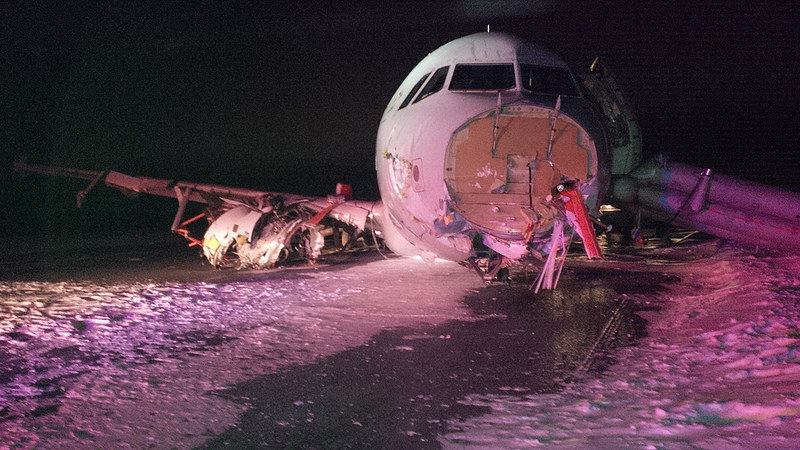
Air Canada Halifax

Edited to add several hours later:

The TSB says the A320 did hit the antenna array and touched down 1,100 feet short. The idea that it overran the end of the runway apparently came from Air Canada’s unslick use of antisocial media.

Because no one had anything more than minor injuries, I’m inclined to be cheeky and so will mention that 1,100 feet works out to almost three ballparks in baseball terms. I’ve also worked out on the back of the same envelope that the crew will not be receiving a cigar on this occasion.

Alas, it would be wishful thinking to hope that anyone will ever go back and correct this caption and hundreds of others in the same vein. I’m going to wager another dollar that they will live on in error forever.
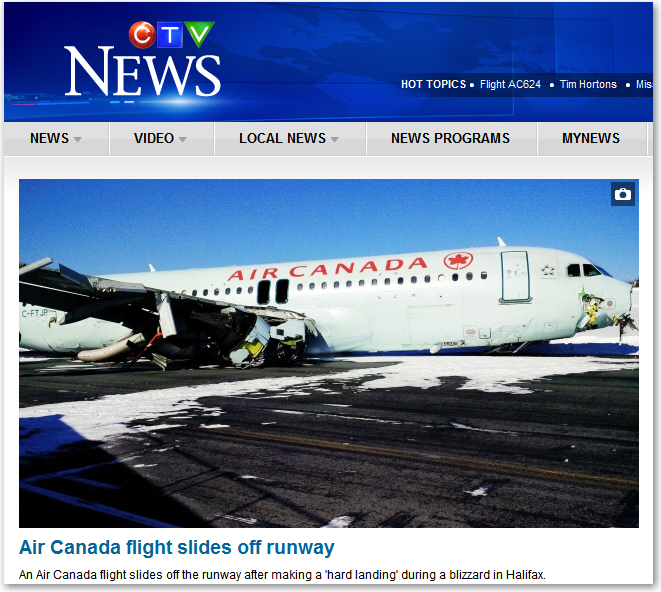
Wrong Caption

Come to think of it, maybe Air Canada’s use of antisocial media was actually pretty slick, even if unintentionally so. It was probably not active preemptive misdirection, but it will likely result in most remembering that the aircraft simply slid off the runway.
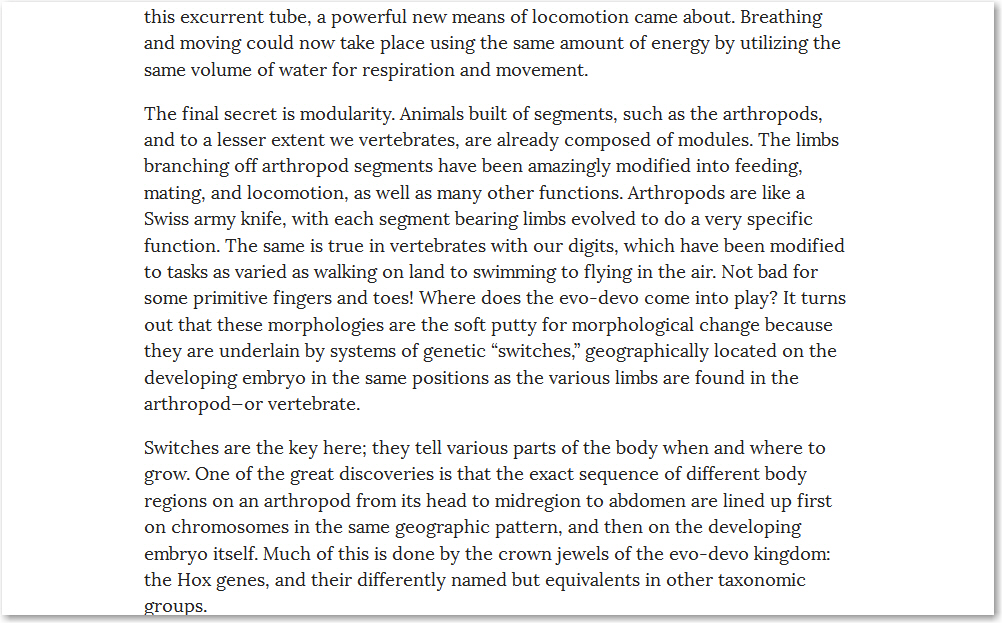
Living on the large print shelf

Current one-size-fits-all web design increasingly leans toward the smaller tablet screen – not fitting all well at all, it turns out – and much of it becomes annoyingly large on a full-size desktop screen. The font below, for example, is twice as large as it should sensibly be on my desktop, and makes me feel like I’ve inadvertently picked up a book from the Large Print selection on the bottom shelf at the library. The three screenshots here are each about 1,000 pixels wide – click on any to see that size.

LARGE PRINT

Click for original size

Sometimes these “must fit an iPad mini” fonts get all bright and shouty, much worse than ALL CAPS. When I see something like the story opening below, I automatically think of Garrett Morris on Saturday Night Live. But before that, I squint, wonder if my sunglasses are still in the car, and idly imagine myself phoning the designer to ask sincerely, “Are you an idiot, or are you being intentionally evil?”

WHAT

“What’s that you say, sonny? Stop whispering!”

Then there are the large print shelf sites also obviously designed by – or for – the colour-blind, in eye pain terms really only one or two steps away from the worst of the Web 0.1 of the mid-1990s:

Ack

Is there a medical term for when your eyeballs feel like they’re being squeezed, roughly?

How is it that a colour scheme like that didn’t get laughed out of the room in early design meetings? At my job some companies ago, they hired a logo design firm, or at least a company claiming to be that. One of the product logos they came up with was so inappropriate as to be unbelievable. It had made it through several meetings, and had been approved by Marketing. So what was wrong with it? Well, it did not mistakenly imply harm to our customers, no no. It actually showed harm to our customers. “What? What? Flthhhhp!” came to mind when I saw it. It was presented to a group of users of the product shortly afterward, and they did laugh it out of the room – and I mean that literally, and I assure you I’m using that word correctly. I’m happy to say that it was never seen again.

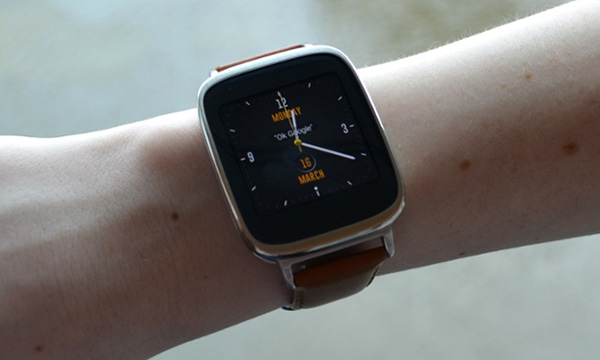
My other “How is it…?” question today is: How is it that reviews of goofily-outsized dumbwatches, the Large Print edition for the forearm, do not all begin with the caption “Tee hee!” underneath the leading photograph? I look forward to saying that myself the first time I see in person some chowderhead wearing one of these “Look at me, all terribly modern and suchlike!” wall clocks.

Lilliput

Tee hee!

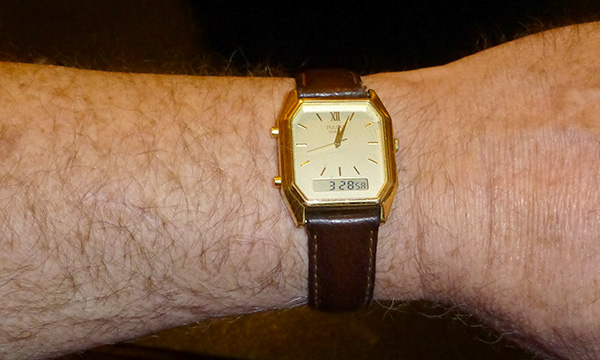
For reference, this is what a wristwatch looks like:

P1020308

A tad anachronistic, perhaps, but does it elicit a “tee hee!”? I think not.


“P.S. If I was on this mission, I’d let the damned thing run, too.”

KSC-68PC-147

Apollo 8 Saturn V stack on its way to Pad 39A

Apollo 8’s original mission was to test the Lunar Module in combination with the Command and Service Module in low Earth orbit for the first time. However, production delays meant there would be no LM spacecraft ready in time for the December 1968 flight. In August 1968, George Low, manager of the Apollo Spacecraft Program Office, proposed that they instead send the Apollo 8 Command and Service Module all the way to the moon and in the process juggle the D, E, and F mission objectives slightly. Those mission types are defined in the 20 September entry in the Q3 1967 Apollo Spacecraft Chronology.

This was just four months before Apollo 8 was due to launch, and NASA did not yet have a plan for the actual mechanics of the first circumlunar mission. In 1998, Apollo 8 commander Frank Borman gave a talk at the National Air & Space Museum on the 30th anniversary of the mission. In it, he said:

So we had a lot to do, because while everyone knew that people were going to go to the moon, all of a sudden, they were confronted with the deal: How do you get there? And this is another sign of NASA at that time. I sat in [Director of Flight Operations] Chris Kraft’s office with Bill Tindall and two or three other people, and in one afternoon, we outlined the basic parameters of that mission. I don’t know how long it would take them today, but I suspect it wouldn’t take more than six months to do that.

Borman is a refreshingly no-nonsense, funny guy, a USAF pilot who you can tell still gets a kick out of referring to his Apollo 8 crewmates as ‘sailors’. You can see his whole talk here on C-SPAN. I actually ordered a VHS videotape of it from C-SPAN after I watched its first broadcast on Christmas Day 1998, mainly because of the segment I’ve excerpted below.

Yesterday, after watching the Apollo 8 episode of “From the Earth to the Moon” once more, I recalled his fascinating and unexpectedly entertaining talk at NASM and further remembered that C-SPAN now has its entire video library online. I thought I’d see if I could find it, grab it, and therefore be able to toss the 570 feet of magnetic dinosaur that I still have on a shelf in my spare room. It’s difficult to grab videos from their site on your own, but the Video DownloadHelper Firefox add-on makes short work of it and videos on other sites.

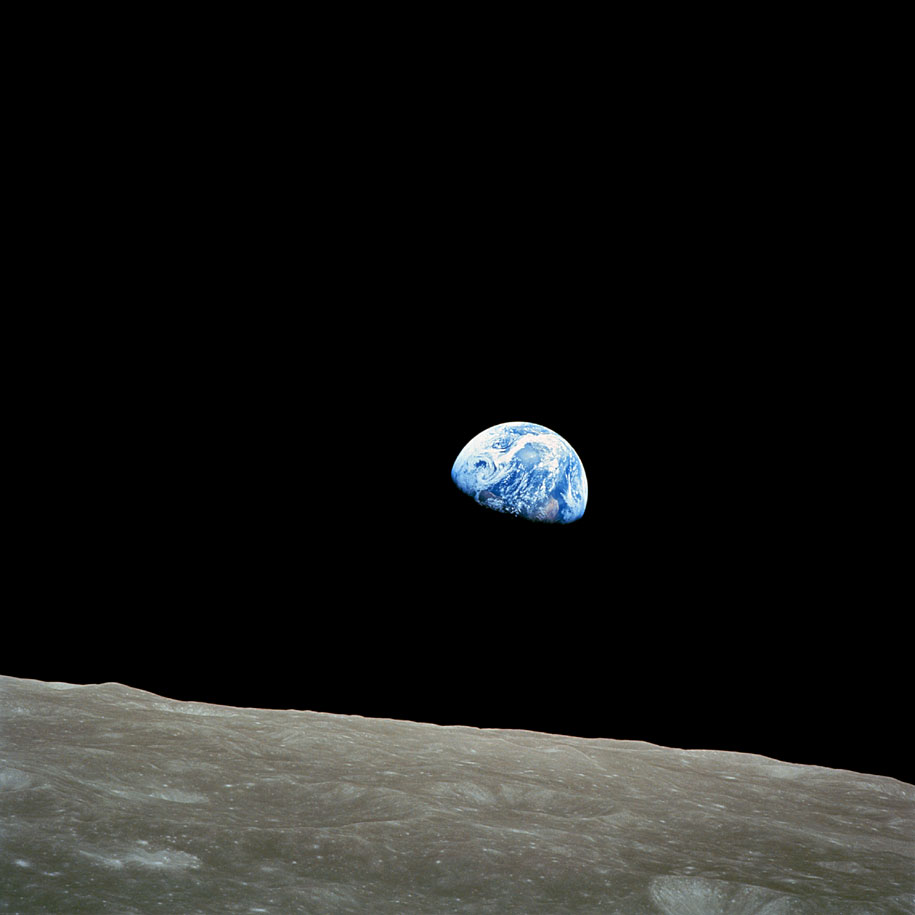
AS8-14-2383

Christmas Eve 1968

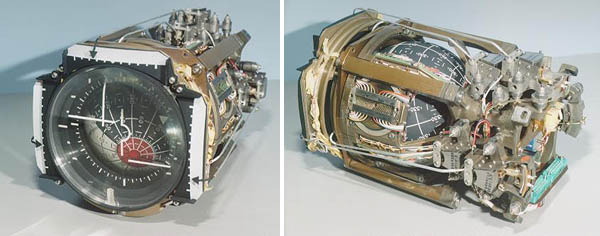
Regarding the intertial guidance system that Borman talks about in that clip: On Apollo, the Flight Director was connected to a three-axis gyroscope system – the Inertial Measurement Unit – and was therefore subject to gimbal lock, a condition which meant loss of attitude reference and a subsequent need to reorient the system through star sightings, which was a pain in the arse. This would occur if you managed to screw up and get your attitude into the red circle visible below. Borman and every other astronaut wished that Apollo had the Gemini program’s four-axis system, which was not subject to this quirk of physics.

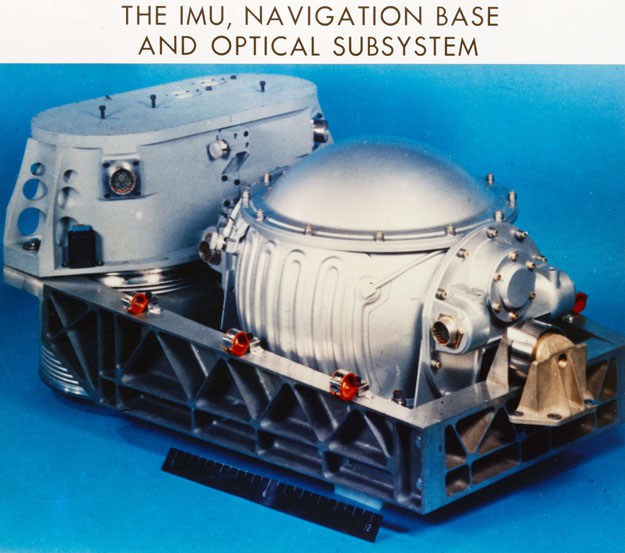
The three gyros themselves were in the basketball-sized IMU in the second photo; for precision matching of measurements, it was mounted out of sight but on the same platform as the optical sighting telescope and sextant to the left.

apollo_fdai

Apollo Flight Director Attitude Indicator

One of the early mission rules for Apollo 8 was that the IMU was to be shut off when it wasn’t needed – which was most of the mission – but Borman objected to this. He knew that, on power-up, the thing sometimes accidentally got itself into a gimbal lock condition, plus he didn’t want to take the chance of it not coming back on at all, so he wanted to keep the gyros spun up for the entire mission. He got his wish, and the rule was changed for all the Apollo missions.

During Apollo 11, Mission Control advised the crew they were dancing close to gimbal lock at one point and suggested they tone down their movements a bit. Command Module Pilot Mike Collins – recalling the four-axis system he had in Gemini 10 – radioed back, “How about sending me a fourth gimbal for Christmas?”

Digital film evolution

“Tampopo” Blu-ray on my TV – click for 1920×1080

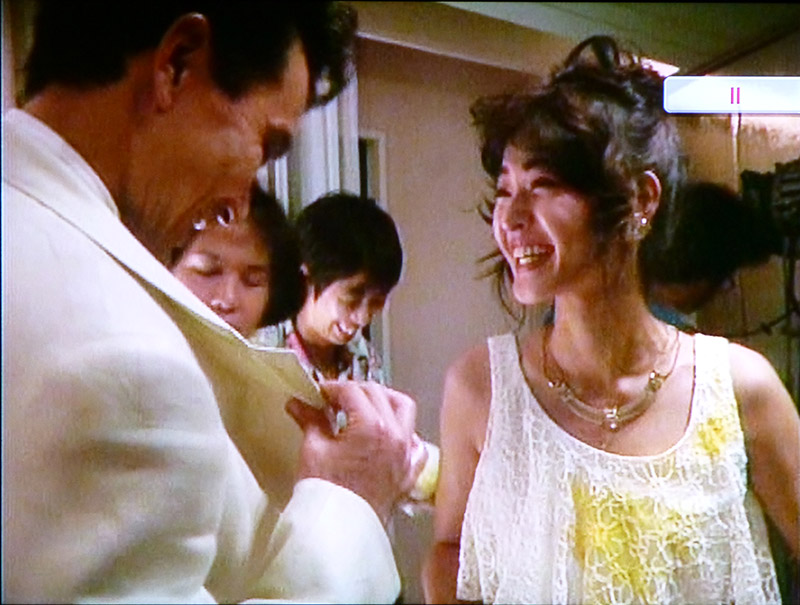
Previously, I’ve compared an ancient “Tampopo” DVD release with one remastered six years later, and I can now compare those to the Blu-ray release eight years further on. The difference is eye-widening. The comparison here is not completely direct; the Blu-ray screens in this post are photos of my TV because I don’t yet have a BD drive in my PC. I colour-corrected those photos in Photoshop so they appeared identical to what I saw on my TV, then adjusted their perspective and size to 1920×1080. The older ones are unretouched frame stills done with Media Player Classic – Home Cinema. Clicking on any of these will show you the native resolution of the respective discs.

dvdsnapshot010546201209

1998 Fox-Lorber DVD

dvdsnapshot010537201209

2004 remastered DVD

P1020281a

2012 Blu-ray release (Germany) – click for 1920×1080

Some Blu-ray transfers come across as a little strange, at least at first. For me, “Patton” is a prime example where the Blu-ray release makes the film almost seem like it was shot on video even though I know it was 65mm/Dimension 150. It’s a bit hard to describe, but the transfer seems too crisp, what you might expect if you applied a skosh too much sharpening filter to the entire film. I’ll admit that it’s amazing to see, say, the minute texture of fabrics, but it’s a little off-putting when you clearly see the fronting lace underneath George Scott’s false eyebrows – viz.:

P1020294f

Click to see a larger size

P1020294

“Ack!” said I

The problem with that particular shot from the opening is that the makeup was simply inadequate for such a close-up – “No, not ready at all, Mr. DeMille!” – but that video feel is there in much of the film. You do get used to it after a time.

I’m happy to report that the “Tampopo” Blu-ray is in the better category of transfer. Rather than turning shot-on-film into shot-on-video, the Blu-ray transfer of “Tampopo” turns it into the equivalent of being front and centre at a stage play. There’s a distinct feeling of being there which I find delightful.
dvdsnapshot013758201209

1998 DVD

dvdsnapshot013748201209

2004 DVD

P1020293

2012 Blu-ray

What I said on seeing this in the fourth minute of the film: “Heh heh.”

P1020259

2012 Blu-ray – click for 1920×1080


An answer to a twenty-year-old question

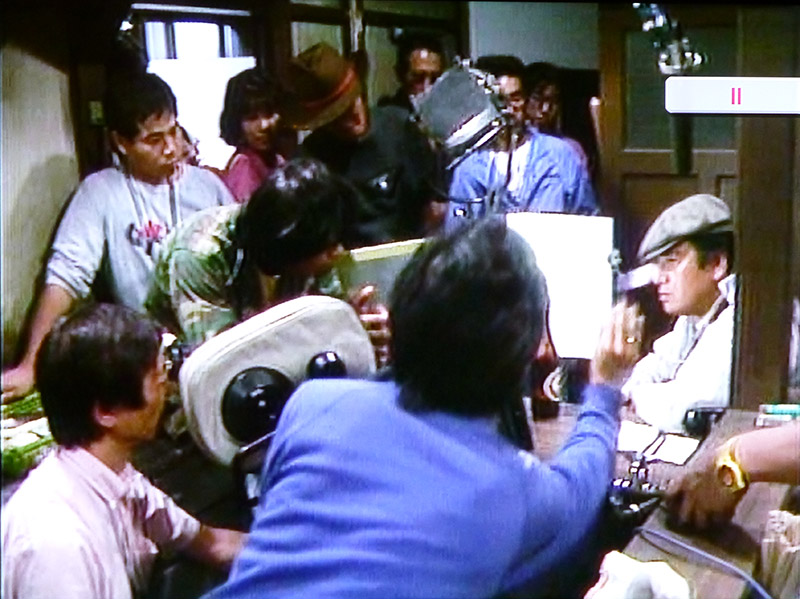
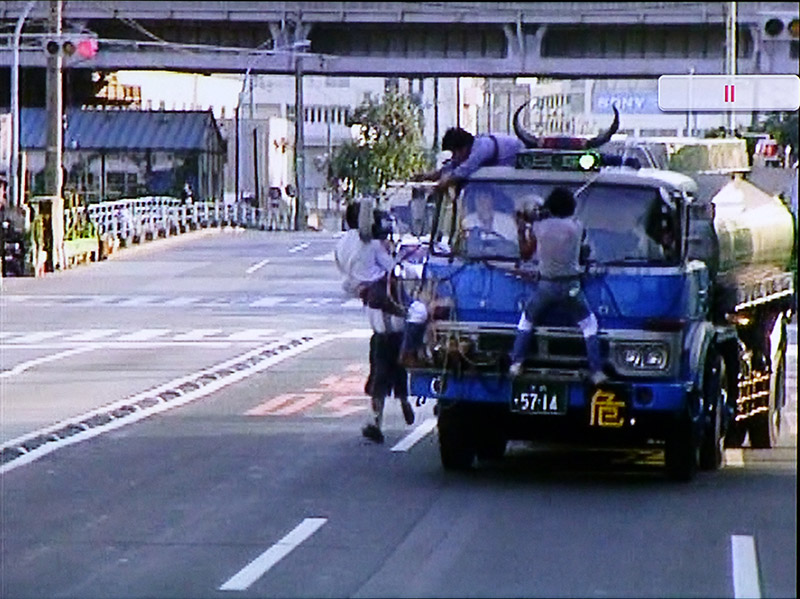
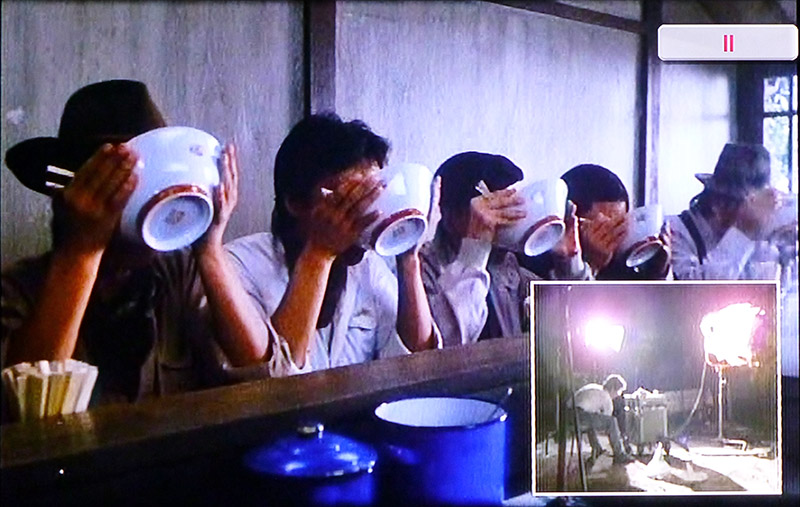
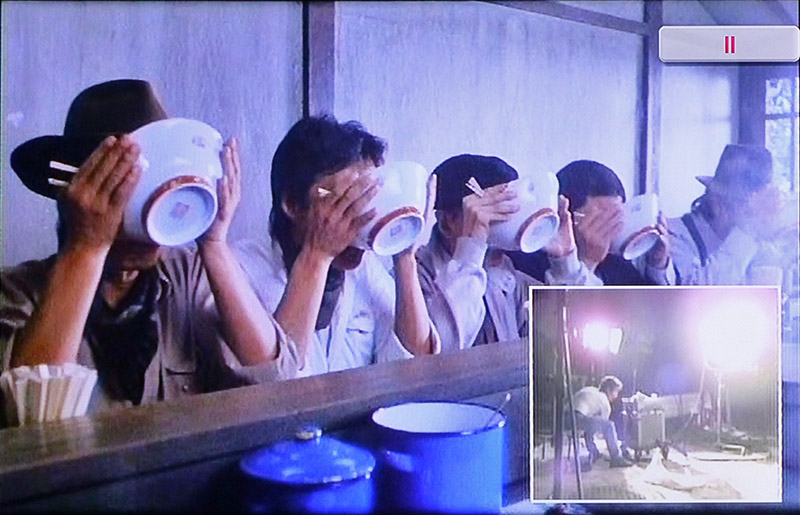
I just watched the 90-minute “Making of Tampopo” documentary and thoroughly enjoyed seeing how thoroughly enjoyable the film was for its participants. Unsurprisingly, most of “Tampopo” was filmed on location, with one of the few sets being the interior of Tampopo’s restaurant itself. There were no subtitles for the documentary, but I understood what was going on fairly well throughout, even as Jûzô Itami explained how they edited together the final scenes outside and inside the renovated restaurant, showing four different versions.

I finally found out the answer to a twenty-year-old question I had, too, one of the reasons I eagerly anticipated seeing this documentary. Ever since I first saw “Tampopo” about ten years after its 1985 release, I’ve wondered if the spine-tingling fading in and out of the sunlight streaming through the window in the final ramen reckoning scene was tightly planned or purely serendipitous. I leaned toward the former, but only slightly. I always thought there was a chance he got extraordinarily lucky. You can find out yourself below.

P1020255

One of about a dozen takes to get the naruto slice to land on Rikiya Yasuoka’s face just so

P1020250

P1020251

Director Jûzô Itami and Fukumi Kuroda

P1020252

Kōji Yakusho and Fukumi Kuroda

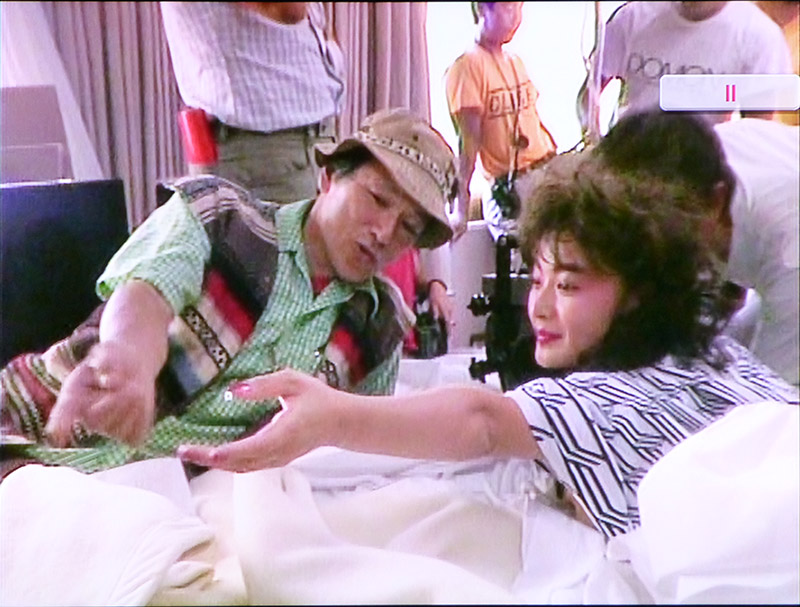
The documentary – quite kindly, I thought – showed the filming of three additional food scenes in the on-location hotel room that ended up on the cutting room floor. They involved cream, strawberry jam, and what appeared to be a profiterole. Oh, and the obviously delicious Fukumi Kuroda, of course.

P1020248

P1020249

So the answer is: Anyone who can keep me guessing for twenty years is a damned fine director.

It’s what’s for dinner

P1020226

Click for a larger view

That’s usually said of beef by the Cattlemen’s Beef Board and the National Cattlemen’s Beef Association – why there is a need for two beef-promoting organisations is beyond me – but tonight it was chicken in the form of chicken nachos. Thin, crisp tortilla chips that hold up to high heat; leftover roast chicken; cheddar, asadero, jack, and queso quesadilla cheeses; some diced jalapeno; and a sprinkling of Mexican spice blend. There are few dishes with a higher satisfaction to effort ratio. That they’re umami for the eyes is a bonus.

Mars Zero and the first step to nowhere

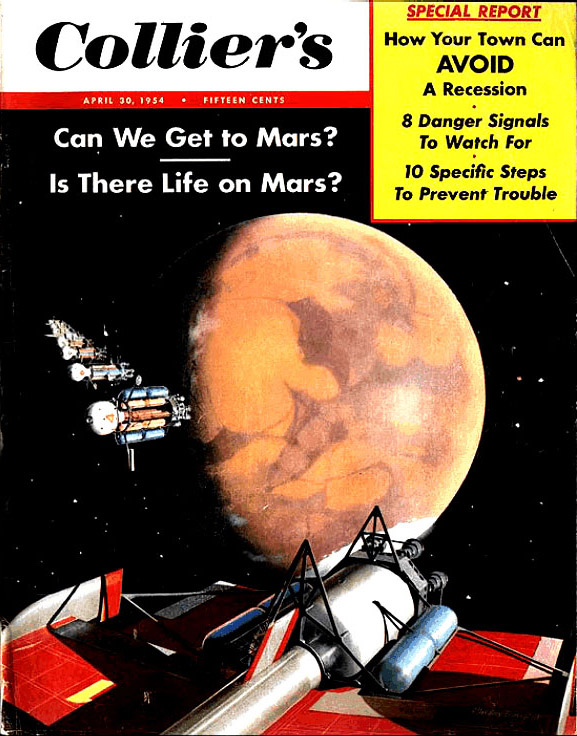
Click to see the entire issue

Click to see the entire issue

The title here has been running through my head recently since the media have once again nearly unanimously acted as willing participants in the fraud that is Mars One, after the project – or is it performance art? – announced its third-round culled-down list of 100 candidates, precisely none of whom will go to Mars.

The chief problem with Mars One is that it’s the product of a fantasist without money, without plans, without industry cooperation, and without the sense God gave a goose. As I read between the lines of recent interviews, many of their volunteers appear to me to be lonely souls with little to look forward to in their lives who seem happy to latch onto even the most vaporous of schemes just for the tiny glimmer of hope it gives them, even if death happens to be the end game.

The media’s almost unfailing neutrality in regard to the non-project, in which they basically rewrite press releases – in effect, becoming cheerleaders – is a particularly regrettable example of the creeping hyper-objectivity of news organisations that increasingly concentrate more on page impressions than truth. Too many stories are presented without questioning anything about them, never mind the in-depth critical analysis that some of them cry out for. The continuing rise of one-sided news written by public relations people – not really ‘people’ in the traditional sense, but I use the term for the sake of  convenience – is welcomed by news organisations ever tightly focused on the bottom line, because it’s much cheaper to hire kids just out of J-School to rewrite PR hogwash than it is to actually look into things – you know, see if they’re true or whatnot.

So, on to serious projects instead. What about NASA? Orion seems like a good ship so far, but I’ve been ignoring the chorus saying it’s the first step to Mars. It is the first step to getting past the low Earth orbit we’ve been stuck in for forty-three years¹, but no more than that. Development of the Space Launch System (SLS) is underway, but that’s where current plans end. The budget money ends there, too.

Many problems challenging a manned Mars mission, such as too-heavy but essential radiation shielding, a known 1-2% bone density loss per month in microgravity, and the new and worrying possibility of permanent vision impairment or loss, remain insurmountable. They may be resolved in the course of time, but I don’t think this is the decade, and the next one is doubtful, too. Half-century? Maybe. With current capabilities and limitations, humans would first be incapacitated and then almost surely killed along the way to Mars. Those who weren’t by some miracle dead by landing wouldn’t be able to move due to pesky skeletons with the tensile strength of a handful of matchsticks.

“Oh, details, details”, some freer spirits than me will no doubt think as they strive to come up with a pithy one-sentence retort involving the word ‘haters’. And that’s fine; this is just my annoyingly science-based opinion, after all. But what about actual space travellers? How do NASA astronauts – the ones who remain, anyway – feel about Mars? Joyous anticipation? Unconcealed excitement? Not exactly.

Lori Garver, who had advised Obama and then become NASA’s deputy administrator, was visiting Johnson Space Center. After “rah-rah” remarks, Garver polled the roughly four dozen astronauts in attendance where they wanted to go. An asteroid? No hands. Mars? Three hands. The moon? All the rest of the hands.

I agree.

—

¹If the Earth were the size of a ping pong ball, the farthest humans have ventured away from it since Apollo 17 in December 1972 would be about 2 millimetres. The Space Shuttle’s operating limit was a bit shy of 400 miles altitude, or about 1/10th the radius of Earth. For terrestrial reference, that’s about the distance from Edinburgh to London or Boston to Washington, DC.

The genius of Preston Blair

Tonight, I pulled out my French DVD box set of the complete Tex Avery cartoons – one of the many reasons I require all-region disc players with PAL to NTSC conversion – and cued up “Swing Shift Cinderella” to marvel at. To me, it’s one of the most astonishing of the old school cartoons, especially considering that Preston Blair, who invented and animated the Red Hot Riding Hood character, produced Red’s dancing entirely from his artistic imagination – no rotoscoping, where an actor is filmed and then key frames are traced…no model…no nothing. And, hey, it was August 1945, so no CGI. You can change the quality here from the default of 360 to 480.

Red appeared in several Avery productions, always with Wolfie and sometimes with Droopy the dog as Wolfie’s foil, but I think this one’s the best. (The full cartoon is over seven minutes, but I uploaded just this portion in the hope that it won’t be summarily removed at the behest of MGM. You know, the ones who won’t release the Avery library on DVD or Blu-ray in the US.) I don’t believe I’ve seen finer free-hand animation of the female figure. For a treat, watch again and follow just her hands. I think their complex and varied natural movements push the cartoon into extraordinary territory.

It’s no surprise that cels of Red dancing were once stolen from an animation stand where they had been left unattended overnight before filming. Blair had to re-do the work, but considered the theft high praise.

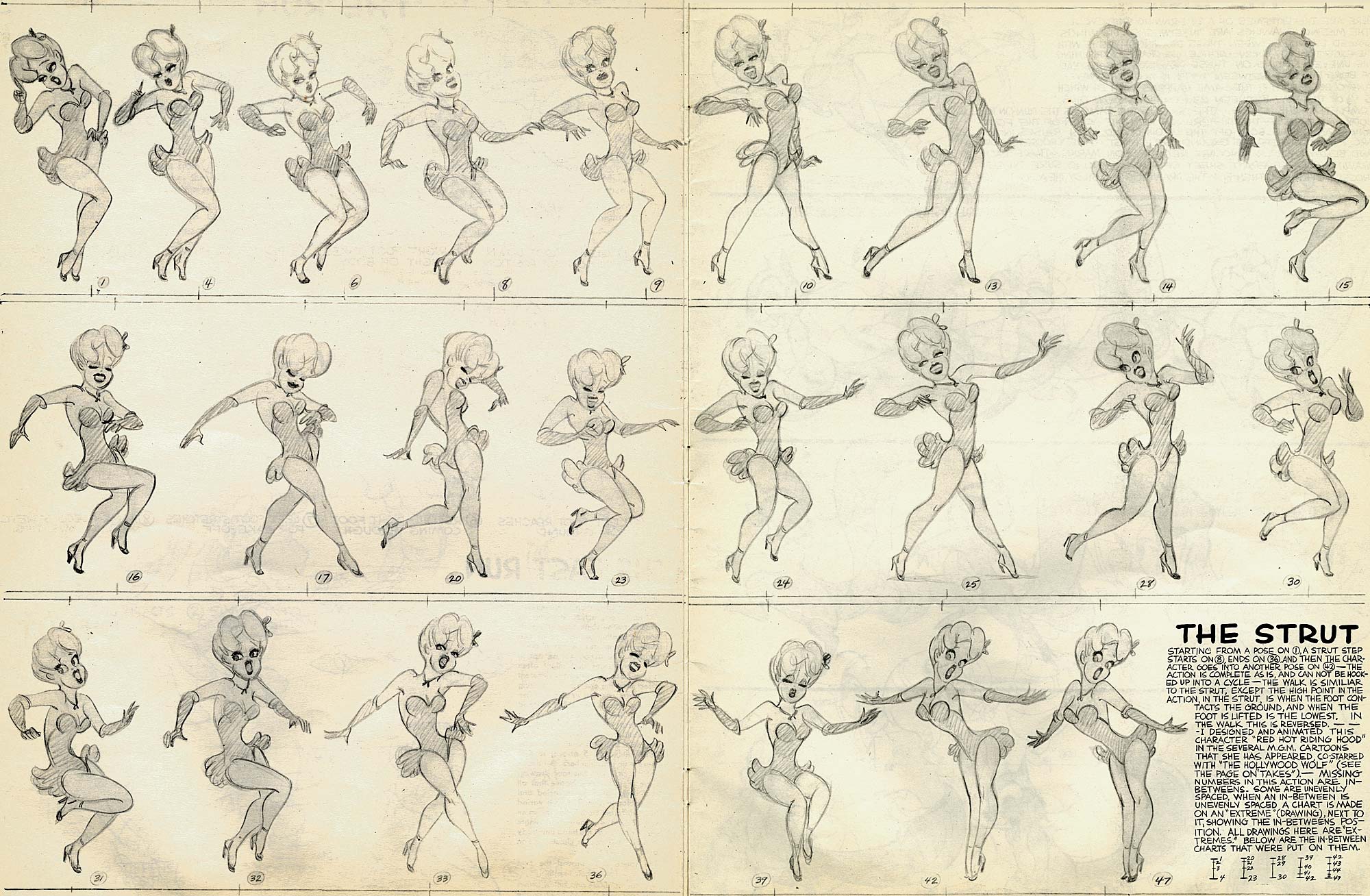
In one of his books, Blair explains one sequence in a chart:

preston-blair-red-hot

Click to see a larger version

Red’s singing voice was provided by the silken notes of Imogene Lynn, perhaps best known for her lead in the most popular recording of “Ac-cent-tchu-ate the Positive” with Artie Shaw, and shown here performing “Big Boy”.

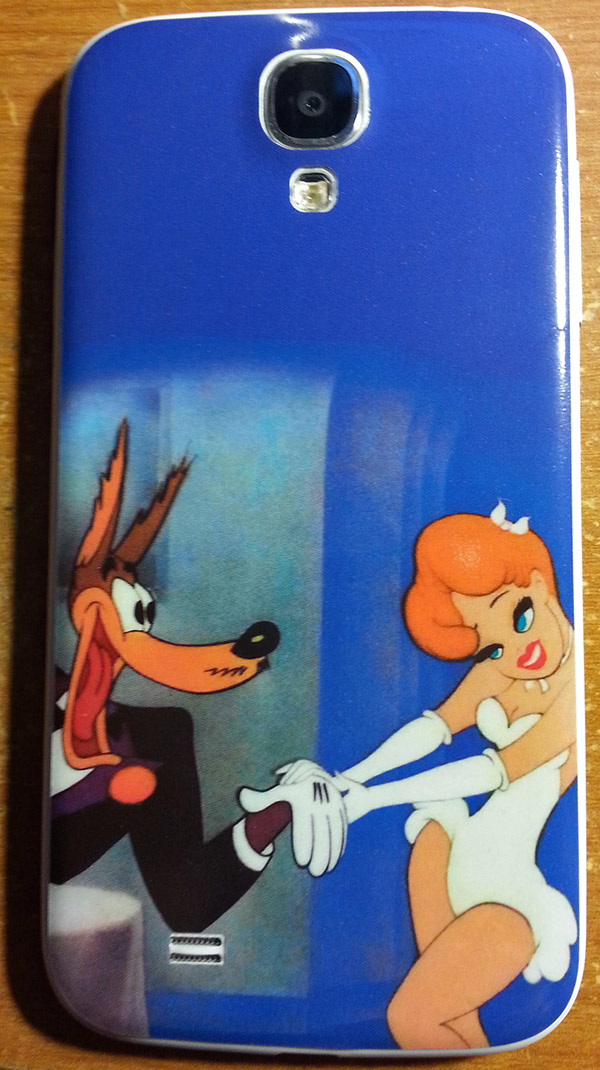
My best mate also loves the Red Hot Riding Hood cartoons and recently got a new mobile, so I customised this skin for the back of her phone on Skinit.com and gave it to her at Christmas – to her great delight.

20141225_131020

Here are a few of the variants of Red that appeared in Tex Avery cartoons:

Red Hot Riding Hood variants

Click to see a larger version


My Kickstarter project will be an invisible & completely silent horse potato detector

Because people really will believe anything:

As the Bio Ceramics collect odors, dirt and waste from your laundry, they need to be ‘recharged’ in order to make sure the pH levels of the laundry water continue to be raised.   To recharge Crystal Wash you simply put them in the sun for an afternoon.

I’m pretty sure they’ve optimistically infused sunlight with a power it does not actually possess. The reason I sigh a lot some days is that it seems there’s no collective memory, none whatsoever, past two or maybe three years ago.

On the bright side, it appears people are cottoning onto their scheme – in a negative and non-wallet-opening way, I mean. Since I first viewed that Kickstarter page several hours ago, they’ve at least removed the claim in one graphic that their device would “re-structure” water, a pretty good baby step toward what I hope will be an embarrassingly drunken series of stumbles that end in the  scrapping, or maybe even the crashing and burning, of the whole thing. Unfortunately, their project wasn’t in the Wayback Machine, so I can’t include that image here, but comments on Kickstarter verify it was there. I’ve added their current version to Wayback so I can, if I wish, note further changes as they make them.

In any case, consider the fact that when people of a commoner sense started examining their claims, they immediately got rid of the most blatant quackery that had been on their Story page for months, and then did not mention this deletion, or the reason behind the edit. This should tell you everything you need to know vis-à-vis the “Honest but perhaps a bit naive, or criminally fraudulent?” question that may have been floating around in your head.

I’m reminded of a relevant letter by Mark Twain:

Nov. 20. 1905

J. H. Todd
1212 Webster St.
San Francisco, Cal.

Dear Sir,

Your letter is an insoluble puzzle to me. The handwriting is good and exhibits considerable character, and there are even traces of intelligence in what you say, yet the letter and the accompanying advertisements profess to be the work of the same hand. The person who wrote the advertisements is without doubt the most ignorant person now alive on the planet; also without doubt he is an idiot, an idiot of the 33rd degree, and scion of an ancestral procession of idiots stretching back to the Missing Link. It puzzles me to make out how the same hand could have constructed your letter and your advertisements. Puzzles fret me, puzzles annoy me, puzzles exasperate me; and always, for a moment, they arouse in me an unkind state of mind toward the person who has puzzled me. A few moments from now my resentment will have faded and passed and I shall probably even be praying for you; but while there is yet time I hasten to wish that you may take a dose of your own poison by mistake, and enter swiftly into the damnation which you and all other patent medicine assassins have so remorselessly earned and do so richly deserve.

Adieu, adieu, adieu!

Mark Twain

On a tangentially related note – gullibility the common thread – here’s a fun quote regarding the Keurig K-Cup ‘coffee’ system:

I don’t have one. They’re kind of expensive to use. Plus it’s not like drip coffee is tough to make.
– John Sylvan, inventor of the K-Cup (now with DRM!)

As to my horse potato detector, invisible and silent it may be, but I’ve been hearing it incessantly today inside my head. This post and this picture I just pasted together may quiet it a bit.

Horse Potato Wash

Latest blizzard: 1 April 1997, 2-3 feet

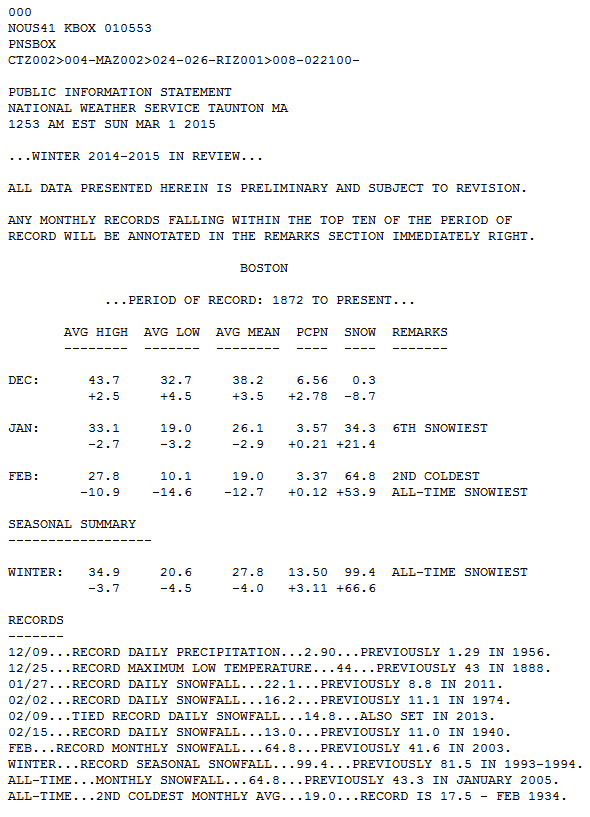
That date is something I keep in mind whenever I read the seasonal totals that the National Weather Service releases on the 1st of March each year, this year’s shown below. Temperatures are in F and snowfall totals in inches. As a perfect example of the temporary nature of their winter ‘in review’, I’ll mention that it’s snowing right now, with an expected 3″ tonight. Also, I believe my area has had around a foot more snow than Boston proper, which is what’s covered by this summary. That’s not a boast – it’s a lament.

The day before that 1997 blizzard occurred here, the temperature had reached 64F/18C.

Winter 2014-2015 in Review

On Saturday night, the people in the Taunton, Mass. NWS office were obviously torn about what would happen tonight, and had a different Massachusetts-related headline on their minds. From the forecast discussion they pushed out:

Taunton discussion

Tampopo redux

I’ve been wanting to see the 87-minute documentary on “The Making of Tampopo” ever since I first read of its existence perhaps fifteen years ago. And now – or soon, anyway – I can. A German special edition Blu-ray of “Tampopo” by the fantastic director Jûzô Itami has been released that includes it. I checked to be sure and it does have English subtitles on the disc, not just German. I found out about it while idly reviewing search results for “Tampopo” shortly after I watched it yet again last night.

Here’s the trailer for the film, which was first released 30 years ago in Japan:

I just ordered the new Blu-ray release from a fellow in Germany, but I’ll have to wait a while before viewing it. While my current internationally modified (read: electronics hacked) LG Blu-ray player can play all DVD regions and convert PAL/SECAM to NTSC, it can only play Blu-ray discs for Zone A; this disc is Zone B. I just found a modified Samsung all-region DVD, all-zone Blu-ray player with PAL/SECAM converter; support for DLNA/NAS/Internet play and search; data discs on CD/DVD/BD-R; support for AVI, WMV, MP4, MKV, MP3, and other files; and DivX, Xvid, WM9, and other formats. All for US$20 less than my modified LG player cost four years ago, but I will resist the temptation to use credit and again practice delayed gratification until I have the cash to get it – possibly in the next two to six weeks.

“Tampopo”, the only film I’ve watched more times than “2001: A Space Odyssey” – that equates to ‘a heckuva lot’ – for the first time in full high definition and with dts-HD audio, plus its “making of” documentary…it’s a dream come true.

37356_front

37356_back

“Only the Mary Ann…”

An excerpt from a speech Mark Twain gave at a dinner in his honour hosted by Lord Mayor John Japp at the Liverpool Town Hall, 10 July 1907:

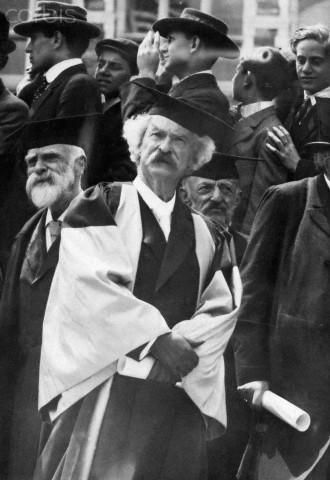
Home is dear to us all, and now I am departing to my own home beyond the ocean. Oxford has conferred upon me the highest honor that has ever fallen to my share of this life’s prizes.¹ It is the very one I would have chosen, as outranking all and any others, the one more precious to me than any and all others within the gift of man or state. During my four weeks’ sojourn in England I have had another lofty honor, a continuous honor, an honor which has flowed serenely along, without halt or obstruction, through all these twenty-six days, a most moving and pulse-stirring honor – the heartfelt grip of the hand, and the welcome that does not descend from the pale-gray matter of the brain, but rushes up with the red blood from the heart. It makes me proud and sometimes it makes me humble, too.

Many and many a year ago I gathered an incident from Dana’s Two Years Before the Mast. It was like this: There was a presumptuous little self-important skipper in a coasting sloop engaged in the dried-apple and kitchen-furniture trade, and he was always hailing every ship that came in sight. He did it just to hear himself talk and to air his small grandeur. One day a majestic Indiaman came plowing by with course on course of canvas towering into the sky, her decks and yards swarming with sailors, her hull burdened to the Plimsoll line² with a rich freightage of precious spices, lading the breezes with gracious and mysterious odors of the Orient. It was a noble spectacle, a sublime spectacle! Of course the little skipper popped into the shrouds and squeaked out a hail, “Ship ahoy! What ship is that? And whence and whither?” In a deep and thunderous bass the answer came back through the speaking-trumpet, “The Begum, of Bengal – 142 days out from Canton – homeward bound! What ship is that?” Well, it just crushed that poor little creature’s vanity flat, and he squeaked back most humbly, “Only the Mary Ann, fourteen hours out from Boston, bound for Kittery Point – with nothing to speak of!”³ Oh, what an eloquent word that “only,” to express the depths of his humbleness!

That is just my case. During just one hour in the twenty-four – not more – I pause and reflect in the stillness of the night with the echoes of your English welcome still lingering in my ears, and then I am humble. Then I am properly meek, and for that little while I am only the Mary Ann, fourteen hours out, cargoed with vegetables and tinware; but during all the other twenty-three hours, my vain self-complacency rides high on the white crests of your approval, and then I am a stately Indiaman, plowing the great seas under a cloud of canvas and laden with the kindest words that have ever been vouchsafed to any wandering alien in this world, I think; then my twenty-six fortunate days on this old mother soil seem to be multiplied by six, and I am the Begum, of Bengal, 142 days out from Canton – homeward bound!

—

¹Twain was awarded a Doctorate of Letters by the University on 26 June 1907.

Mark Twain Receiving Honorary Degree from Oxford

²A line on the hull indicating the maximum safe draft.

³Kittery Point is not actually mentioned in Richard Dana’s book, but Twain’s good friend William Dean Howells had a summer home there.


Ultimate optimists

In the last few years, I’ve noted a small but noticeably growing trend of people wearing no winter clothing on the coldest of winter days – trousers and shirts, sure, but no coat of any kind. I usually see them in shopping centre car parks, but have noted them in other places as well.

Because they used to be rarer sights than they are now, my theory used to be that they were just running a quick errand and were in a hurry. Now I see them – almost always male and usually younger, I should point out – often enough that I think it may be reflective of a time where many simply never go outdoors for more than a run to the store for something, some of them perhaps thinking of frigid weather as a sort of annoying feature of the non-online game of life that never needs to be thought of in terms of anything but several minutes.

I’d be willing to bet that some of them don’t even own a coat – I mean, why would you not take five seconds to don one if you did own one, other than thinking, “How could there possibly be any consequences of dressing for balmy weather in the dead of winter?”

My puzzlement with this has only a little to do with the old admonition to “Bundle up or you’ll catch your death of pneumonia!” It’s more to do with the baffling optimism of someone who’s totally unprepared to spend more than a few minutes in an environment where the phrase “died of exposure” crops up with fair frequency in news reports. Will their car never break down or slide into a ditch? Will they never lock themselves out of their house? And will their mobile’s battery never hit 0%? To me, it’s akin to parents refusing to vaccinate their kids, rationalising “Oh, what are the chances they’ll ever get exposed to that. Anyway, we bleach every surface in our house and that will protect them just fine.” Such levels of optimism imbue the world with a gentleness and harmlessness that, on average, it simply doesn’t possess.