Spot the difference: National Geographic edition

Here’s part of the narration from National Geographic’s catfish-hunting leopard programme, a co-production of National Geographic Wild and BBC. It originally aired last November on NGC and I viewed it back then.

“Take three, and she nails it. Having watched her, the rest of the family soon follow suit and gets in on the act. Before now, it seems no one has seen leopards pouncing on live fish.” [at 2:35 in the linked clip]

BBC Natural World, who just aired the programme for the first time as “Africa’s Fishing Leopards”, appears to have fact-checked that claim, as I did myself back in November. From its narration by Sir David Attenborough:

“Take three, and she’s got it. Having watched her, the rest of the family are soon following suit and getting in on the act. While leopards are known to collect fish from drying rivers, to actually hunt them when the water’s high is something rarely witnessed. Certainly, after a lifetime in the African bush, it’s behaviour that Brad has never seen before.”

Apparently, the folks over at National Geographic Channel lack the internet access the BBC enjoys. The video below was posted in 2009. I found it back in November with a search for leopard fishing. It was the first result. What I would enjoy saying to an NGC producer’s face: “Hmmm.”

Timberland Tales

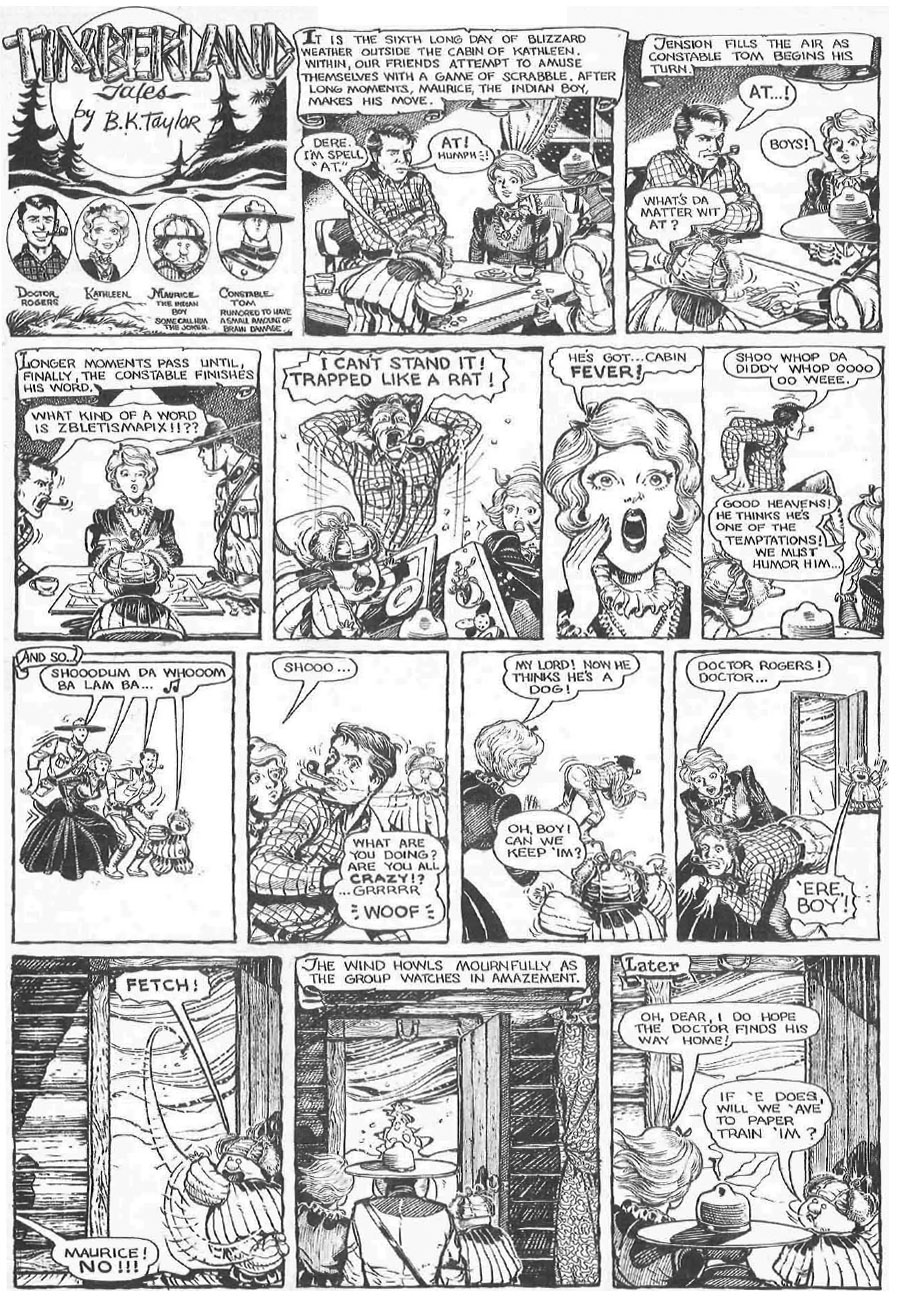
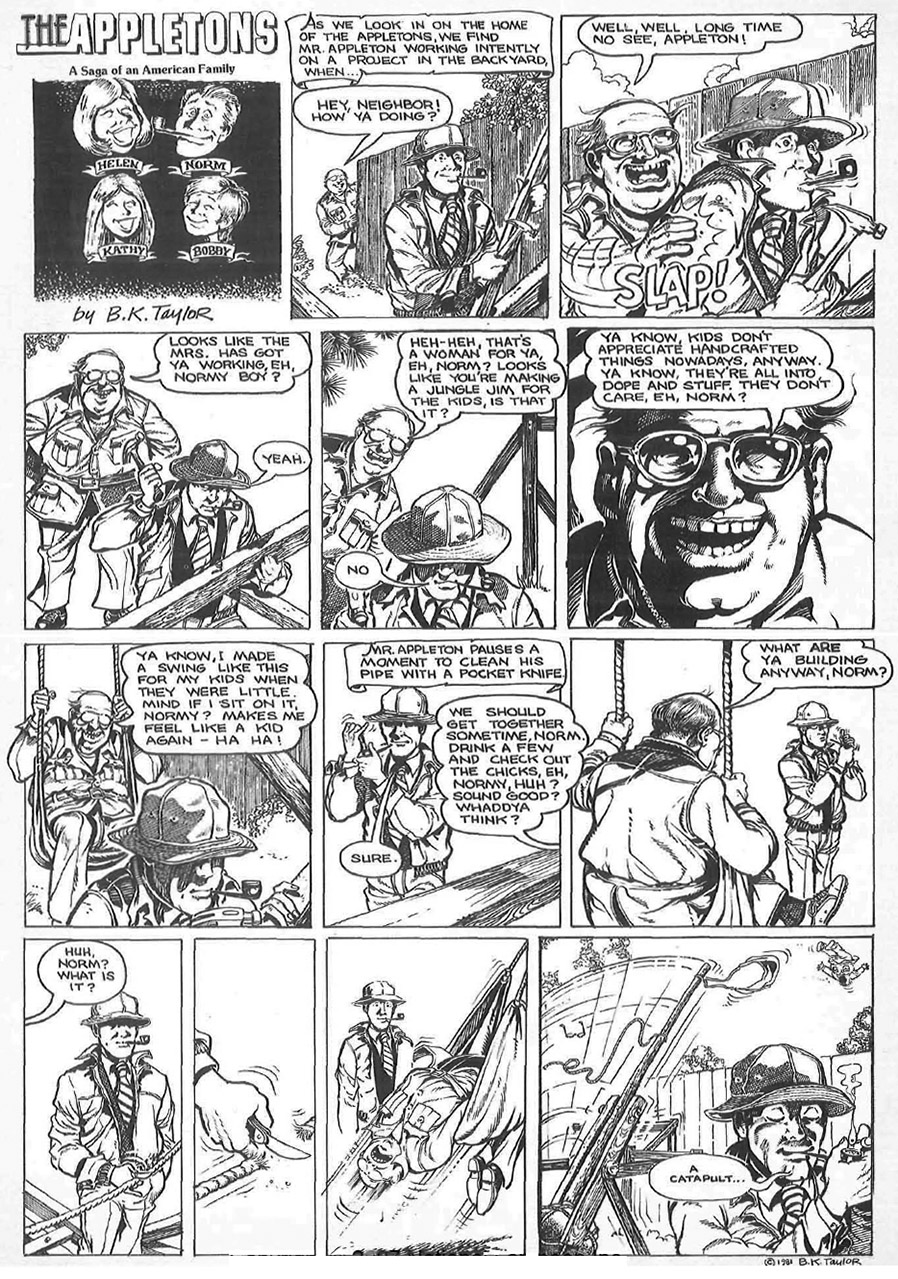
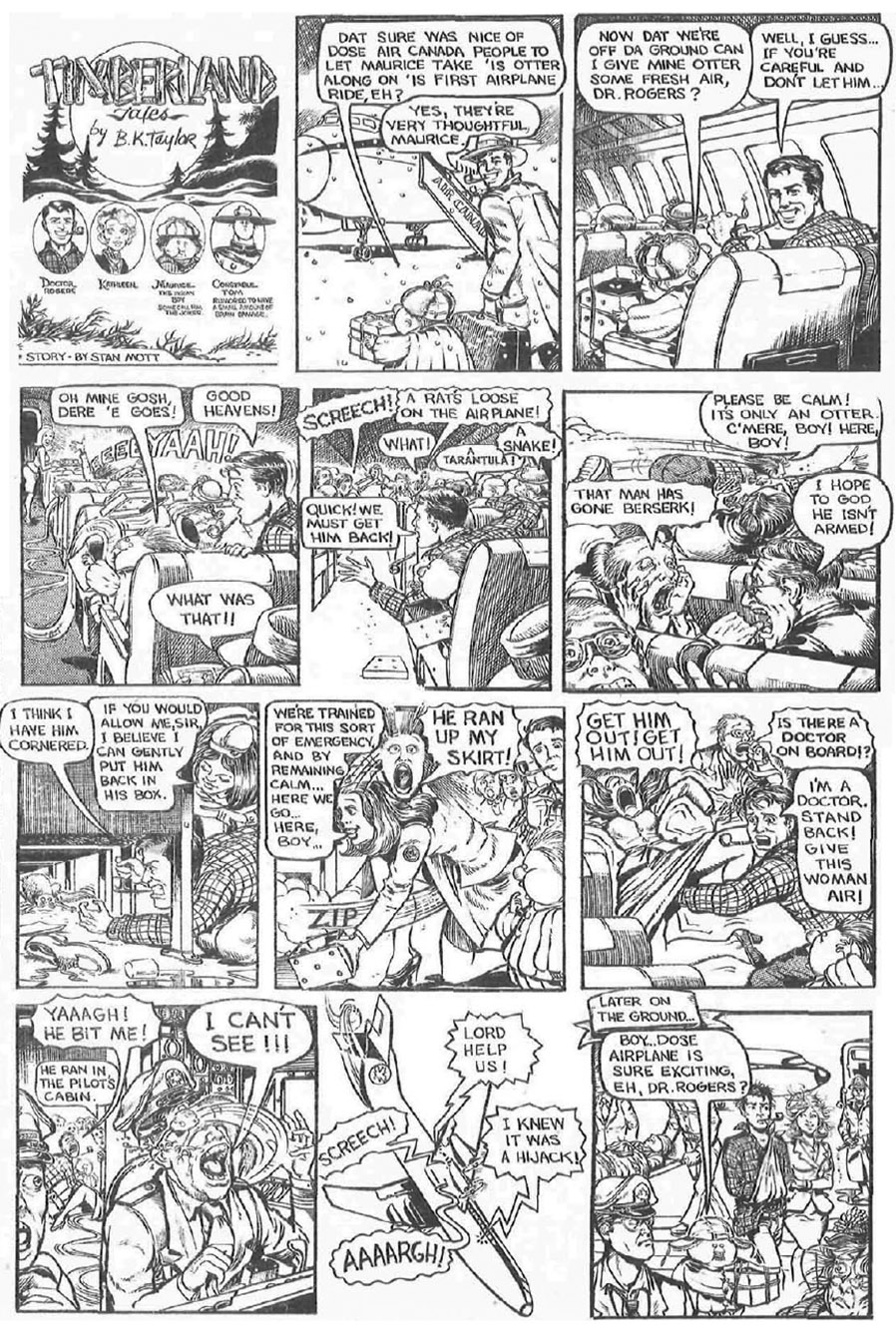
The best things in the long-defunct National Lampoon magazine were the “Timberland Tales” and “The Appletons” strips by B.K. Taylor. Slapstick isn’t easy to do well live, never mind in comics.

Edited July 2019 to add: B.K. Taylor is releasing a book of the collected “Timberland Tales” and “The Appletons” strips in March 2020. See this post: https://finleyquality.net/sakrafise/

Click any of these for a large version.

Timberland Tales April 1981

From April 1981


The Appletons January 1982

From January 1982


Timberland Tales March 1979

From March 1979


A winter blunderland

A local weatherman the other day: “All I can say is, take comfort in the fact that next winter will be nothing like this winter. I will guarantee that.”

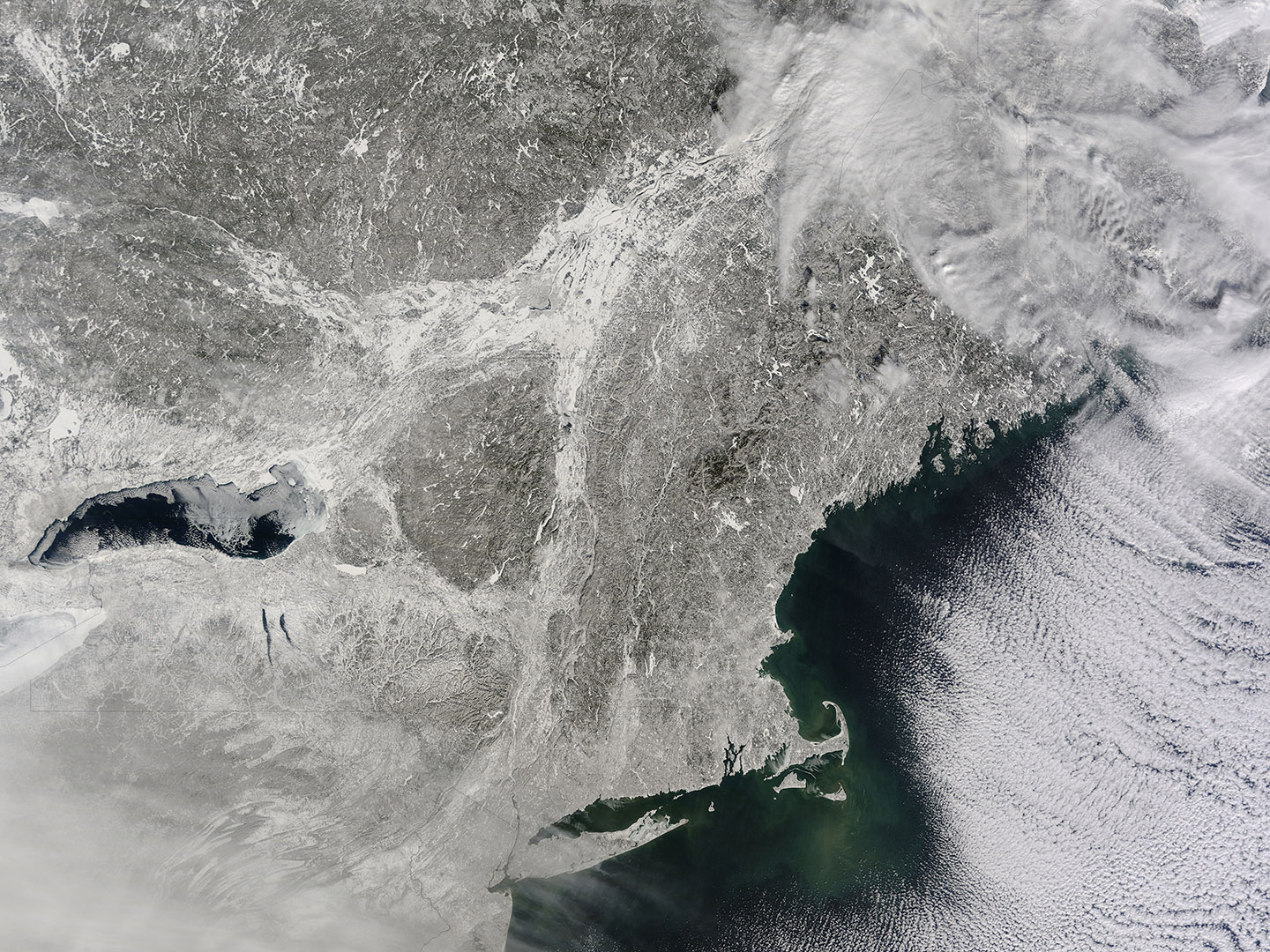
This view is after another blizzard dumped 12-20 inches on Eastern New England last Saturday night into Sunday. It was fifteen inches at my house, bringing the three-week total to a number too enervating to type, utter, or contemplate.

Click for a more enervating view

The second image shows the snow-covered northeastern states as observed on Feb. 16, 2015, by the Moderate Resolution Imaging Spectroradiometer (MODIS) on NASA’s Terra satellite. Cloud streets over the Atlantic Ocean in both images hint at the potent winds blowing across the East Coast from the Canadian interior. Following the blizzard, temperatures dropped as low as -30 degrees Fahrenheit (-34° Celsius) in parts of New England.

Cottage comfort

  1. Fill a 9×13″ pan with some seared ground beef seasoned with salt, pepper, and rubbed sage; its fond deglazed with a little beef stock; a few tablespoons of Worcestershire sauce; some Trader Joe’s frozen roasted sweet corn; a boatload of buttery, creamy mash; and a veneer of coarsely grated strong cheddar.
  2. Bake at 375F/190C for 50-55 minutes until it’s piping hot and the cheese is coloured perfectly, comme ci.
  3. Eat in front of fireplace.
  4. Make monosyllabic comments sprinkled with grunts to taste.

1. Click for a larger view 2. Try not to become fixated.


No popcorn used

The laziest man I ever met put popcorn in his pancakes so they would turn over by themselves.
– W.C. Fields

Click for a larger view

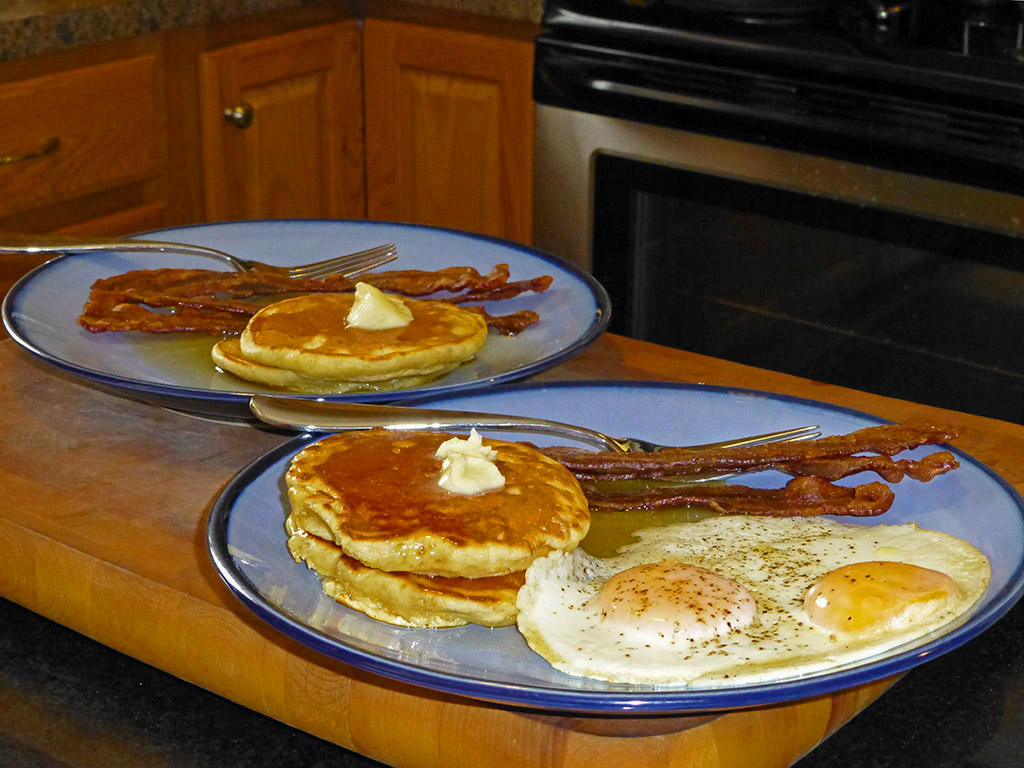
On a day off with a friend, slow-cooked bacon, eggs sunny side up for me, and pancakes – recipe here. The keys to scrumptious diner-style pancakes: gentle and only brief mixing of the dry into the wet ingredients, malted milk powder, and medium-low on the burner, which will give you 325-350F/160-175C in the pan and result in pancakes that are beautifully caramelised and soft, not crunchy.

John McPhee on firewood

Excerpt from “A Reporter at Large: Firewood” in The New Yorker, 25 March 1974. The full essay is in McPhee’s collection Pieces of the Frame.

Science was once certain that firewood was full of something called phlogiston, a mysterious inhabitant that emerged after kindling and danced around in the form of light and heat and crackling sound – phlogiston, the substance of fire. Science, toward the end of the eighteenth century, erased that beautiful theory, replacing it with certain still current beliefs, which are related to the evident fact that green wood is half water. Seasoning, it dries down until, typically, the water content is twenty per cent. Most hardwoods – oak, maple, cherry, hickory – will season in six months. Ash, the firewood of kings, will season in half the time. When firewood burns, it makes vapor of the water. The rest of the log is (almost wholly) carbon, hydrogen, and oxygen – the three components of cellulose, also of starch and sugar. When a log is thrown on the fire, the molecules on the surface become agitated and begin to move vigorously. Some vibrate. Some rotate. Some travel swiftly from one place to another. The cellulose molecule is long, complicated, convoluted – thousands of atoms like many balls on a few long strings. The strings have a breaking point. The molecule, tumbling, whipping, vibrating, breaks apart. Hydrogen atoms, stripping away, snap onto oxygen atoms that are passing by in the uprushing stream of air, forming even more water, which goes up the chimney as vapor. Incandescent carbon particles, by the tens of millions, leap free of the log and wave like banners, as flame. Several hundred significantly different chemical reactions are now going on. For example, a carbon atom and four hydrogen atoms, coming out of the breaking cellulose, may lock together and form methane, natural gas. The methane, burning (combining with oxygen), turns into carbon dioxide and water, which also go up the flue. If two carbon atoms happen to come out of the wood with six hydrogen atoms, they are, agglomerately, ethane, which burns to become, also, carbon dioxide and water. Three carbons and eight hydrogens form propane, and propane is there, too, in the fire. Four carbons and ten hydrogens – butane. Five carbons…pentane. Six…hexane. Seven…heptane. Eight carbons and eighteen hydrogens – octane. All these compounds come away in the breaking of the cellulose molecule, and burn, and go up the chimney as carbon dioxide and water. Pentane, hexane, heptane, and octane have a collective name. Logs burning in a fireplace are making and burning gasoline.

Let it snow, let it snow

The next storm is on the schedule and it’s to be another blizzard Saturday night. Old Probabilities is saying it may bring the twenty-day total snowfall at my house to…oh, I don’t know exactly, but somewhere around seven-and-a-half to eight feet – well more than an average year’s snowfall in just under three weeks. I’ll do some errands in the afternoon, return home, don my sheepskin slippers, turn down the lights, open the blinds, look out at the snow as I cook something piping hot and comforting for dinner, and feel a little better about winter now that my Multi-Fire XD electric fireplace is in its permanent home as of last night. It’s quite relaxing, indeed all the way to soothing.

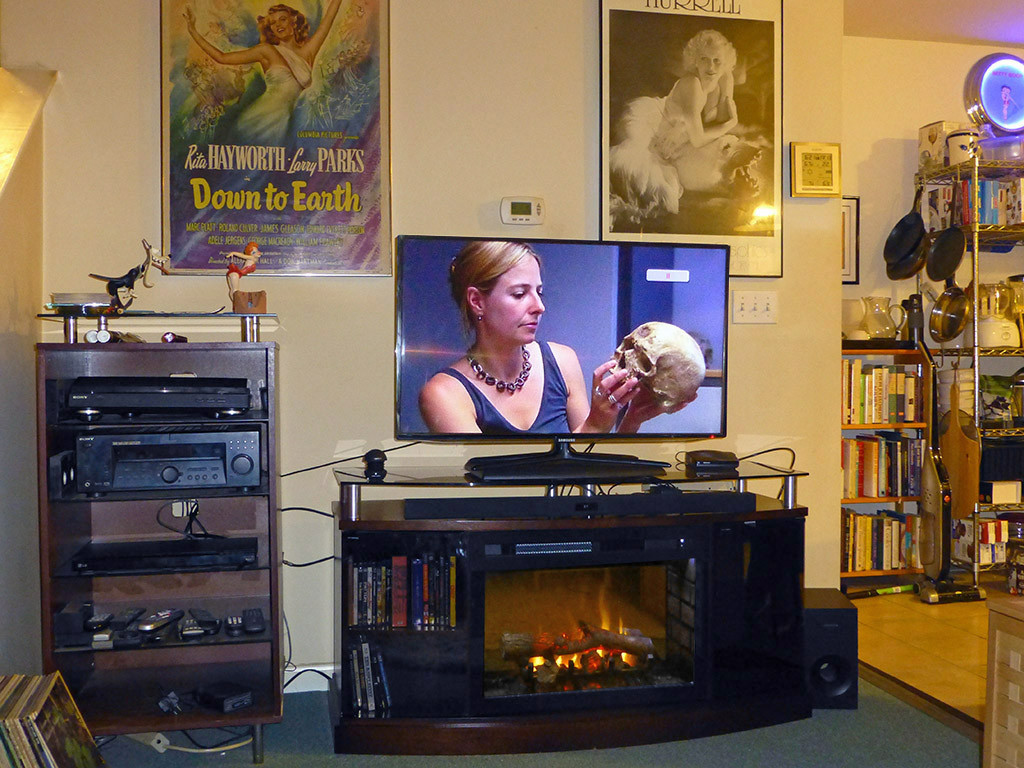
A friend was going to help assemble the flat-packed Windham media console but his kid was sick, so I put the 140-pound behemoth together on my own. The instructions were perfectly clear, but the weight and size of the pieces made the job awkward for one and the somanabatch took two-and-a-half hours to build.
P1020122

Click for a larger view

I selected the Windham because, like my old media console, it has a raised glass platform for the telly that allows me to have the set perched on a turntable – the rectangular piece under the four legs at the top – so I can easily rotate the TV 75 degrees counterclockwise to watch while I work in the kitchen that’s off to the right, and have my soundbar – the 40″ wide black bar underneath the glass – in a position where it won’t get knocked off when I swing the set around.

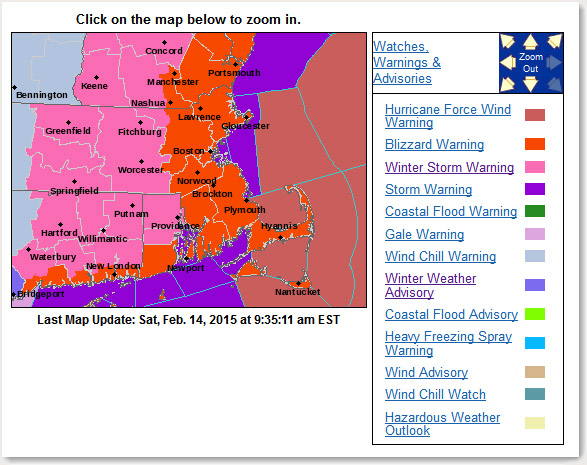
I imagine a multi-watch/warning/advisory map like this morning’s is akin to foreplay for professional weather people. All of the items on the right are in effect for various parts of the state and shoreline; the colours on the map side reflect only the most important warnings for each area.
Oysters for meteorologists

“Oh, baby.”

URGENT – WINTER WEATHER MESSAGE
NATIONAL WEATHER SERVICE TAUNTON MA
1057 PM EST FRI FEB 13 2015

…WINTER STORM WILL BRING BLIZZARD CONDITIONS TO EASTERN MASSACHUSETTS THIS WEEKEND AND HEAVY SNOW FARTHER INLAND…

MAZ005-013-017-018-020-021-023-141200-
/O.EXT.KBOX.BZ.W.0002.150215T0000Z-150215T1800Z/
CENTRAL MIDDLESEX MA-WESTERN NORFOLK MA-NORTHERN BRISTOL MA-WESTERN PLYMOUTH MA-SOUTHERN BRISTOL MA-SOUTHERN PLYMOUTH MA-DUKES MA-
INCLUDING THE CITIES OF…FRAMINGHAM…LOWELL…FOXBORO…NORWOOD…TAUNTON…
BROCKTON…FALL RIVER…NEW BEDFORD…MATTAPOISETT…VINEYARD HAVEN
1057 PM EST FRI FEB 13 2015

…BLIZZARD WARNING NOW IN EFFECT FROM 7 PM SATURDAY TO 1 PM EST SUNDAY…

* LOCATIONS…EASTERN MASSACHUSETTS INCLUDING MARTHAS VINEYARD.

* HAZARD TYPES…BLIZZARD CONDITIONS…INCLUDING HEAVY SNOW…POOR VISIBILITIES…AND STRONG TO DAMAGING WINDS.

* SNOW ACCUMULATIONS…8 TO 10 INCHES. SNOW DRIFTS UP TO A FEW FEET CAN ALSO BE EXPECTED.

* TIMING…SATURDAY EVENING INTO SUNDAY.

* IMPACTS…TRAVEL WILL BECOME NEARLY IMPOSSIBLE AND POTENTIALLY LIFE THREATENING DUE TO WHITEOUT CONDITIONS AND BITTERLY COLD WIND CHILLS….ESPECIALLY ALONG AND INSIDE ROUTE 128. CONDITIONS WILL REMAIN DANGEROUS FOR TRAVEL WELL INTO SUNDAY DUE TO BLOWING AND DRIFTING SNOW…REDUCED VISIBILITY AND DANGEROUSLY COLD WIND CHILLS.

* WINDS…NORTH 20 TO 30 MPH WITH GUSTS UP TO 60 MPH.

* VISIBILITIES…ONE QUARTER MILE OR LESS AT TIMES.

* TEMPERATURES…AROUND 20.

PRECAUTIONARY/PREPAREDNESS ACTIONS…

A BLIZZARD WARNING IS ISSUED WHEN SUSTAINED WINDS OR FREQUENT GUSTS OVER 35 MPH ARE EXPECTED WITH CONSIDERABLE FALLING AND/OR BLOWING AND DRIFTING SNOW. TRAVEL MUST BE COMPLETED BY LATE SATURDAY AFTERNOON. THOSE VENTURING OUTDOORS MAY BECOME LOST OR DISORIENTED. STAY INDOORS.

&&

$$
 

When charts are gut-wrenching

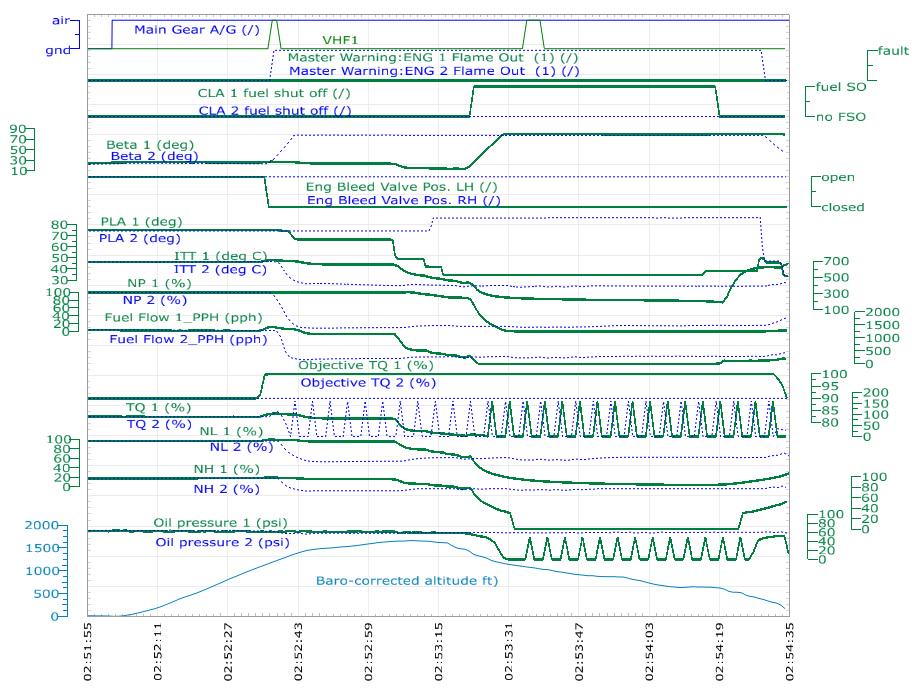
Flight Data Recorder chart from the TransAsia flight that crashed in Taipei:

I’ll amend this later if I’m reading that chart incorrectly, but it seems to indicate that they initially had a master warning that engine two flamed out. Engine two auto-feathered, meaning it automatically turned the propeller blades parallel to the airflow to reduce drag. The crew mistakenly powered back engine one (PLA is Power Lever Angle) to 35%, just above Flight Idle, and then shut its fuel off (CLA – Condition Lever Angle set to FSO). As they lost altitude, they realized their mistake and tried to restart engine one – at first, failing to restore its fuel supply – but they were down to 500 feet AGL by the time they restored the fuel and it was too late to recover. It hit the bridge sixteen seconds later.

If true, this would be much the same as the British Midland flight 92 air crash in 1989.

The driver whose taxi was hit, seen exiting the vehicle in the second picture below, did spot the aircraft coming. The instant he applied his brakes is shown below. His quick reaction and that one-tenth of a second or so of slight slowdown almost certainly saved his life and that of his his passenger. Had they been just one foot farther forward, there would have been a different ending for them.

TransAsia Crash Snapshot

Click for a larger view

Video here.

TransAsia Taxi

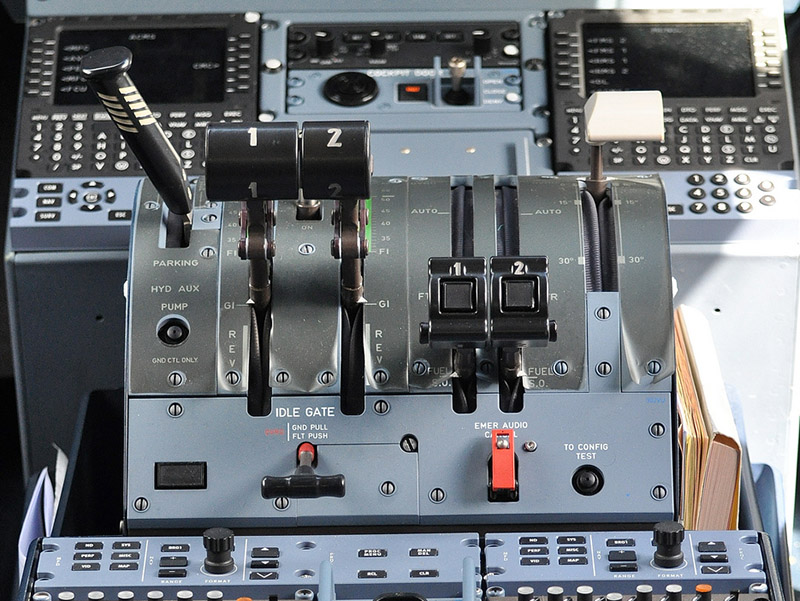
ATR 72-600 Engine Controls

ATR 72-600 engine controls: In the middle, Power Levers (PLA on the chart) on the left and Control Levers (CLA) on the right


Breakfast, slowly

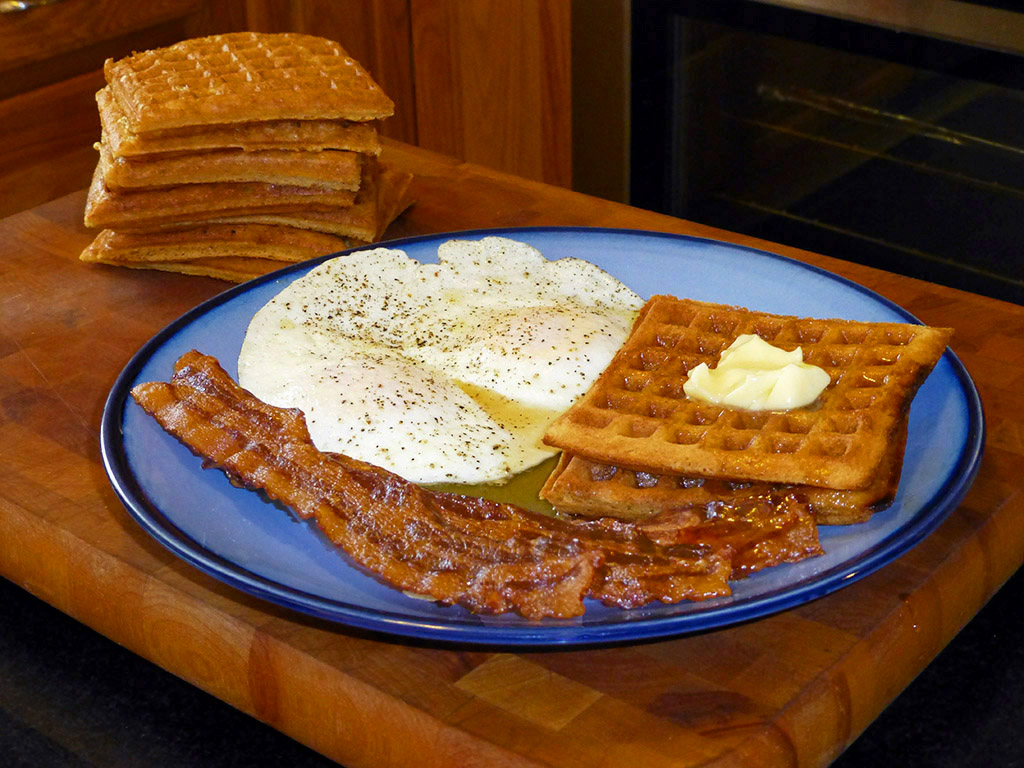
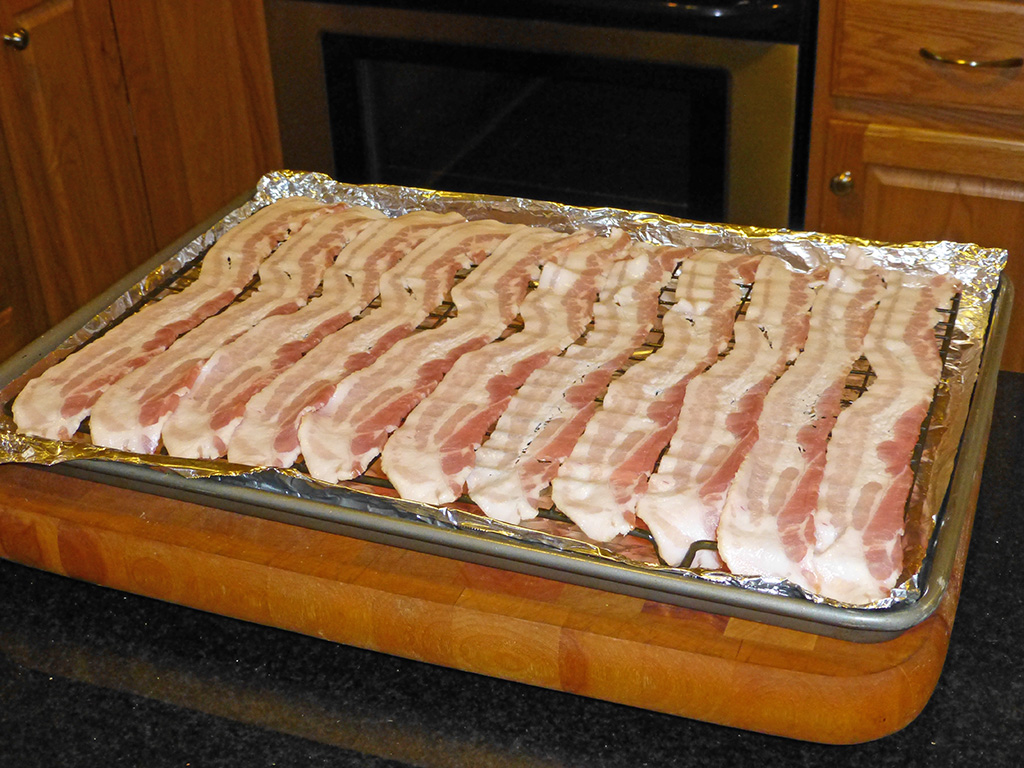
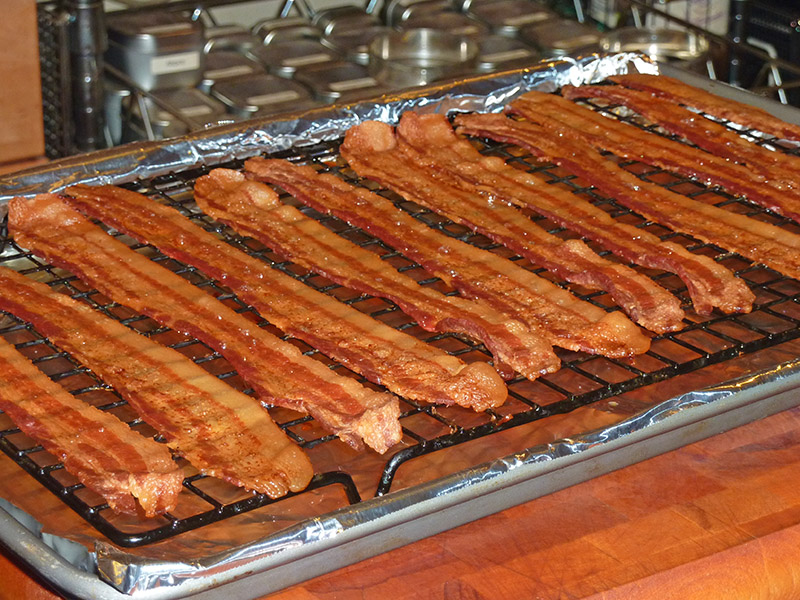
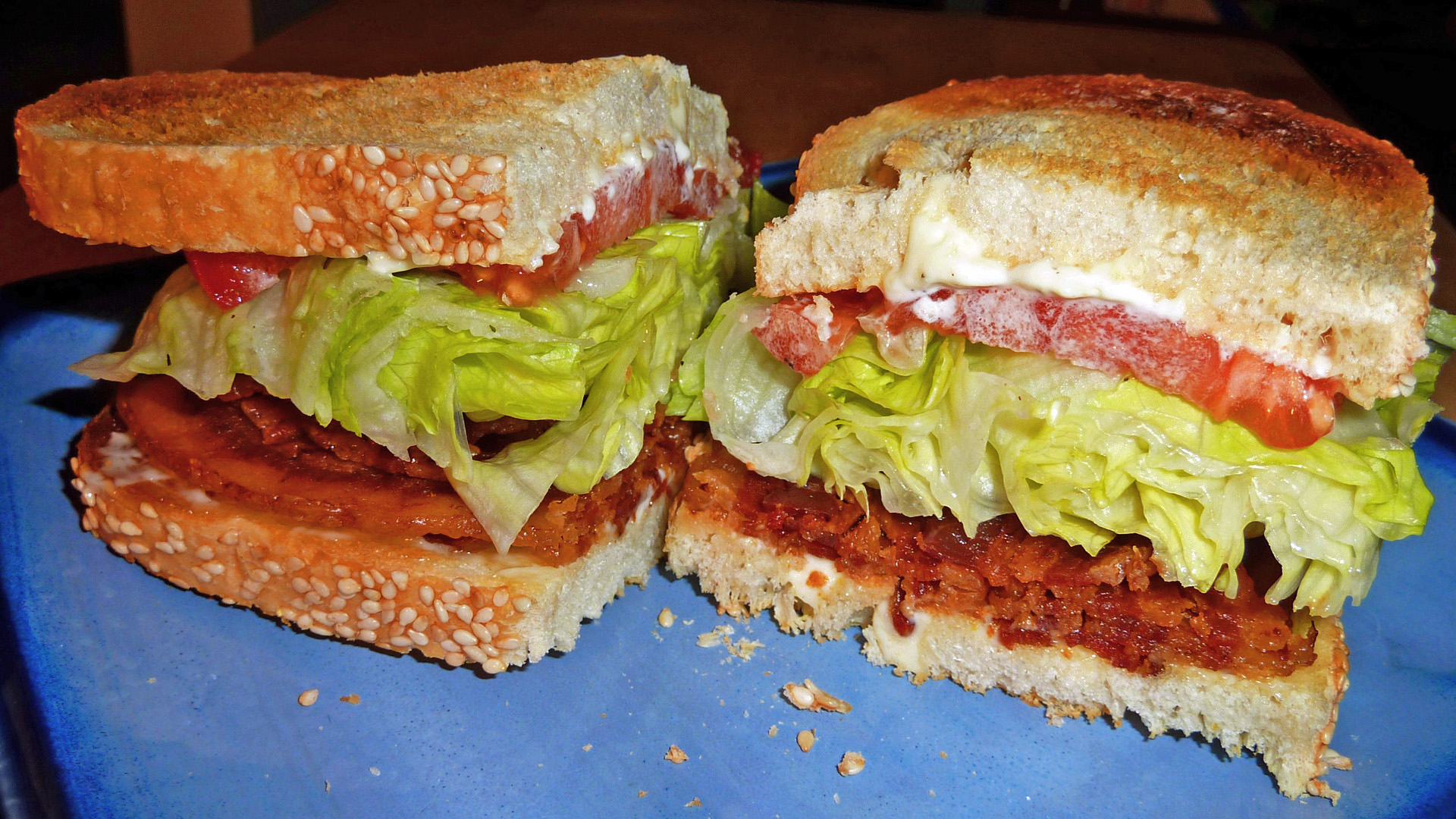
A late breakfast today, with slow-cooked hickory-smoked bacon – or thinly-sliced pork belly if you don’t call this bacon – homemade buttermilk waffles, and a couple of eggs over easy.

The remaining waffles will freeze nicely – about four times nicer than supermarket frozen waffles, in fact.

Slow-Cooked Bacon

With a little experimentation some years ago, I determined that this is the best way to slow-cook bacon: Preheat your oven to 275-285 F (135-140 C). The reason for that temperature? Not just to go slowly, but because the curing salts used in bacon production begin turning bitter at about 300F/150C. Line a large sheet pan with aluminum foil, taking care not to rip it or get holes in it (for easy cleanup). Put a fairly close-mesh wire rack in the sheet pan, then place your rashers on the rack in a single layer, just touching each other. A half-sheet pan will hold about 3/4 lb, 1/3 kilo, or 11-16 rashers of regular cut depending on their width, which varies considerably from package to package.

P1010769

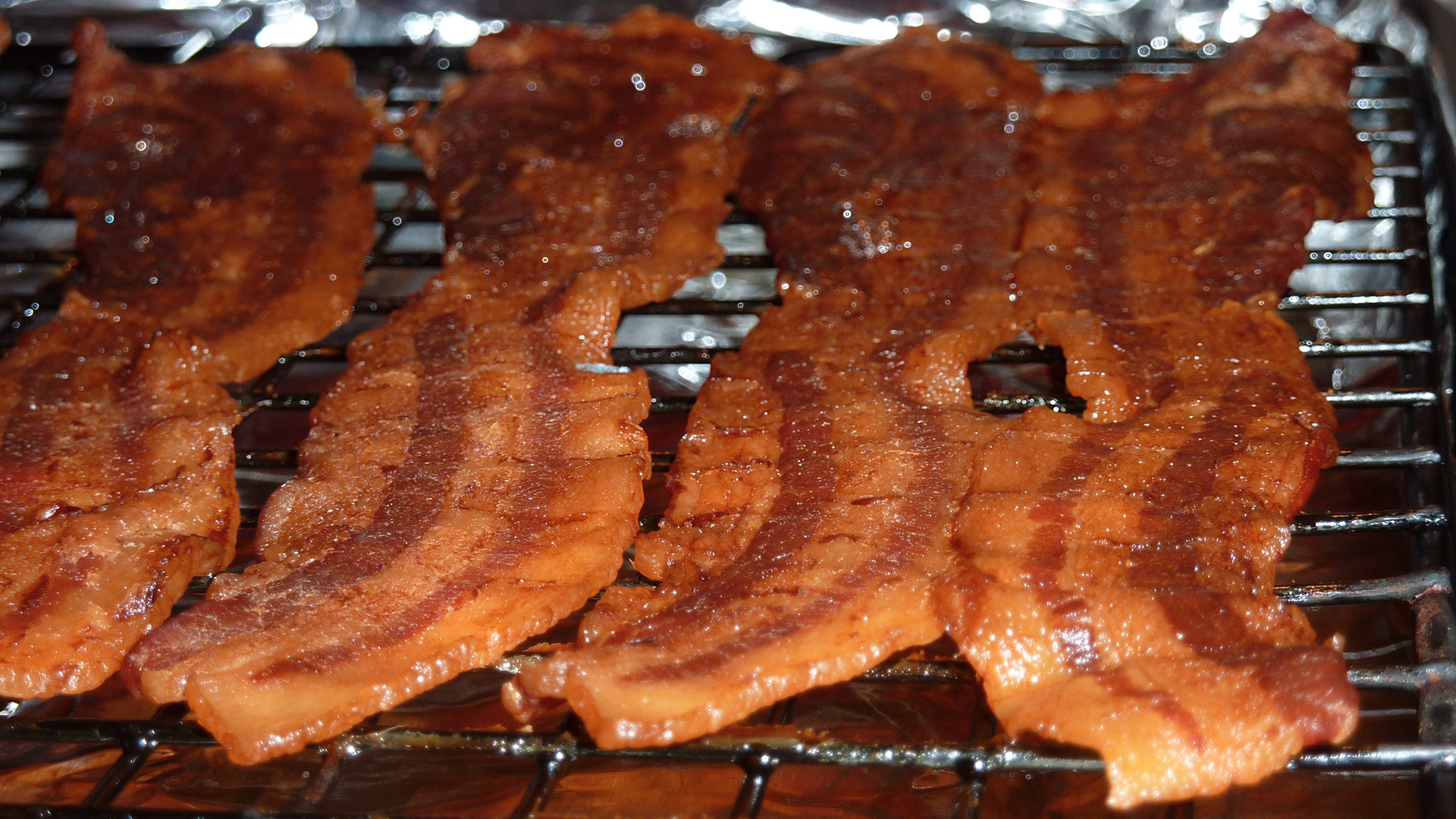
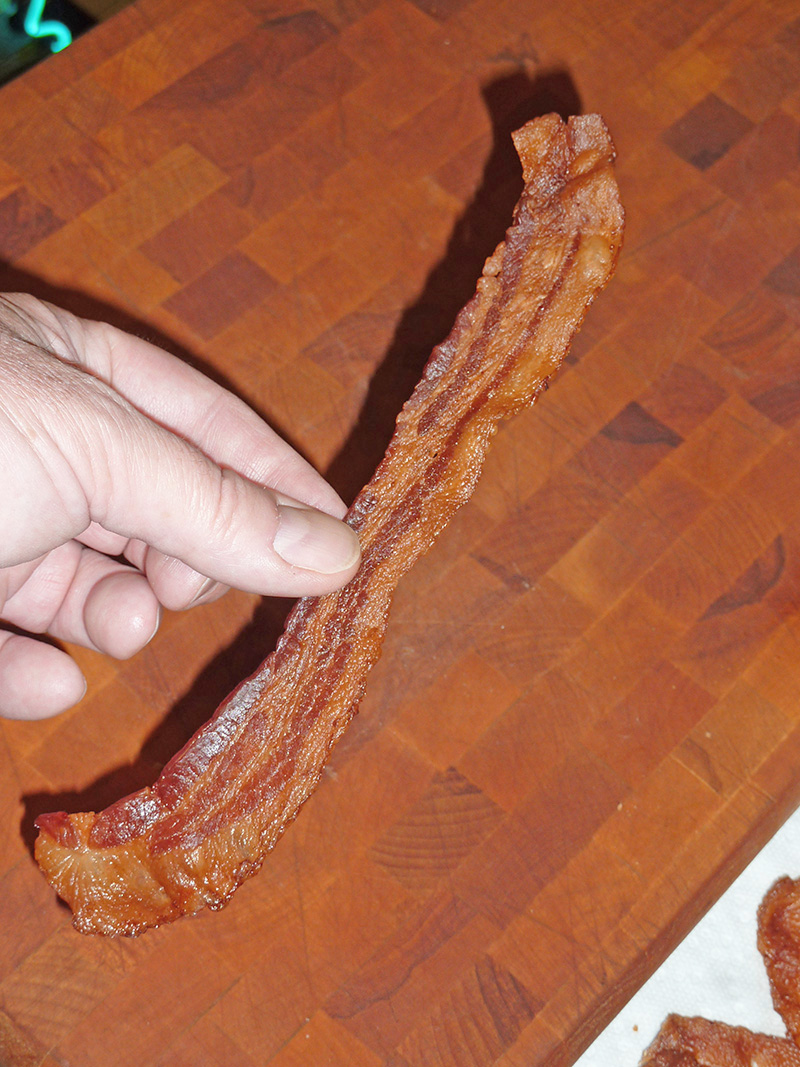
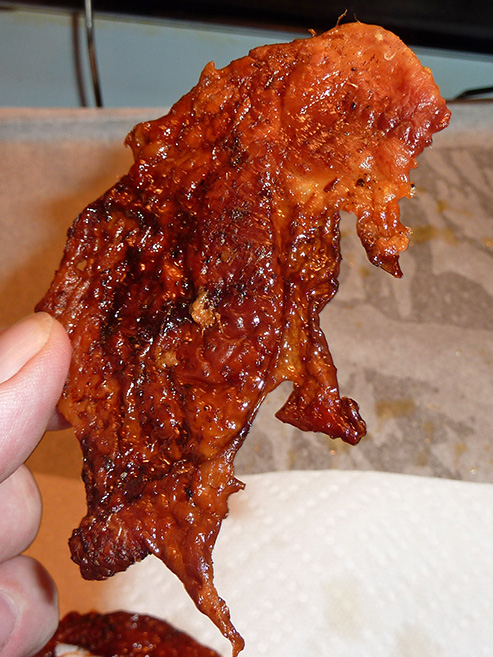
You can cook more than you need, because these will reheat very nicely with 30 seconds in a microwave. I use a regular (not thick) cut, cured, hickory-smoked bacon for this method; smoked or not is a personal preference, but I’ve found uncured bacon doesn’t work as well. Now, slow-bake it for 90 minutes – yes, 90 minutes. (Because bacons vary considerably, you should start taking a look at the 75 minute mark and maybe every 5 minutes thereafter so it doesn’t get too dark. I also look at the wetness: When the rashers start to look not completely dry but more dry than wet, they’re perfectly done.) What happens is magical. You end up with slices that are about 90% of their original size and about one-fifth of their original weight, and about a half-cup of perfectly clear bacon drippings in the (lined) pan. The bacon is a deep color with no burned parts at all, has very little grease (it’s all in the pan), and absolutely melts in your mouth. In fact, the cooked bacon is so delicate and wafer-like that some pieces will probably break in two from their own weight when you remove them from the rack to paper towels to drain.

The best part is that the bacon is now reduced to almost pure flavour, and it will be the most intense bacon flavour you are ever likely to encounter. It may be difficult to restrain yourself and actually make the rest of your breakfast or BLTs instead of scarfing down the whole lot straight out of the oven. It’s also probably a bit healthier for you, since 80% (or so) of the fat is gone and sitting in the pan.

P1050474

p1010772big

Click for 1920×1080

You can bake chicken skin in a similar low-and-slow manner, but between layers of parchment paper, with a second pan sitting on top to keep it flat.

P1010757

Just stop it, already

This sort of inclusion in a news article is pointless and maddening:

This has created a storm of criticism against this TV pundit known for her strong and often extreme opinions, but more than 11,000 people have pressed the “Like” button for this blog article on [Dingleface].

Well, sure, but worldwide, I’m certain you could easily find 11,000 people who would “Like” the idea of smashing your own thumb with a hammer, or feeding ground glass to dinner guests, or dropping toddlers off in the centre of a highway at naptime. Why not instead tell the truth?

This has created a storm of criticism against this TV pundit known for her strong and often extreme opinions, but, unsurprisingly, more than 11,000 trolls and/or mentally ill people enthusiastically supported her as they sat in mostly dark, unkempt rooms, mostly in their pants, in another of their series of feeble attempts to be noticed by someone…anyone. Such is the world.

The great majority of media outlets seem to believe that antisocial media totals gathered at filing time make their stories more relevant, maybe more in tune with the younger demographic, but these might-as-well-be-random numbers only make the articles more superficial and trivial. They’re the news equivalent of packing peanuts, but a little less so: They’re light, fluffy, and perhaps useful as filler when one needs to reach that word count, but in the long run, they will not protect the media jobs within.

peanut