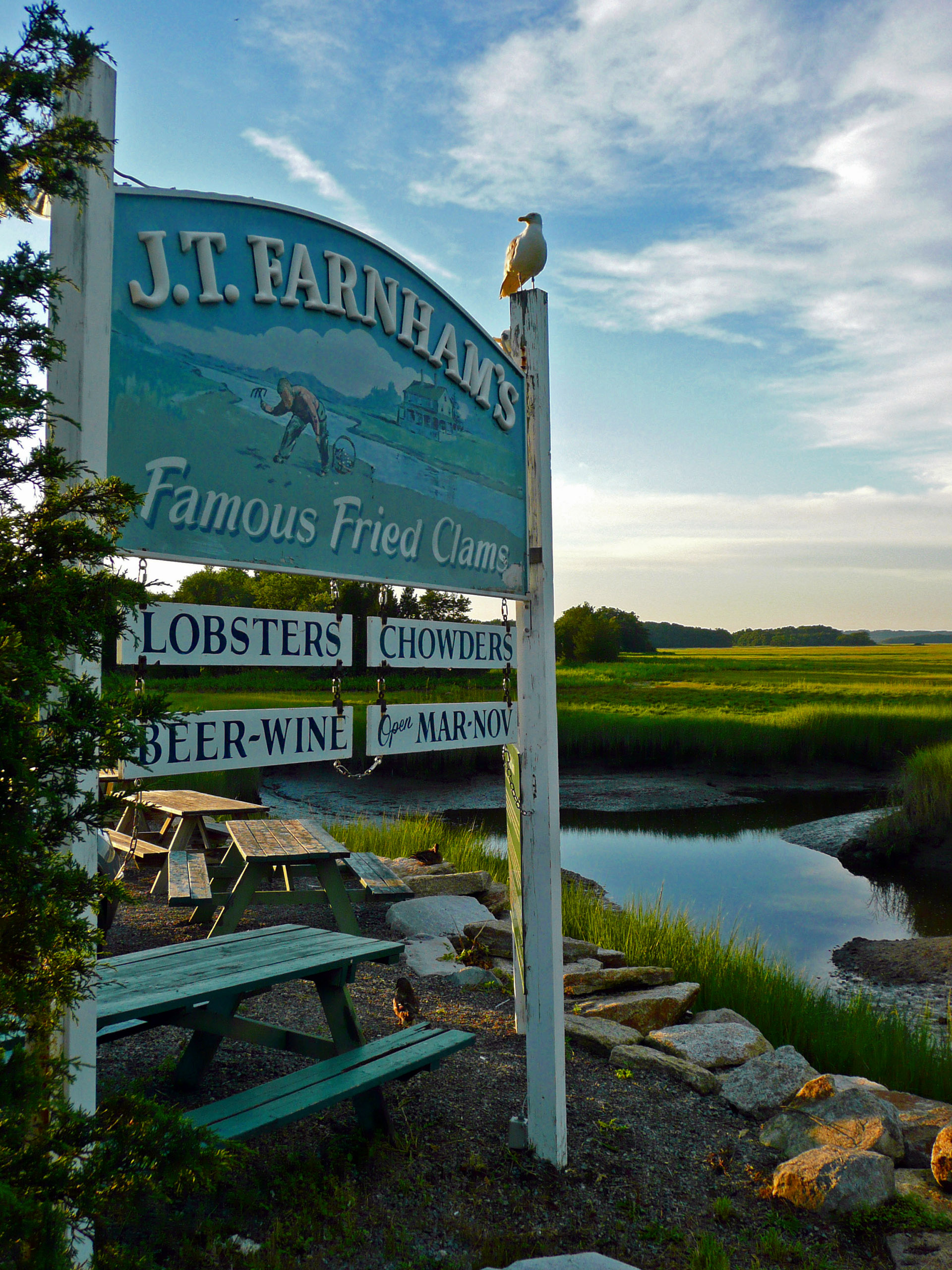
My view of the salt marsh during tonight’s dinner at J.T. Farnham’s; click for a larger version
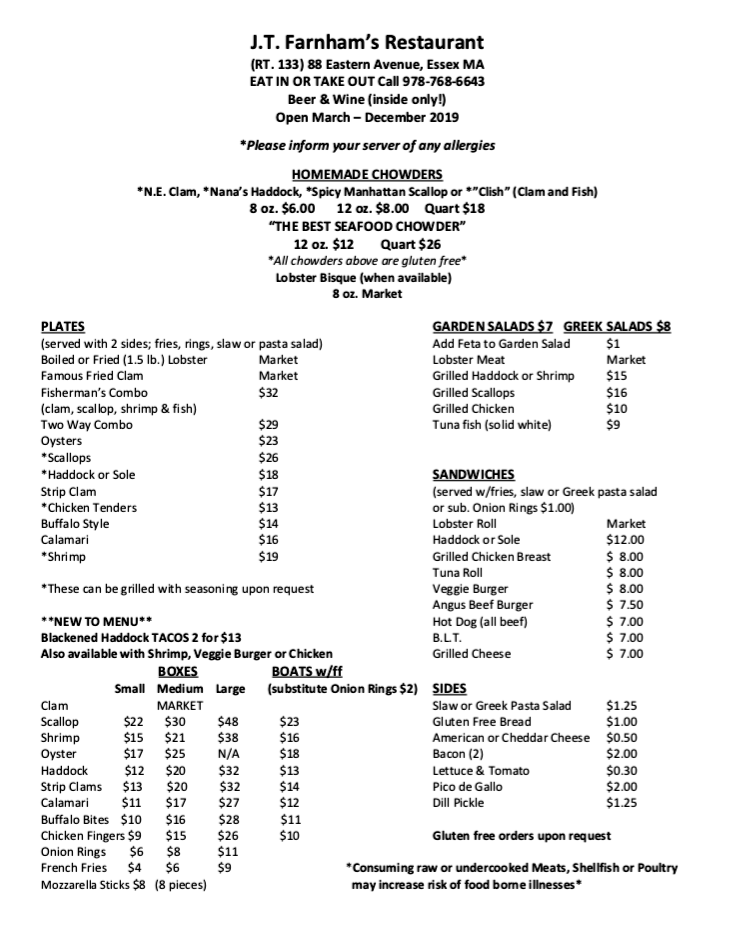
This year’s menu:
I got my usual clam plate with fries and onion rings, plus a quart each of clam chowder and haddock chowder to bring home. Market price on the clam plate was US$24, lower by a few dollars than last year.
I was more interested in eating than taking pictures, so here’s a plate they made earlier. They look this scrumpdillyicious every time. This is what I think of whenever I use or hear the phrase “golden brown and delicious”.
Once again, I’ve come away from listening to an episode of RadioLab convinced that they sometimes play dumb for effect. In this episode, “Bit Flip”, they went on for some minutes about how none of them had any idea what the significance of the number 4,096 might be, even as someone started going through the powers of two for them. The rest of the episode was devoted to detailing how not one of them had ever heard of the rare but real effect cosmic ray hits can sometimes have on electronic equipment – a good amount less rare at very high altitude and in space. They seem to have never heard of cloud chambers, either, and, after building one and seeing the effect for themselves, announced that yes, it seems those cosmic ray dealy-bobs really do exist. Pardon me?
I do like RadioLab, but my bullshit detector has clanged loudly more than once in the past as I listened, in maybe eight or ten episodes over the years. Their ubiquitous and multiple exclamations of “What?! I can’t believe it! But how?” have long fallen flat on my ears – not just because they always go over the top with their supposed disbelief/shock/surprise in this scripted show, but sometimes because I know the topic at hand actually came up at some length in mainstream science news stories years ago. When this happens, I say to myself, in Ray Goulding’s voice, “Wattaya, dumb? Don’t you know anything, you people?” (I’m quoting from the Bob & Ray sketch below – Ray’s on the left.)
But I don’t think that; I think they’re well aware and perhaps hope and trust that everyone has forgotten about them by now. Some of those news stories have occurred within the lifetime of RadioLab itself, but even for the older ones, Robert Krulwich especially, co-host of the show and also science correspondent for National Public Radio, is of an age that surely he remembers most of them. He’s the one I most suspect of putting on an act in such episodes. I can imagine him saying, “Yes, of course I heard of that back in the ’90s, but look, we gotta stick with the show’s M.O.: Salient facts are scripted as surprises known by none of us.”
Also galling about this episode is that they seemed to conclude that all the cases they talked about are highly likely to have been the result of cosmic ray hits, something which is certainly if minutely possible but, since there is no evidence after the fact, is certainly impossible to prove, or even say with any level of confidence unless you’re experimentally set up to detect the particles as they hit. Particularly egregious was their strong implication that an Australian Airbus in-flight upset was likely caused by a cosmic ray hit. (In effect, “See? Can’t even trust airplanes!”) Mushrooms would thrive in this steaming pile of horse potatoes. The Australian Transport Safety Board’s entirely opposite conclusion, after exhaustive study, was that Single Event Effects, the catchall name for such cosmic ray hits, were “very unlikely” to have been the cause of the malfunction. So RadioLab goes and finds some schmoe who says the equivalent of “So what they were really saying is that there’s still a pretty good chance, yeah?” and they nod enthusiastically – not because it makes any sense, but because it matches the narrative they chose to follow.
I often used to tell people in a nonchalant manner that due to a long-standing superstition among publishers, you can’t find the word “gullible” in any printed dictionary. The number whose immediate response was a wide-eyed “Really?” was not insignificant; they are perhaps the target audience for this episode.
“Yes, even I am dishonest. Not in many ways, but in some. Forty-one, I think it is.” – Mark Twain in a letter to Joseph Twichell, 15 March 1905
After listening to the first episode, which was well done, I can recommend the new “13 Minutes to the Moon” BBC World Service podcast, promoted as “The full story of the people who made Apollo 11 happen and prevented it from going badly wrong.”
It will run for twelve episodes – if they’re all 45 minutes like the first one, that will be nine hours total.
16 July 1969: Collins suiting up in a frame from this year’s “Apollo 11” documentary film
Mike Collins, Command Module Pilot of Apollo 11, wrote what is considered one of if not the best of the astronaut memoirs, Carrying the Fire, originally published in 1974. It’s finally been released as an ebook, so I’m rereading it in its weightless form now. If you read it after watching his recent hour-plus Aero-Astro classes at MIT here, it’s quickly obvious that he had no ghostwriter for this book – a rarity in such memoirs. It’s fully and delightfully in his own voice.
Gemini and Apollo astronauts underwent both tropical and desert survival training in case they reentered – or aborted during launch phase – away from recovery forces and ended up in entirely the wrong place; cold weather training wasn’t needed because the orbital mechanics of Gemini and Apollo flights dictated paths near the equator. Wrapping up the narrative of his Air Force tropical survival school training in Panama, he has this to say in the book:
“Somewhere along the way I picked up a couple of hundred companions, chiggers, evenly distributed from the waist down. I cannot adequately explain to the unchiggered what they are missing. My dictionary says simply that chiggers are ‘the parasitic larva of certain mites.’ It doesn’t say they are also abominable little red creatures who burrow into your skin, where they ultimately die. Uneasy in their terminal tunnels, they either jump about or dig deeper, or secrete some irritant, or something; at any rate they itch like crazy. Friends are always pleased to offer remedies. ‘Rub them with Scotch and sand. They’ll get drunk and stone each other to death.’ They merely itch worse when they (or you) have a hangover. ‘Have you tried an ice pick?’ The most popular notion (false) is that they can be suffocated, and I have heard doctors recommend covering each spot with clear nail polish. Why clear rather than blush pink (my natural color) I cannot say, but I can say with authority that it doesn’t work either, nor does the iodine-like chigger medicine sold in pharmacies. The only thing to do is wait ten days for the truculent little bastards to die or depart, leaving behind a cratered field of battle not easily forgotten by the landowner.”
One of my internal hard drives at home used for media has been logging some errors recently, and I confirmed with the free CrystalDiskInfo that its SMART records show it’s close to running out of reserved sectors that can be used to replace bad ones, likely meaning some physical degradation has been occurring lately. The yellow “Caution” that CrystalDiskInfo shows for the drive means the drive should be replaced ASAP before it inevitably starts getting unrecoverable errors – or possibly suffers a catastrophic failure – so I ordered a new 6TB drive to replace the crusty old 4TB, which was due for an upgrade anyway because it’s nearly full.
Last night, I started copying the old drive to the new with Microsoft’s RichCopy utility, which can do multiple copy threads at once and is therefore a lot faster than copying with Windows Explorer or with xcopy at the command line, but after eight hours it wasn’t even 10% done, so I abandoned that.
I then remembered what I didn’t remember last night, which is that the free Macrium Reflect that I use for backup can clone disks to same size or larger drives. I hadn’t tried it before, so I started it 20 minutes ago. Watching it in action, I see it actually takes the target drive offline and uses volume shadowing to make the clone. It’s writing 180+MB/second to the target drive instead of the 12-15MB/sec RichCopy was achieving and is already 5% complete, so instead of 80+ hours it will take about 8.
Postscript: I ended up having to use AOMEI Backupper to clone the drive (their free version allows you to clone non-system disks). Macrium Reflect kept reporting an unrecoverable read error 73% of the way through, but I had verified with chkdsk /r, which checks all sectors for bad blocks, that the only bad blocks were in unallocated sectors on the drive. Macrium’s “Intelligent sector copy” clone method, which I had selected, is supposed to copy only allocated sectors, but it was obviously trying to copy unallocated sectors, a hundred or so of which are bad on the old drive. Backupper was a little slower than Macrium (160MB/sec rather than 180+), but it didn’t try to read any unallocated sectors.