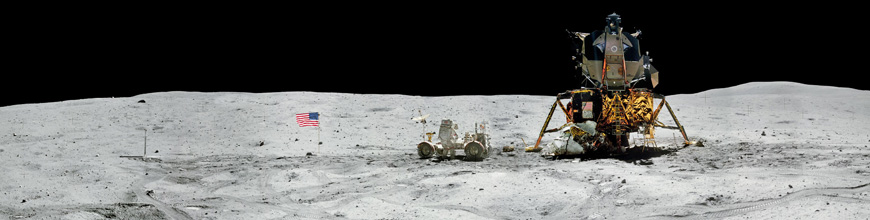
“I take back any bad things I ever said about MIT — which I never have.”

The quotation is from Mike Collins, Command Module Pilot of Apollo 11, as their spacecraft entered lunar orbit. He was commenting on how well the computer had controlled their Lunar Orbit Insertion burn, adjusting their course to velocities accurate within a tenth of a foot per second in all three axes – essentially perfect. In full, from the onboard audio recording:

Minus 1, minus 1, plus 1. Jesus! I take back any bad things I ever said about MIT – which I never have.

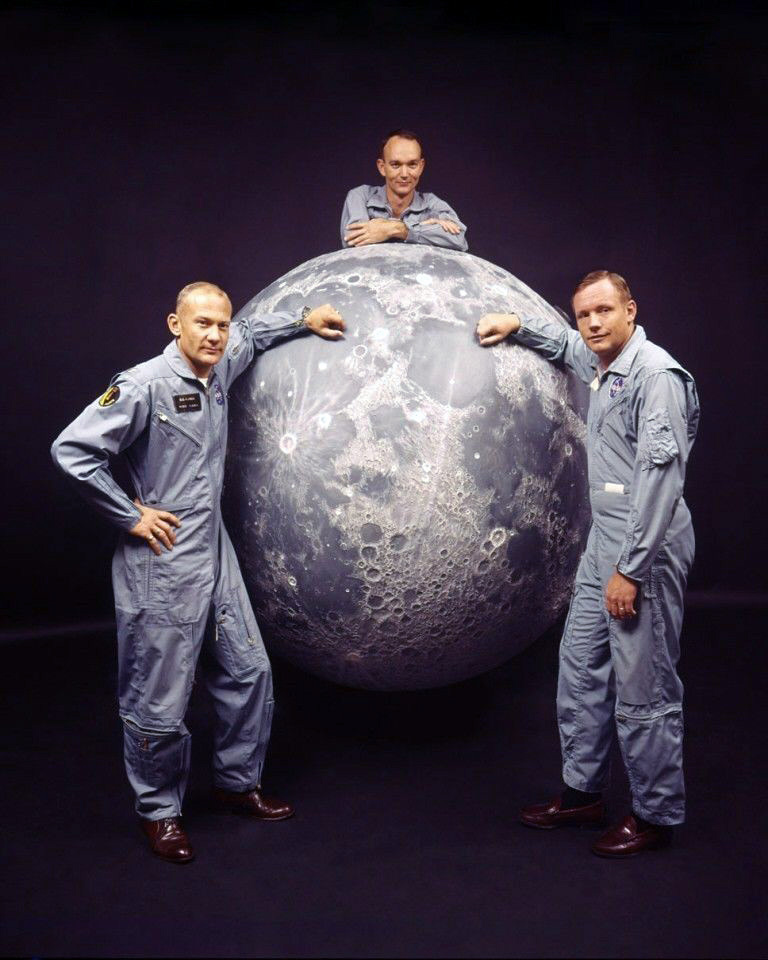
Collins wrote the best of the astronaut biographies, Carrying the Fire, and he turned 88 today. He’s behind the moon in this crew photo, when all three of them, born in 1930, were 39:
MIT’s Department of Aeronautics and Astronautics curriculum includes a graduate semester devoted to “Engineering Apollo” – where twenty-six class sessions barely scratch the surface, according to the professor in the first video below – itself one of those twenty-six classes. Collins was a guest there in 2015 and last year.

People are really telling Dingleface all this stuff?

Hackers gained access to “gender, locale/language, relationship status, religion, hometown, self-reported current city, birthdate, device types used to access Facebook, education, work, the last 10 places they checked into or were tagged in, website, people or Pages they follow, and the 15 most recent searches” for 14 million users…

I would like to meet some of these people.

“Let me hold your wallet for a minute.”

“Oh, sure. Here you go.”

“I’ll just be taking this photo, some of the cash, and one of your cards. Okay?”

“Um…okay, I guess?”

“Yes it is. Tell me, do you hold any sort of degree?”

“No, I only went to college for a year.”

“Okay. Dating anyone right now?”

“Not at the moment, no.”

“Got it. Now, what was the last thing you bought?”

“It’s kind of embarrassing, but if you must know, it was some Immodium and some toilet bowl cleaner.”

“I see. Well, thanks! Nice to meet ya!”

Sea life in the melting Himalaya

When two continental masses happen to move on a collision course, they gradually close out the sea between them – barging over trenches, shutting them off – and when they hit they drive their leading edges together as a high and sutured welt, resulting in a new and larger continental mass. The Urals are such a welt. So is the Himalaya. The Himalaya is the crowning achievement of the vigorous Australian Plate, of which India is the northernmost extremity. India in the Oligocene, completing its long northward journey, crashed head on into Tibet, hit so hard that it not only folded and buckled the plate boundaries but also plowed in under the newly created Tibetan plateau and drove the Himalaya five and a half miles into the sky. The mountains are in some trouble. India has not stopped pushing them, and they are still going up. Their height and volume are already so great they are beginning to melt in their own self-generated radioactive heat. When the climbers in 1953 planted their flags on the highest mountain, they set them in snow over the skeletons of creatures that had lived in the warm clear ocean that India, moving north, blanked out. Possibly as much as twenty thousand feet below the seafloor, the skeletal remains had formed into rock. This one fact is a treatise in itself on the movements of the surface of the earth. If by some fiat I had to restrict all this writing to one sentence, this is the one I would choose: The summit of Mt. Everest is marine limestone.

So wrote John McPhee in Basin and Range, one of five books collected in his Pulitzer Prize-winning geological history of North America, Annals of the Former World (1998), whose volumes are Basin and Range (1981), In Suspect Terrain (1983), Rising from the Plains (1986), Assembling California (1993), and Crossing the Craton (1998).