Posters and framing on the cheap

Click for a larger version

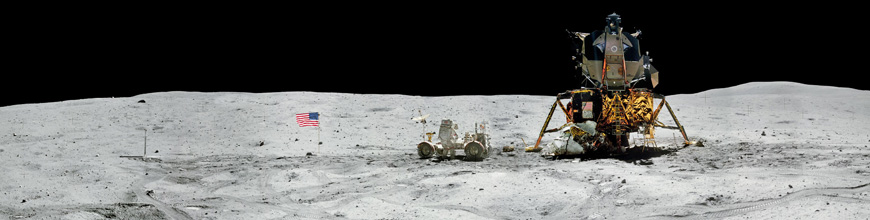
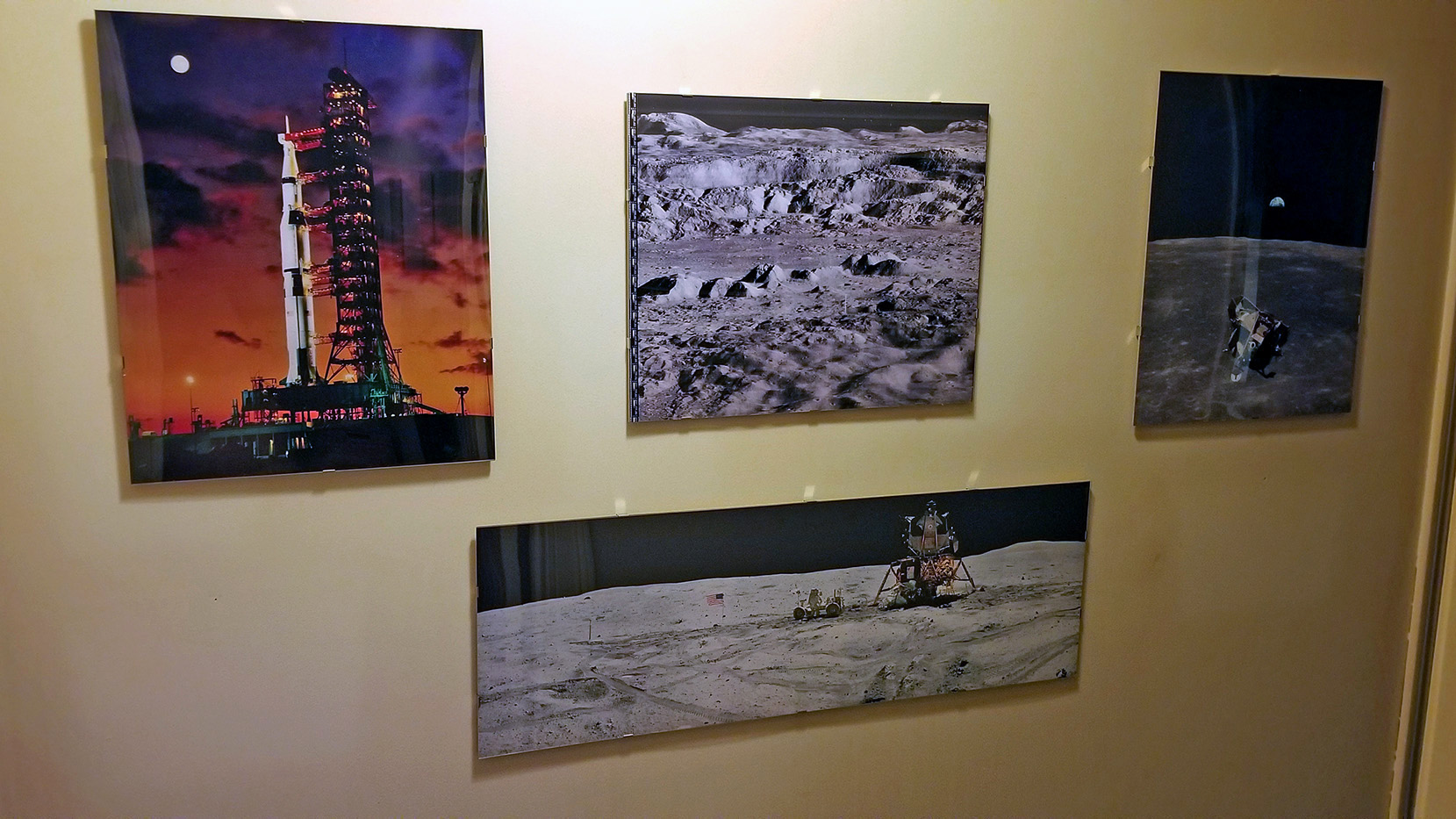
Last weekend, I refreshed the pictures in my upstairs hallway, the new ones shown above. As a frame of reference, the photo shows an area of about 7×3 feet. For about a hundred dollars total, I was able to get three 16×20″ prints and one 12×36″ panorama of high-resolution Apollo-era photographs from Shutterfly and mount them in the best borderless clip frames available.

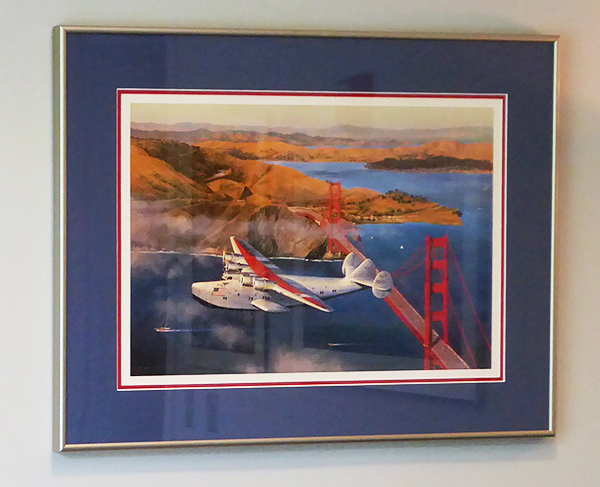
There was a time when I did my own picture mounting on foam board and framing using mail-order Nielsen #11 frame pieces and locally-sourced, custom-cut sheet glass (I never attempted matting), but these days I most often use clip frames – good ones, that is – because they’re easier, they look clean and classy, and they’re a lot cheaper than professional framing or even DIY Nielsens. The last picture I had mounted, double-matted, and framed, the “Clipper at the Gate” shown below, cost me well north of US$200 – and that didn’t include the signed print, which I had purchased several years previously. Don’t get me wrong – the framing and matting is well-done and quite attractive, but I have a lot of drawings, paintings, and photos on my walls and I am well south of a millionaire.
I was able to get those four hallway prints done both well and on the cheap thanks to four things:

  • In recent years, the negatives from the Apollo programme have been scanned with better equipment and at much higher resolution, which allows for nice-looking enlargements – not the case with the low-res images previously available. In the case of the three-foot-wide print, someone stitched together a 10,000-pixel-wide image from a panorama photo series Charlie Duke took during Apollo 16.
  • The recently completed Lunar Orbiter Image Recovery Project used current technology to produce, from the data on hundreds of carefully preserved original 1960s magtapes, awe-inspiring photos far beyond the resolution and quality NASA could produce fifty years ago. The top middle picture in the hallway is an oblique photo of Copernicus from 150 miles south of the crater that was taken by chance during a “let’s move the film forward a bit” housekeeping task on Lunar Orbiter 2.
  • A plethora of discounts, including 40% or 50% off sales that Shutterfly runs every week or two, periodic Visa Checkout deals (US$25 off the next order), and even $25 Shutterfly credits that Best Buy includes with many hard drive purchases means you can easily get prints in these bigger sizes for $12-$16 each. That’s cheap for high quality large prints.
  • Massachusetts-based Quadro Frames, which I’ve used for many years, produces the highest quality borderless clip frames I’ve seen; other, more widely-available types are mostly flimsy and ill-fitting. 16×20″ frames from Quadro are US$12.50 and it’s $20 for 12×36″. Each frame is precisely fashioned and includes a sturdy, non-bending backing board with perfectly cut, strong clip channels on the back, pristine and perfectly clear PET plastic glazing panels with peel-off protective sheets on both sides (or glass panels for just $3 more), and more than enough clips that slip into the back channel with a satisfying firm snap. Even their care in shipping to guarantee safe arrival is the best possible: I always think, “Wow, just look at that” when I open boxes from them. For some of my orders, I’ll wager it’s taken them half an hour or more to pack the materials so fastidiously. It’s a good example of corporate responsibility and pride in doing things right.

Here are the source photographs I uploaded to Shutterfly for the hallway prints. You can pause the slideshow and right-click to view and/or save any image at its full size.

This slideshow requires JavaScript.

I also got these three enlarged to 16×20″ and they’re up elsewhere in the house:

This slideshow requires JavaScript.

The moon is a messy place

In which I discuss moon suits, moon dust, moon models, and moon stories

“Smells like someone just fired a carbine in here.”
– Apollo 17 Commander Gene Cernan on smelling moon dust inside the Lunar Module

I finally got around to making my 1/6th scale Gene Cernan figure look a little more realistic. Brand new, it looked like this:

Apollo 17 Commander Capt. Gene Cernan, the last man on the moon, in 1/6th scale

I never quite liked the pristine look of it because the only time it was that clean was the day it arrived from the manufacturer, ILC Dover, a division of Playtex at the time the suits were designed. Yes, Playtex designed the 21-layer Apollo suits. Here’s the figure after I applied a fair amount of graphite powder using two different brush sizes:

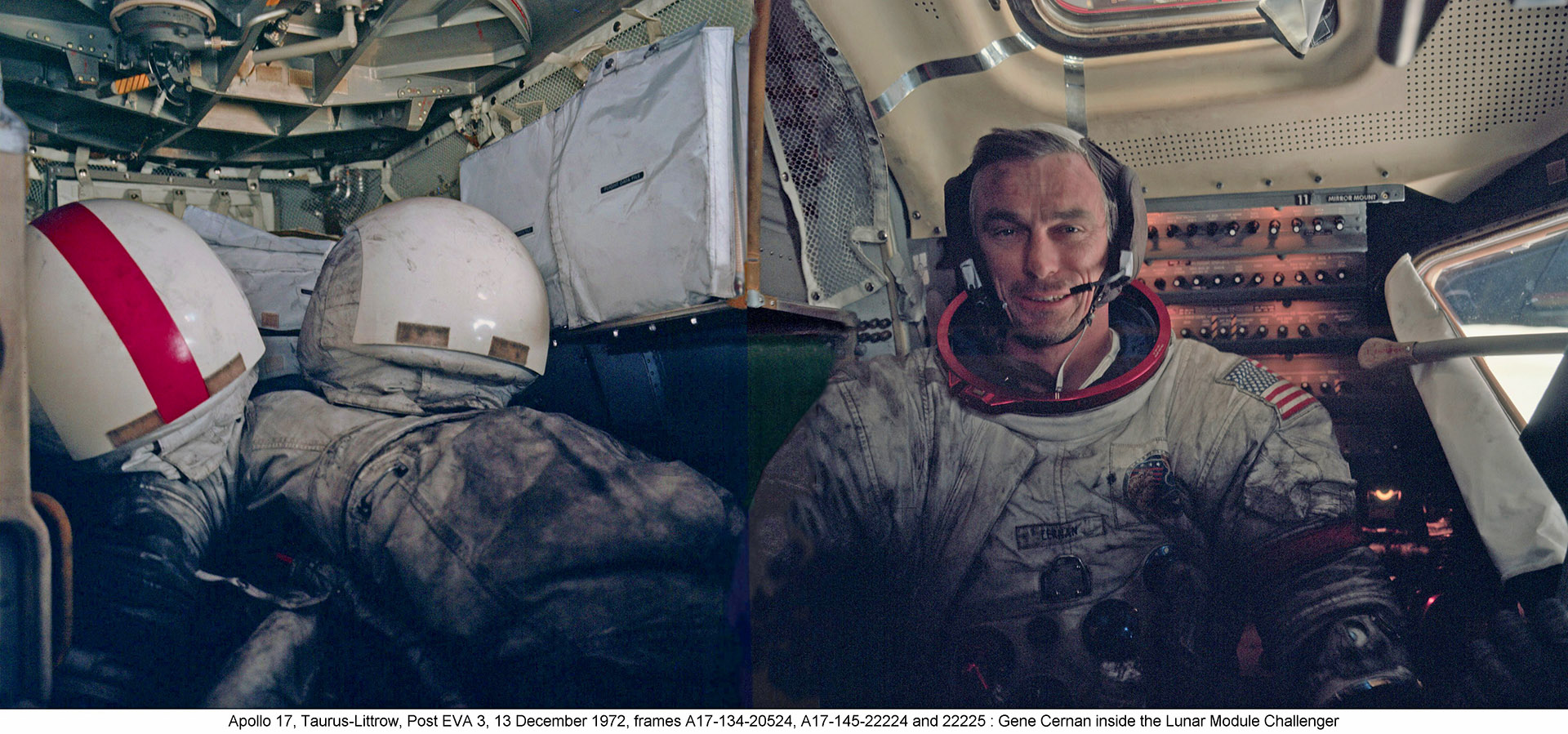
Now you may think I went a little over the top with that, but I didn’t. My variation is probably about what Cernan’s A7LB suit looked like after two of the three seven-hour moonwalks he and Jack Schmitt made. Below you can see what his suit looked like after their third and final moonwalk on 13 & 14 December 1972 – and this was after they spent quite a while brushing each other off before re-entering the Lunar Module for the last time.

Click for a larger version

The large brush they used for the suits – and the lunar rover – was six or seven inches wide. They also had a smaller brush for camera lenses and such. You can see both in this compilation. Gene Cernan raises his gold-plated visor here while cleaning the rover’s camera lens.

Moondust is funny stuff – fine, powdery, almost like snow, and it smells of burnt gunpowder when it’s on the moon. That smell goes away on prolonged contact with normal air, so the returned samples no longer smell of anything. They don’t really know why it smells like gunpowder, but there are some theories.

Excerpts from the Apollo 17 Technical Crew Debriefing [corrected link to PDF] on 4 January 1973, during which the problems with dust came up a lot:

“Dust – I think probably one of the most aggravating, restricting facets of lunar surface exploration is the dust and its adherence to everything no matter what kind of material, whether it be skin, suit material, metal, no matter what it be and its restrictive friction-like action to everything it gets on. For instance, the simple large tolerance mechanical devices on the Rover began to show the effect of dust as the EVAs went on. By the middle or end of the third EVA, simple things like bag locks and the lock which held the pallet on the Rover began not only to malfunction but to not function at all. They effectively froze. We tried to dust them and bang the dust off and clean them, and there was just no way. The effect of dust on mirrors, cameras, and checklists is phenomenal. You have to live with it but you’re continually fighting the dust problem both outside and inside the spacecraft. Once you get inside the spacecraft, as much as you dust yourself, you start taking off the suits and you have dust on your hands and your face and you’re walking in it. You can be as careful in cleaning up as you want to, but it just sort of inhabits every nook and cranny in the spacecraft and every pore in your skin. Although I didn’t have any respiratory problems, I think the LMP, which he can comment on later, had some definite local respiratory problems right after the EVA – due to dust in the cabin.”
– Commander Gene Cernan

“Dust – We’ll just talk about in-cabin dust. After the first EVA, there was considerable dust in the cabin. It would be stirred up by movements of the suit and the gear that we had. Almost immediately upon removing my helmet, I started to pick up the symptoms that you might associate with hay fever symptoms. I never had runny eyes or runny nose. It was merely a stuffiness in the nose and maybe in the frontal sinuses that affected my speech and my respiration considerably. After about 2 hours within the cabin, those symptoms gradually disappeared. By morning of the next day they were gone completely. After the second and third EVAs, although I’m sure the dust was comparable, the symptoms were not nearly as strong as after the first EVA. That was as if I either developed a mucous protection of the affected areas or had some way or another very quickly developed an immunity to the effects of the dust.”
– Lunar Module Pilot Jack Schmitt

Here’s James Burke, prime Apollo reporter for the BBC, wearing – and removing, one by one – all the components of the A7L spacesuit. The A7L was used through Apollo 14 and the more advanced A7LB, with essentially doubled consumable capacities that allowed for seven-plus-hour moonwalks, was used on Apollo 15, 16, and 17.

That report was prepared prior to the moon landings. In 1979, Burke did an excellent ten-year anniversary documentary that explains a lot of the workings of lunar missions better than most.

I think this is a great time to start reading Spacesuit: Fashioning Apollo. I’ll do that tonight.

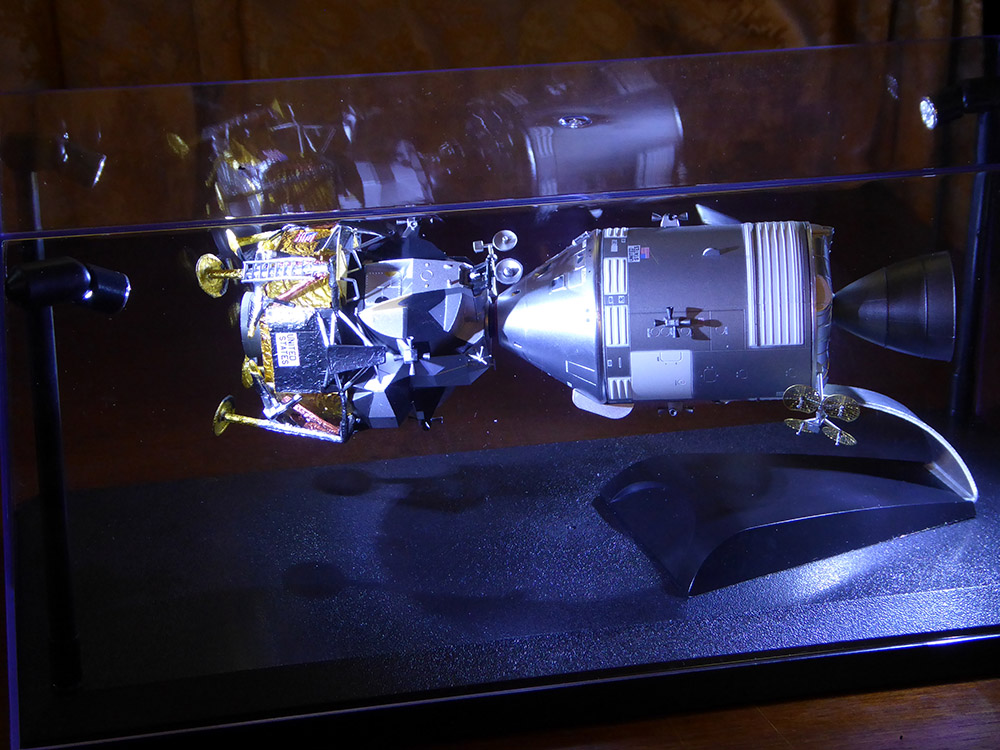
I also now have a lighted display case for the Dragon Lunar Approach model I have at home. In normal light, it looks like this:

In the dark with the case’s inbuilt lights turned on, this is closer to how the pair would appear in the sunlight of deep space during the translunar coast:

Finally, a treat: Several years ago on BBC Radio 4, Jeanette Winterson did a fascinating ten-part, 150-minute series about the moon from many perspectives. It’s called “The Inconstant Moon” and you can listen on her site here. Quite a pleasant way to spend a couple of hours.

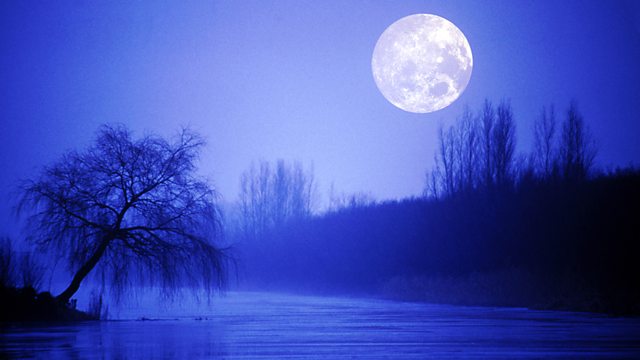
Radio 4 used this graphic for the programme:

Musk decides not to murder tourists

Surprise, surprise, there will be no slaughtering of tourists around the moon in Q4 2018 as originally stated early last year. That’s a sensible thing. Besides, nobody but the worst of humanity would want to see the millions of laugh-cry emojis that would inevitably be pasted willy-nilly by the worst of humanity.

“If I’ve told you media people once, I’ve told you a hundred million times that I never engage in hyperbole! Ever, do you hear me? Now get out or I call in the bulldozers!”

See also: NASA decides not to murder astronauts

No such thing as a mistake

I’m losing a bit of faith in the QI podcast “No Such Thing as a Fish” lately. In nearly every episode in recent months, I’ve noted at least one mistake, sometimes as many as three when subjects on which I know a fair amount come up. They’re mostly small mistakes, but they’re bothersome since Quite Interesting is noted for its high accuracy, with only a handful of mistakes that I can recall in the fifteen years of the television series. I have much enthusiasm for high quality – see my site name – so I have a lot of respect for QI.

As an example, the most recent podcast claimed that the falcon feather/hammer Galileo demonstration Commander Dave Scott gave during Apollo 15 was done during Apollo 12. A small mistake, but that’s pretty sloppy by QI standards. Such mistakes make me wonder about the accuracy of the things they discuss that I’m not familiar with, and if the television show is also going to be somewhat untrustworthy next series since the podcast crew work there.

I think the problems may have started when the podcast co-presenters started going on tour, publishing books, &c a year or so ago. It’s likely they rely on each other to be careful with their research, but with their busy schedule, they’re slipping substantially and don’t yet know it. Some cross fact-checking would be prudent if they’re going to continue travelling a lot. Don’t make me come over there.