“Quality means doing it right when no one is looking.”

I just ordered this 2007 book, which I didn’t know about until today:

EngineerReport

It’s out-of-print and no longer available at the Golden Gate Bridge store, but I found a “like new” copy on AbeBooks and it’s still available from some on Amazon.

The book builds off of the original Report of the Chief Engineer, 1937, by Joseph B. Strauss (which is no longer sold), and relates the many technical, political, and financial challenges encountered in the late 1940s through the turn of the 21st century. Chronicling the many successful actions taken to maintain the Bridge’s ability to serve as a transportation link well into the future, the book provides insights into the most crucial engineering and design challenges met since the Bridge opened 70 years ago. This is a historical record of the leading role the structure has played in the investigation of long span suspension bridge behavior, in the development of modern design theories, in the application of modern bridge maintenance methods, and in the development of innovative traffic management methodologies. The Bridge has been the scene of many firsts, which are detailed in this volume. Stellar examples of this include the first-ever total replacement of the vertical suspender ropes on a suspension bridge undertaken in the 1970s, and the successful replacement of the entire Bridge roadway in the 1980s.

I have a slice of one of the original vertical roadway suspension cables mentioned above.

P1040423

I’m sure this book will be a fascinating companion to the first volume, published in 1937 some months after the bridge opened. I have an ex-library copy of the original book and it’s quite a read, with dozens of photographs of all phases of construction and several fold-out engineering drawings.

Joseph Strauss's introductory letter from the first volume published in 1937

Joseph Strauss’s introductory letter from the first volume published in 1937

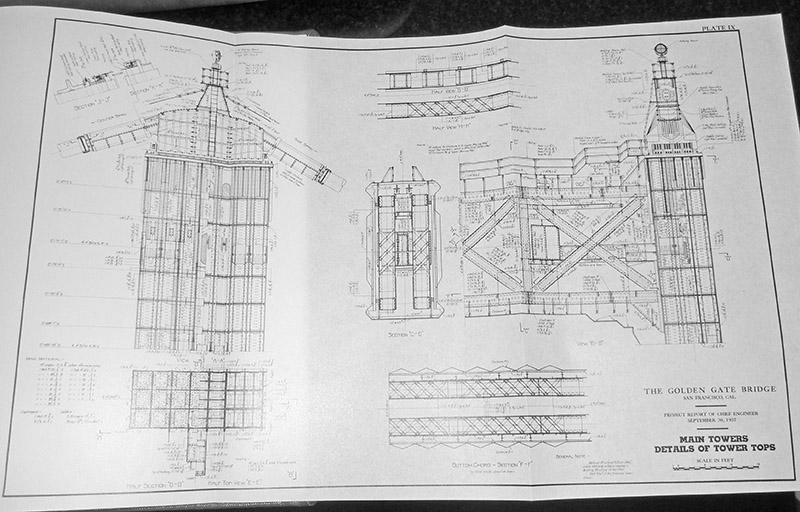
Just this year, the Internet Archive scanned the 1937 volume and you can get it here. Unfortunately, it seems a lot of the fold-out plates such as the one below were missing from their copy. The only thing missing from mine – it was roughly torn out – is the fold-out colour painting that appears in their PDF at the front of the book.
P1040411

I took these photos of my favourite bridge in the world in 2002. I produced the panorama just now from three crusty old Kodak DC-280 photos – a paltry 2 megapixels each – with the beautifully free and high-quality Hugin. It finds all the matching points and you hardly have to lift a finger. You can click on these to view a larger size.

DCP_1229 - DCP_1231

I use this one for my phone’s home screen wallpaper:

DCP_1244c

Just several weeks ago, something was done about the one unfortunate characteristic of the bridge: Now, finally, a suicide barrier is to be constructed.

“Oh, wowie two-shoes, the new Yellow Pages are here!”

“Wait ’til I tell all the kids at school I’ve seen one of those!”

I would feel about the same had I received a wagon wheel on my doorstep, or perhaps a Model T crank, but at least I could use one of those as some sort of cheesy decoration. I think all you can do with this is mock it.

Verizon is the only business listed under Anachronism Dealers

There’s no compelling reason to mosaic FTD’s readily-available number; I did it just on general principles.

Giss a kiss

I love credit unions, especially mine. Monday night, I noted a pending charge on my debit card of an amount and a merchant unfamiliar to me. Last night, it moved from pending to real and right out of my account, so I did a web search on the name and city (Studio City, CA), followed by a local search for anything with that name or an order amount of US$40.00 – nothing – then called the credit union this morning.

The efficient woman in the call centre four towns away said the details indicated it was a point-of-sale charge – with a signature, in California, on Monday. As I haven’t been in California since 2002, and I’m pretty sure that was a Friday, we thought it prudent to cancel the card. She filled out the online disputed charge form for me and said, “We can either mail you a new card or you can stop at a branch and get a new one.” She also said it might take up to five days for the charge to be reversed, but it was actually reversed by the time I moseyed over to the nearest branch three hours later to get my new card, which they printed and handed to me less than two minutes after I gave them my old card and driver’s licence. The problem’s complete resolution: 3½ hours. It would have been less had I not waited until lunch to visit the CU.

I imagine if I was still a Bank of America customer as I was twelve years ago before joining the credit union, that 3½ hours would be about the amount of time they’d’ve spent on just the first day interrogating me to find out just what sort of dastardly conspiracy I was masterminding. I base this theory on their standard policy of assuming that all in-person customer so-called deposits are being perpetrated by people trying to kite checks, and making everyone wait days to access their money. Of course, that was twelve years ago, so I imagine things must be much improved over there at the friendly neighbourhood BoA branch, because monolithic banks, like fine wine, only improve with age, right? Why are you shaking your head? More like old milk, you say?

The web search I did indicated the merchant in question may be a surfing instructor. Surfing? T’yuh.

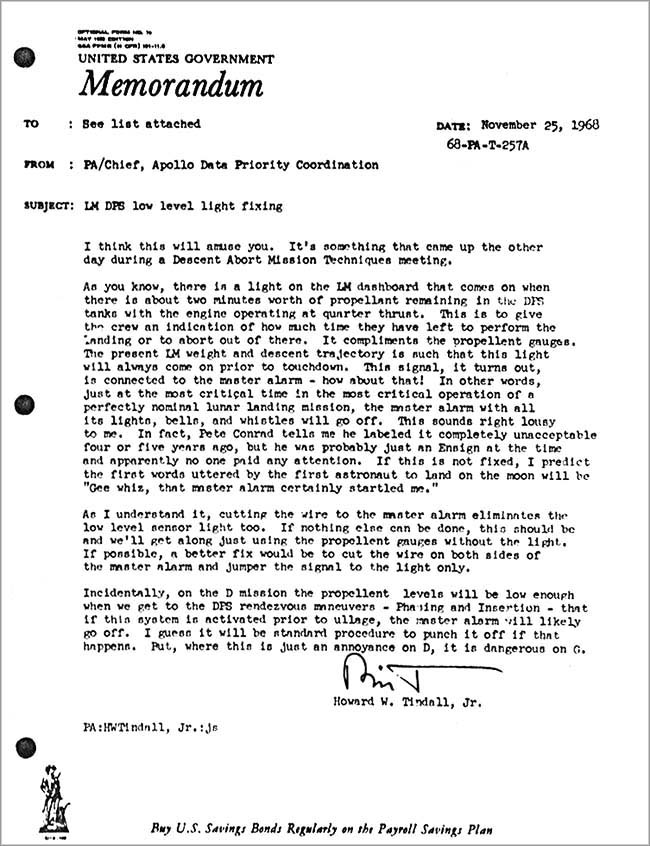
Tindallgrams

Edited October 2019 to add: In July of this year, I wrote a more comprehensive article on Bill Tindall that includes several of his memos. You can find it here: https://finleyquality.net/the-thousand-ring-circus/

An introduction to Tindallgrams from one of the documents linked below:

The enclosed collection of memoranda were written by Howard W. “Bill” Tindall, Jr., the former Director of Flight Operations at NASA’s Manned Spacecraft Center in Houston. They document key technical decisions made between 1966 and early 1970 for all unmanned and manned flights through Apollo 13, and became widely know as “Tindallgrams.” Astronauts, flight controllers, and engineers took part in this planning, and many have lamented that they had lost track of their copies, so we have bound this set together for them. As Buzz Aldrin remembered, “Bill had a brilliant way of analyzing things and the leadership that gathered diverse points of view with the utmost fairness.”

In 1966, Apollo Spacecraft Program Manager George Low made Tindall responsible for all guidance and navigation computer software development by the Massachusetts Institute of Technology. Bill quickly grasped the key issues and clearly characterized the associated pros and cons, sometimes painfully for us, but his humor, friendliness, and ever-constructive manner endeared him to all of us.

In 1967, Low put Tindall in charge of a group called Mission Techniques, which was designed to bring together hardware development, flight crew procedures, mission roles, and spacecraft and control center computer programming. According to former MSC Director Christopher Kraft, “Those meetings were the hardened core of Apollo as far as operations planning was concerned. That’s where the famous Tindallgrams came from.” He continued, “It would be difficult for me to find anyone who contributed more individually to the success of Apollo than Bill Tindall.”

Those of us who took part in those meetings and other interactions with Bill will always appreciate another aspect of his contribution…he made it a lot of fun!

I’ve read hundreds of Tindallgrams. The one below is my all-time favorite, so I’ve cleaned it up considerably from the microfiche photocopy I got from the Kennedy Space Center years ago. These days, you don’t have to write to NASA and then wait eight or ten weeks before being pleasantly surprised by a ten-pound box in the mail. You can find PDFs with scans of many Tindallgrams here on collectSPACE, all completely weightless through the marvel of modern technology – much of which is the indirect result of Apollo, come to think of it.

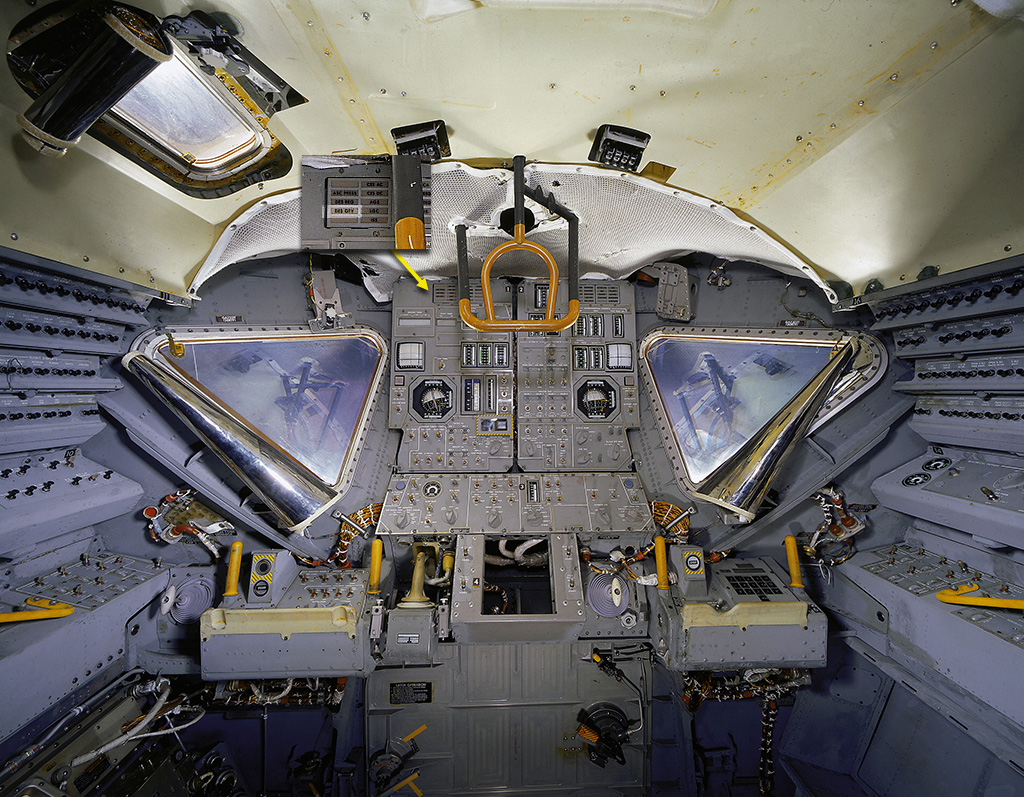
LM2 cockpit

In this photo of the LM-2 cockpit at the National Air & Space Museum, I’ve placed an arrow pointing to the panel and highlighted in the inset the DES QTY light being discussed:

LM2 Controls

By the way, they made the fix as Tindall had hoped – the DES QTY light did come on during landings, but did not trigger the master alarm.

Aviation history, connected

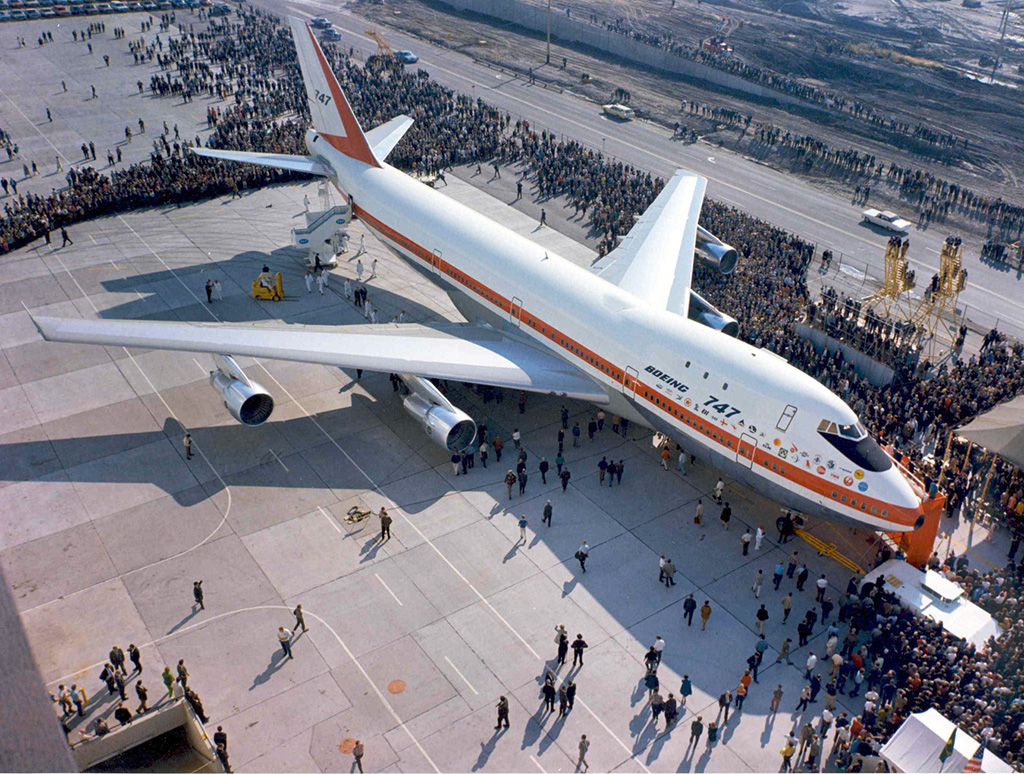
Boeing 747 Rollout 1969-09-30

RA001 on 30 September 1968

I was reading this article in the Seattle Post-Intelligencer on the long-overdue restoration of the prototype Boeing 747, shown above on its rollout day – rolling, yes, but without working engines yet – and got to wondering if the Museum of Flight still had “Bomber” Bob Richardson’s B-17F as well.

I found that they do, which pleased me because I once flew in that B-17 in the days leading up to the 1988 Wings of Eagles Airshow at the National Warplane Museum in Geneseo, New York. I was a volunteer and arrived a couple days early, staying in the SUNY Geneseo campus dorms overlooking the NWM field. I got to talking with the museum president, Austin Wadsworth, a couple days before the airshow was to start, and he invited me to join the pre-airshow press flights the following morning. Those flights were to be in two B-17s. I remember my dropped-jaw excitement and exactly what he said as I left: “Get here early.” I needed no extra alarm.

The next morning, I arrived at 6:30am and then proceeded to have the time of my life, flying off the grass airfield in the museum’s B-17G, Fuddy Duddy, up to Buffalo, then swapping between Fuddy Duddy and Bomber Bob’s Kathleen, at that time the only F-model B-17 still flying, as they took groups of reporters up for separate promo flights over Niagara Falls. By the time we returned to Geneseo six or so hours later, I had a grin on my face that lasted for weeks – one that returns as I type this.

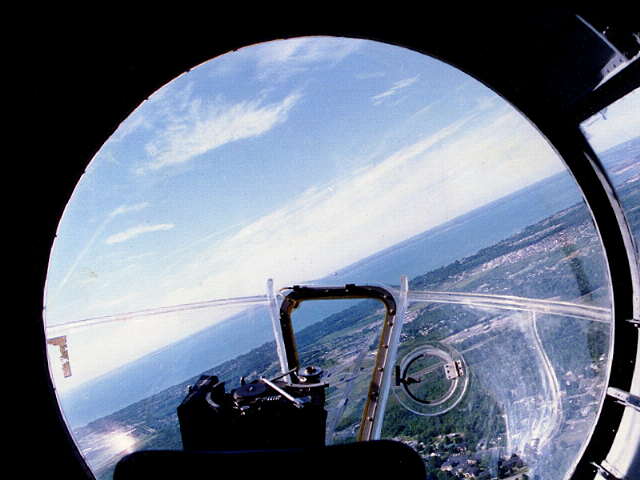
When we flew back to Geneseo in the afternoon, I took this photograph from the bombardier’s position in the nose of Kathleen shortly after takeoff as we banked away from Lake Erie:

Departing Buffalo, at about 800 feet

That’s an old scan of a physical photo – no digital cameras back then. I recently found and scanned at a much higher resolution another departure photo I took and it’s here.

Richardson had stopped in Geneseo to be at the airshow with Kathleen on his way back to Seattle from the UK after participating in the shooting of David Puttnam’s “Memphis Belle” film (which was way, way over the top but still entertaining). I remember that he died the year after I flew on his aircraft. I didn’t know him well, but from all accounts he was quite a guy. I’m still grateful that he welcomed me on his aircraft that day with only an hour or so’s notice from Wadsworth.

The airshow that followed was, in a word, spectacular, with a total of six B-17s present along with nearly a hundred other mostly WWII-era aircraft. I think it was the largest gathering of B-17s since the production of the “Twelve O’Clock High” film in 1949, and I don’t believe that number has been seen together since, either. Just five B-17s participated in the “Memphis Belle” filming.

I took this shot early on Saturday morning, opening day of the airshow, before too many people spoiled the opportunity. Fuddy Duddy is at the far end, and Kathleen is the only olive drab aircraft:

b17grpf

Six B-17s at the 1988 Wings of Eagles Airshow, Geneseo, New York

The following year, I returned with an 8×10 of my six tails shot and presented it to Wadsworth along with my thanks for the once-in-a-lifetime opportunity. “Ah…proof it really happened,” he said with a smile.

That next year, the airshow featured five B-17s, a Consolidated B-24, and the Canadian Warplane Heritage Museum’s Avro Lancaster:

I read another pleasant bit of news just now when I searched to verify I was recalling his name correctly: The National Warplane Museum name has returned to Geneseo, with Austin Wadsworth still in the left seat. I figure if anyone could pull off another large flock of B-17s one day, that’s the man right there.

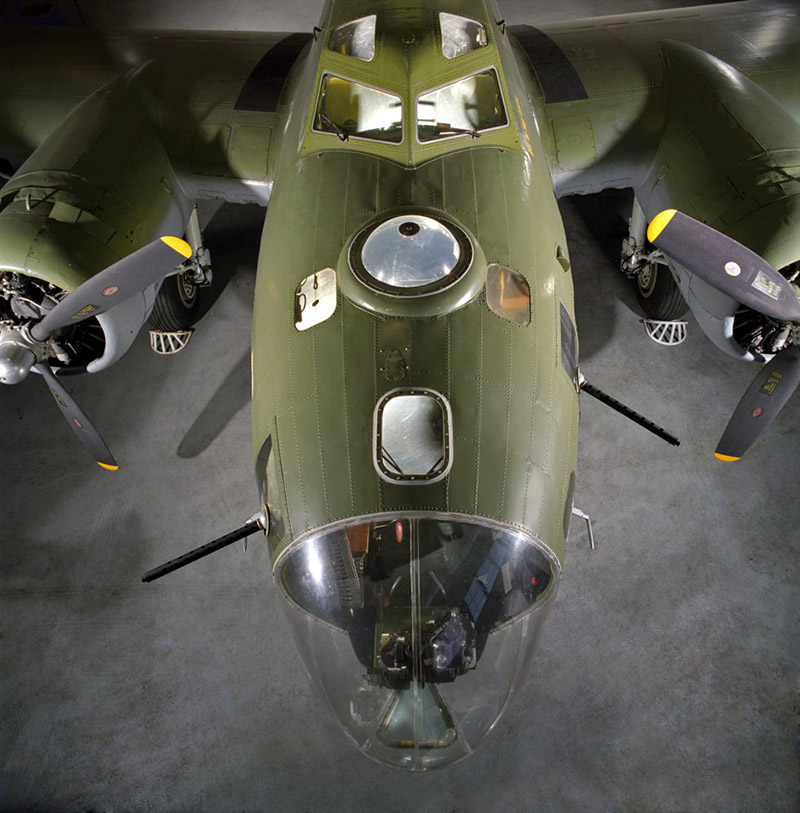
Here’s Bomber Bob Richardson’s B-17F today in the Museum of Flight:

TMOF Boeing B-17F

You develop an instant global consciousness, a people orientation, an intense dissatisfaction with the state of the world, and a compulsion to do something about it. From out there on the moon, international politics looks so petty. You want to grab a politician by the scruff of the neck and drag him a quarter of a million miles out and say, “Look at that, you son of a bitch.”

Ed Mitchell, Lunar Module Antares pilot, Apollo 14

How not to run a business; or, How to run a business into the ground

A good article in the New Hampshire Business Review on the ongoing Market Basket Saga, which I capitalise because most articles describe it that way now, with “fiasco” running a close second:

Market Basket: A business case study for decades

Pastry case inhabited by domesticated Giraffa camelopardalis

The company is communicating solely via press releases written in that special Corporate Regional English that says little but does impress some business school graduates*, plus memos, some to managers and some to all employees via their mailboxes – their physical mailboxes, I mean – that vacillate between threatening and quasi-conciliatory. They’re not actually speaking with anybody, whilst employees and customers have so far held five rallies with thousands of people in attendance. The delineation between winners and losers here seems clear.

*I imagine some of them as Father Jack: “Leverage! Calibrate! Drink!”

On Friday, Massachusetts Governor Deval Patrick wrote to the Market Basket board of directors with an offer to help mediate, saying “By any measure, the disruption caused by your recent change in CEO has gotten out of hand, and I am writing to urge you to find a prompt resolution.”

Meanwhile, my freezer slowly empties and I haven’t done a proper grocery run in nearly a month. The latest figures I saw say their revenue is down 92-95% depending on the store.

Sticks to the ribs

My birthday dinner last night was baby back ribs slow-braised at 250F/120C in wine, Worcester sauce, honey, and garlic, then hickory-smoked and finished with a glaze of barbeque sauce barked at high temperature under the grill; dauphinoise potatoes à la Jeffrey Steingarten; and bi-colour sweetcorn pretty fresh off the field in Harvard, Massachusetts – the town, not the university. We ate quite late (note bathrobe) and were stuffed, so dessert, a Maine blueberry grunt with vanilla ice cream, was deferred to tonight and is steaming on the stovetop now.

The moon

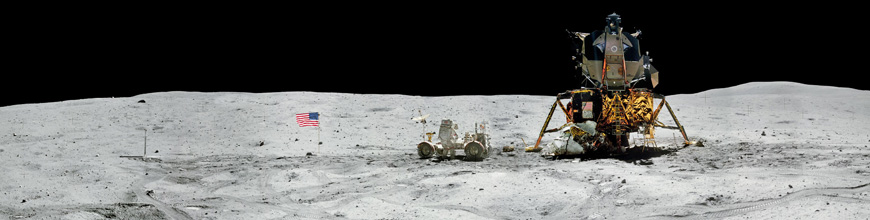
If the moon is mesmerising to me on an everyday basis, like this evening when I paused to take this photograph, how transfixing must it have been for the last forty-five years to the men who once walked on it?

P1010198

Mark Twain & Sherlock Holmes

Letter to the Mallory Brothers on behalf of actor William Gillette.

Hartford, September 29, 1883.

Dear Sirs,

You have a contract with Mr. Will Gillette; & I am aware that you are trying (as usual with you) to sneak out of the performance of its conditions. I am personally interested in the matter; therefore I suggest to you couple of piety-mouthing, hypocritical thieves and liars that you change your customary policy this time.

Yours Truly,

S. L. Clemens

Gillette was known as “America’s Sherlock Holmes”

“Now pay attention, fellas. Step 7 is important.”

"Does this bug you? I'm not touching you."

7. Never annoy the fuze in this manner.

Not really. The actual instruction is “7. Hold arming vane by hub, press it into position.” This illustration is from the WWII US Army Air Force Bombardier’s Information File Armament section, said manual in PDF form at the link.

On the same page, though I think oddly not highlighted in any way, is this sensible advice: “Don’t bump detonator against side of cavity.” I’d’ve probably put it this way:

WARNING: Do not – repeat, do not – bump detonator against anything, you fool!