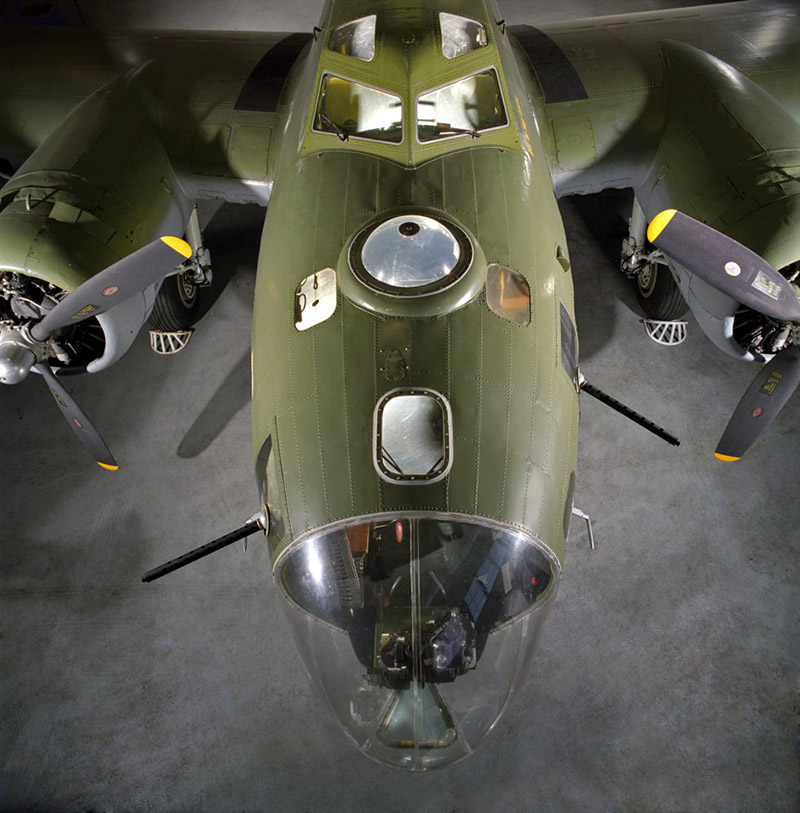
Memphis Belle flies again

After writing about B-17s and the 1990 “Memphis Belle” film the other day, I looked at this video once more, remembering that my takeoff from the National Warplane Museum grass strip featured the same wide leftward swing of the B-17’s tail into the wind that’s in the sequence starting at 2:28 – rather exciting when you’re inside the aircraft:

https://www.youtube.com/watch?v=R_Af4HVl1WI

I lamented that the DVD I have, from the following year, is in that old “widescreen, but not – ha ha!” format, where there’s black stripes not only top and bottom but left and right, just as you see when you play the above, so the actual resolution of the video is horribly limited, to put it mildly – maybe one-quarter of full HD quality. It doesn’t look very good on my 42″ set, where it’s reminiscent of those first postage-stamp videos Windows 3.1 could play. But then I noticed in the YouTube recommended video list Memphis Belle – Take Off – Available May 6, and was pleasantly surprised to find out that the film was released on Blu-ray just a few months ago. This weekend, I’ll be able to watch it properly for the first time since I saw it in the cinema.

Comfort Diner meatloaf

Click for a larger version

Printing tip: At the bottom of each article on the site, a print/PDF/email function allows you to print or save a PDF of just the body of the article without any web site formatting. Scroll to the end of the article and find these icons: In the print dialog, you can click any element you don’t need to remove it from the printed/saved version.

parislights wanted to make this again and asked that I repost the recipe, so here it is…

This recipe from Manhattan’s Comfort Diner, with its unusual use of oats instead of bread crumbs, produces a delightfully soft-textured meatloaf that’s miles away from the mundane and typical dense-pack meatloaf that I find somewhat unpleasant.

The original recipe from The Comfort Diner Cookbook is below. Note: My changes to the recipe, which are substantial and I think important, are immediately below it.

Mom’s Meatloaf

Ingredients:

  • 3 tablespoons olive oil
  • 2 garlic cloves, minced
  • 1 cup finely diced white onion (1 medium-size onion)
  • 1 cup finely diced celery (2 to 3 stalks)
  • ¼ cup finely diced green bell pepper (from 1 bell pepper)
  • 1 tablespoon dried basil
  • 1 tablespoon dried thyme
  • 1 tablespoon dried oregano
  • 2 large eggs
  • 1 cup whole milk
  • 1 cup plain whole oats
  • 1 pound ground beef [80-85% lean]
  • ½ pound ground veal (if you don’t want to use veal, just increase the ground beef to 1 ½ pounds)
  • ½ pound ground pork
  • ½ tablespoon table salt
  • ½ tablespoon freshly ground black pepper
  • ¼ cup Worcestershire sauce
  • ½ cup canned diced tomatoes, drained
  • ½ cup ketchup or canned diced tomatoes, for topping

Directions:

  1. Preheat the oven to 325F/160C. In a large sauté pan on medium heat, warm the olive oil, then add the garlic, onion, celery, bell pepper, basil, thyme, and oregano. Sauté the vegetables for 3 to 4 minutes, until they begin to soften.
  2. In a bowl, whisk together the eggs and milk. Add the oats.
  3. In a large bowl, combine the meats well by hand. Season with the salt and pepper. Pour the liquid mixture over the blended meats and mix thoroughly to combine. Add the Worcestershire sauce, tomatoes, and sautéed vegetables. Mix well.
  4. Place the mixture in a 9×12 baking dish and form it into a long, rounded loaf. There should be at least 1 inch of space around the loaf to allow fat to run off.
  5. Spread the ketchup or diced tomatoes evenly on top of the loaf, and bake for 50 to 60 minutes, until firm and cooked through.
  6. Remove the meatloaf from the oven and allow to cool for 2 to 3 minutes before serving.

Here are my changes and baking notes:

  • Change: The herbs from dried to chopped fresh (I like the grassy note you never get from dried) and the peppers from green to a mix of sweeter bell peppers like red, orange, and yellow
  • Double: The onions and the herbs; you’re going to caramelize the onions, meaning two cups will reduce down to maybe two-thirds of a cup, and fresh herbs aren’t as intense as dried
  • Triple: The peppers (I use ¼ cup finely diced of each of the three colors)
  • Lower: The milk to 2/3 cup or the mixture is almost too sloppy to free-form.

Here are the veg and herbs for the double recipe that I usually make. This amount cooks down to about three cups in the end.

Sautéing the veg substantially changed:

  • Caramelize the onions in the olive oil on a medium-high heat to a mahogany color, stirring frequently so they don’t burn; I double the quantity because they shrink to almost nothing. This is going to take a while – don’t believe the majority of TV chefs and recipes that tell you caramelizing onions takes 10 or 12 minutes, because someone else did it for them and they haven’t done it themselves for many years – or they’re just lying because no one wants to hear it takes half an hour. In any case, it’s worth your time.*
  • Add the celery and diced peppers when the onions are about 2/3 done
  • Add the garlic only in the last couple of minutes to avoid burning it
  • Add the herbs to the sauté only in the last minute
  • You may find that the mix gets a little too dry during this extended sauté – if that’s the case, add a bit more oil or some oil and butter

*There is a method out there that uses baking soda to supposedly speed-caramelize onions, but I found it saves only a few minutes. Worse, even the tiniest quantity seems to break the onions down so much that you end up with onion mush…nicely colored, sure, but mush. It’s a cynic’s view, I’ll admit, but I think some of the sites propounding this method just might be using traditionally caramelized onions in their photos, because no one wants to see a mound of mush.

This is what your elixir will look like after sautéing. Your house smells good now, too, doesn’t it?

Tips:

I usually combine the milk, eggs, and oatmeal in a bowl before I start sautéing the veg and herbs. By the time the veg are done, the oatmeal has soaked up a good bit of the liquid, which makes for easier mixing.

You may need to adjust the seasoning, so make a small, thick patty from an ounce or two of the finished mixture and sauté it over medium heat, turning frequently, to an internal temp of 160F/72C so you can safely taste it. E coli is hardier than some critters and lives right up to 150F/65C, so for this recipe, a probe thermometer should be your close friend. The right internal temperature is especially important in the finished loaf. I use a TempTest 1, a sort of compact version of the same company’s more well-known Thermapen, but much cheaper ones like their Super-Fast pocket model, an Oxo instant read you can pick up at Bed Bath & Beyond, or this Taylor from Amazon – the one I use at my office – are similarly accurate, just not as fast as the more expensive models.

If you make two loaves at a time as I usually do, your mis en place is probably going to take about 35 minutes if you’re fairly proficient – 45 if you’re also making mash from a boatload of potatoes. Let’s call it an hour if you further add a passel of carrots. There’s a helluva lot of stuff to peel, dice, and slice when you make two loaves and a couple of sides.

Baking changes:

Line a pan with heavy duty tinfoil and put a fairly close-mesh wire rack in the pan. Fold a piece of heavy duty tinfoil to the size of the loaf you intend to form (about 10×5″) and place on the rack. When you put the loaf on this, it will stop the mixture squidging through the rack underneath but will also allow the fat to drip off into the lined pan below as the meatloaf cooks. This way, it’s not swimming in its own fat at the end.

If the mixture is on the loose side – and it almost certainly will be – you can refrigerate it for a few hours or overnight before forming, or be brave and form it anyway, then get it out of the oven at about fifteen minutes and, using a couple layers of food prep gloves to avoid burning yourself, push the sides in to get its height back. I’ve done that more than once, but I don’t recommend it.

These days, I always do all the prep one evening, chill the finished mixture overnight, and bake it for dinner the next night after a day of delightful anticipation. I think the finished flavor is improved when the ingredients have plenty of time to insinuate themselves upon each other overnight, but the real bonus is that all you have to prep the next night is your vegetable sides. It’s a very satisfying method.

For this double recipe, I refrigerated the mix overnight to firm it up nicely, then packed half at a time into a loaf pan and unmolded onto the foil islands on top of the wire rack like so. When the mixture is well-chilled beforehand, the loaves don’t slump at all in the oven.

The meatloaves on their foil islands shortly after going in the oven, holding their shape nicely after chilling overnight

In my experience, the 50 to 60 minutes in the recipe well underestimates the baking time. It’s more like 80 to 90 minutes when you have a properly tall loaf. Just use an instant-read thermometer to ensure the very middle of the loaf is 160F/72C. Any little critters that may have been along for the ride will be pushing up teeny-tiny daisies by then.

I don’t paint the ketchup on top until baking is about three-quarters done, when the internal temperature is past 120F/50C (don’t forget to wash the thermometer probe afterward). This way, it still darkens and thickens nicely, but doesn’t form the almost burned crust of the original recipe. The result:

Click for a larger version

Sides that go well with this (they’re all in that picture at the head of the article):

  • Julia Child’s garlic mashed potatoes, recipe here (scroll halfway down that page); even without the garlic sauce, mashed done her way is the best way. The key is the drying of the potatoes over low heat after ricing or mashing and before adding the butter and cream. (Sometimes, instead of the slow braising of the garlic in that recipe, I cut the bottoms off two whole heads of garlic, drizzle with olive oil, wrap in foil, and roast in a 400F/200C oven for half an hour, then simply squeeze the tamed and softened cloves into the mash.) Keep tasting the mashed as you add salt and pepper until it makes you go “Mmmm.”
  • Carrot coins braised in butter, just barely bubbling on medium-low heat until tender, then glazed with a touch of brown sugar and garnished with a handful of the carrot’s close cousin, parsley. I usually peel and slice about 3 pounds, which needs two sticks of butter to partially cover the carrots; stir it occasionally as it braises. Serve with a slotted spoon so you don’t have a puddle of butter on the plate.
  • Alton Brown’s Better Than Granny’s Creamed Corn, recipe here. Be sure to add plenty of freshly ground pepper at the end, tasting continually – you’ll know it immediately when you’ve hit the sweet spot.

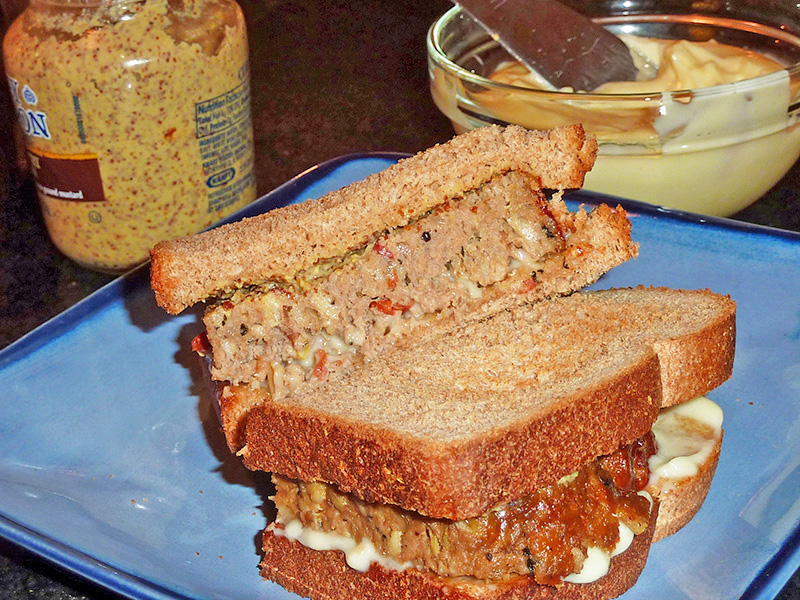
What do do with leftovers: Heat thick slices and serve on lightly toasted whole wheat slathered with grainy mustard and mayo.
meatloaf 3

Feeling ambitious? Make some of this for your sandwiches:

mayo

Homemade Mayonnaise

All you do is whisk together these six things in a medium sized bowl (tip: wet a kitchen towel, form it into a circle, and place your bowl onto it for stability while whisking):

1 egg yolk
1 teaspoon water
½ teaspoon salt
A few grinds of white pepper
1 ½ teaspoons lemon juice
1 teaspoon apple cider vinegar

Then, using a Pyrex glass measure with pouring lip or something similar, whisk in 1 cup of oil (I often use canola), by drops at first to start the emulsion, then a thin stream, then a thicker stream, whisking briskly all the while. Then you adjust seasonings as necessary. And you look at the clock and just four or five minutes has passed since you started.

It almost seems too simple to produce something so tasty and useful. In fact, it’s so good and so easy that you may look out the window to see if the Commercial Mayonnaise Police are outside, waiting to break your door in whilst shouting, “What’s all this, then?!”

If you’re familiar with Trader Joe’s mayonnaise, this is much the same in flavor. If you prefer the taste of Hellman’s/Best mayonnaise, you can cut back on the lemon juice and add some mustard powder.


Edited November 2018 to add this even easier method that you can use if you have a stick blender:

2-Minute Stick Blender Mayonnaise

In a jar just wider than your stick blender, place:

1 egg yolk
2 teaspoons water
1/2 teaspoon table salt
1 teaspoon apple cider vinegar
1 1/2 teaspoons lemon juice (if you like a little less tang, lower this to 1 teaspoon)
1/4 teaspoon mustard powder or a teaspoon of mustard
A few grinds of white pepper or black pepper

Carefully pour one cup of neutral vegetable oil like canola on top of those.

Place the stick blender all the way on the bottom of the jar, making sure it encloses the egg yolk.

Pulse the stick blender for a second or two, then wait a second or two. As you repeat this, you will see the emulsion start to form at the bottom. Repeat this pulse-wait cycle eight or ten times. At this point, you are likely to have some oil still sitting on top. Slowly raise and lower the blender to incorporate the rest of the oil.

“Quality means doing it right when no one is looking.”

I just ordered this 2007 book, which I didn’t know about until today:

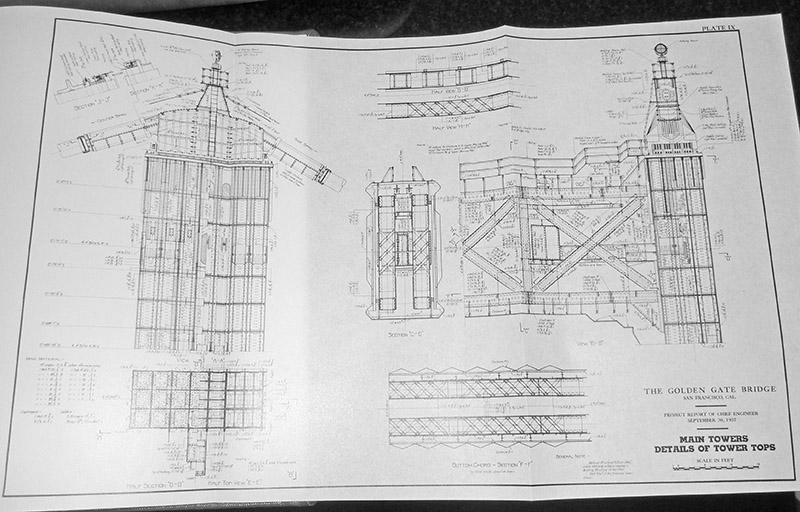
EngineerReport

It’s out-of-print and no longer available at the Golden Gate Bridge store, but I found a “like new” copy on AbeBooks and it’s still available from some on Amazon.

The book builds off of the original Report of the Chief Engineer, 1937, by Joseph B. Strauss (which is no longer sold), and relates the many technical, political, and financial challenges encountered in the late 1940s through the turn of the 21st century. Chronicling the many successful actions taken to maintain the Bridge’s ability to serve as a transportation link well into the future, the book provides insights into the most crucial engineering and design challenges met since the Bridge opened 70 years ago. This is a historical record of the leading role the structure has played in the investigation of long span suspension bridge behavior, in the development of modern design theories, in the application of modern bridge maintenance methods, and in the development of innovative traffic management methodologies. The Bridge has been the scene of many firsts, which are detailed in this volume. Stellar examples of this include the first-ever total replacement of the vertical suspender ropes on a suspension bridge undertaken in the 1970s, and the successful replacement of the entire Bridge roadway in the 1980s.

I have a slice of one of the original vertical roadway suspension cables mentioned above.

P1040423

I’m sure this book will be a fascinating companion to the first volume, published in 1937 some months after the bridge opened. I have an ex-library copy of the original book and it’s quite a read, with dozens of photographs of all phases of construction and several fold-out engineering drawings.

Joseph Strauss's introductory letter from the first volume published in 1937

Joseph Strauss’s introductory letter from the first volume published in 1937

Just this year, the Internet Archive scanned the 1937 volume and you can get it here. Unfortunately, it seems a lot of the fold-out plates such as the one below were missing from their copy. The only thing missing from mine – it was roughly torn out – is the fold-out colour painting that appears in their PDF at the front of the book.

P1040411

I took these photos of my favourite bridge in the world in 2002. I produced the panorama just now from three crusty old Kodak DC-280 photos – a paltry 2 megapixels each – with the beautifully free and high-quality Hugin. It finds all the matching points and you hardly have to lift a finger. You can click on these to view a larger size.

DCP_1229 - DCP_1231

I use this one for my phone’s home screen wallpaper:

DCP_1244c

Just several weeks ago, something was done about the one unfortunate characteristic of the bridge: Now, finally, a suicide barrier is to be constructed.

“Oh, wowie two-shoes, the new Yellow Pages are here!”

“Wait ’til I tell all the kids at school I’ve seen one of those!”

I would feel about the same had I received a wagon wheel on my doorstep, or perhaps a Model T crank, but at least I could use one of those as some sort of cheesy decoration. I think all you can do with this is mock it.

Verizon is the only business listed under Anachronism Dealers

There’s no compelling reason to mosaic FTD’s readily-available number; I did it just on general principles.

Giss a kiss

I love credit unions, especially mine. Monday night, I noted a pending charge on my debit card of an amount and a merchant unfamiliar to me. Last night, it moved from pending to real and right out of my account, so I did a web search on the name and city (Studio City, CA), followed by a local search for anything with that name or an order amount of US$40.00 – nothing – then called the credit union this morning.

The efficient woman in the call centre four towns away said the details indicated it was a point-of-sale charge – with a signature, in California, on Monday. As I haven’t been in California since 2002, and I’m pretty sure that was a Friday, we thought it prudent to cancel the card. She filled out the online disputed charge form for me and said, “We can either mail you a new card or you can stop at a branch and get a new one.” She also said it might take up to five days for the charge to be reversed, but it was actually reversed by the time I moseyed over to the nearest branch three hours later to get my new card, which they printed and handed to me less than two minutes after I gave them my old card and driver’s licence. The problem’s complete resolution: 3½ hours. It would have been less had I not waited until lunch to visit the CU.

I imagine if I was still a Bank of America customer as I was twelve years ago before joining the credit union, that 3½ hours would be about the amount of time they’d’ve spent on just the first day interrogating me to find out just what sort of dastardly conspiracy I was masterminding. I base this theory on their standard policy of assuming that all in-person customer so-called deposits are being perpetrated by people trying to kite checks, and making everyone wait days to access their money. Of course, that was twelve years ago, so I imagine things must be much improved over there at the friendly neighbourhood BoA branch, because monolithic banks, like fine wine, only improve with age, right? Why are you shaking your head? More like old milk, you say?

The web search I did indicated the merchant in question may be a surfing instructor. Surfing? T’yuh.

Tindallgrams

Edited October 2019 to add: In July of this year, I wrote a more comprehensive article on Bill Tindall that includes several of his memos. You can find it here: https://finleyquality.net/the-thousand-ring-circus/

An introduction to Tindallgrams from one of the documents linked below:

The enclosed collection of memoranda were written by Howard W. “Bill” Tindall, Jr., the former Director of Flight Operations at NASA’s Manned Spacecraft Center in Houston. They document key technical decisions made between 1966 and early 1970 for all unmanned and manned flights through Apollo 13, and became widely know as “Tindallgrams.” Astronauts, flight controllers, and engineers took part in this planning, and many have lamented that they had lost track of their copies, so we have bound this set together for them. As Buzz Aldrin remembered, “Bill had a brilliant way of analyzing things and the leadership that gathered diverse points of view with the utmost fairness.”

In 1966, Apollo Spacecraft Program Manager George Low made Tindall responsible for all guidance and navigation computer software development by the Massachusetts Institute of Technology. Bill quickly grasped the key issues and clearly characterized the associated pros and cons, sometimes painfully for us, but his humor, friendliness, and ever-constructive manner endeared him to all of us.

In 1967, Low put Tindall in charge of a group called Mission Techniques, which was designed to bring together hardware development, flight crew procedures, mission roles, and spacecraft and control center computer programming. According to former MSC Director Christopher Kraft, “Those meetings were the hardened core of Apollo as far as operations planning was concerned. That’s where the famous Tindallgrams came from.” He continued, “It would be difficult for me to find anyone who contributed more individually to the success of Apollo than Bill Tindall.”

Those of us who took part in those meetings and other interactions with Bill will always appreciate another aspect of his contribution…he made it a lot of fun!

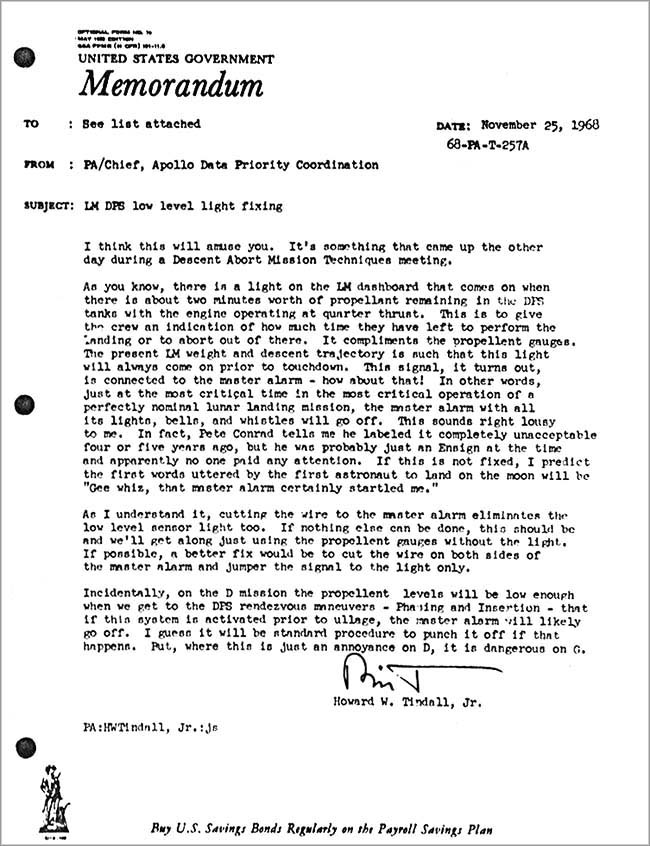
I’ve read hundreds of Tindallgrams. The one below is my all-time favorite, so I’ve cleaned it up considerably from the microfiche photocopy I got from the Kennedy Space Center years ago. These days, you don’t have to write to NASA and then wait eight or ten weeks before being pleasantly surprised by a ten-pound box in the mail. You can find PDFs with scans of many Tindallgrams here on collectSPACE, all completely weightless through the marvel of modern technology – much of which is the indirect result of Apollo, come to think of it.

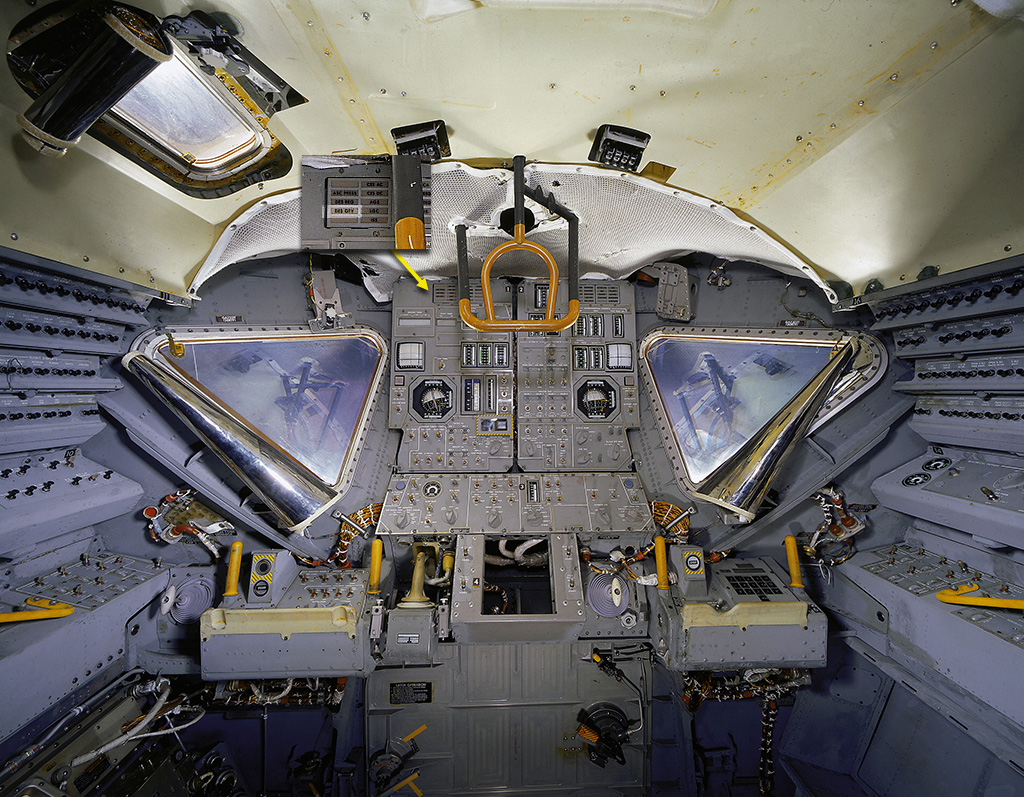
LM2 cockpit

In this photo of the LM-2 cockpit at the National Air & Space Museum, I’ve placed an arrow pointing to the panel and highlighted in the inset the DES QTY light being discussed:

LM2 Controls

By the way, they made the fix as Tindall had hoped – the DES QTY light did come on during landings, but did not trigger the master alarm.

Aviation history, connected

Boeing 747 Rollout 1969-09-30

RA001 on 30 September 1968

I was reading this article in the Seattle Post-Intelligencer on the long-overdue restoration of the prototype Boeing 747, shown above on its rollout day – rolling, yes, but without working engines yet – and got to wondering if the Museum of Flight still had “Bomber” Bob Richardson’s B-17F as well.

I found that they do, which pleased me because I once flew in that B-17 in the days leading up to the 1988 Wings of Eagles Airshow at the National Warplane Museum in Geneseo, New York. I was a volunteer and arrived a couple days early, staying in the SUNY Geneseo campus dorms overlooking the NWM field. I got to talking with the museum president, Austin Wadsworth, a couple days before the airshow was to start, and he invited me to join the pre-airshow press flights the following morning. Those flights were to be in two B-17s. I remember my dropped-jaw excitement and exactly what he said as I left: “Get here early.” I needed no extra alarm.

The next morning, I arrived at 6:30am and then proceeded to have the time of my life, flying off the grass airfield in the museum’s B-17G, Fuddy Duddy, up to Buffalo, then swapping between Fuddy Duddy and Bomber Bob’s Kathleen, at that time the only F-model B-17 still flying, as they took groups of reporters up for separate promo flights over Niagara Falls. By the time we returned to Geneseo six or so hours later, I had a grin on my face that lasted for weeks – one that returns as I type this.

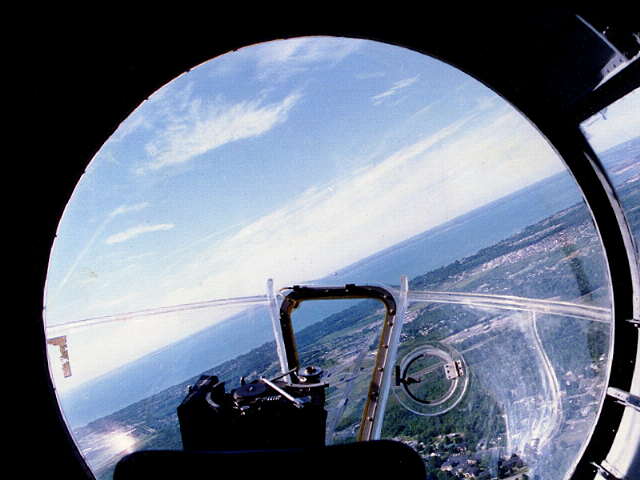
When we flew back to Geneseo in the afternoon, I took this photograph from the bombardier’s position in the nose of Kathleen shortly after takeoff as we banked away from Lake Erie:

Departing Buffalo, at about 800 feet

That’s an old scan of a physical photo – no digital cameras back then. I recently found and scanned at a much higher resolution another departure photo I took and it’s here.

Richardson had stopped in Geneseo to be at the airshow with Kathleen on his way back to Seattle from the UK after participating in the shooting of David Puttnam’s “Memphis Belle” film (which was way, way over the top but still entertaining). I remember that he died the year after I flew on his aircraft. I didn’t know him well, but from all accounts he was quite a guy. I’m still grateful that he welcomed me on his aircraft that day with only an hour or so’s notice from Wadsworth.

The airshow that followed was, in a word, spectacular, with a total of six B-17s present along with nearly a hundred other mostly WWII-era aircraft. I think it was the largest gathering of B-17s since the production of the “Twelve O’Clock High” film in 1949, and I don’t believe that number has been seen together since, either. Just five B-17s participated in the “Memphis Belle” filming.

I took this shot early on Saturday morning, opening day of the airshow, before too many people spoiled the opportunity. Fuddy Duddy is at the far end, and Kathleen is the only olive drab aircraft:

b17grpf

Six B-17s at the 1988 Wings of Eagles Airshow, Geneseo, New York

The following year, I returned with an 8×10 of my six tails shot and presented it to Wadsworth along with my thanks for the once-in-a-lifetime opportunity. “Ah…proof it really happened,” he said with a smile.

That next year, the airshow featured five B-17s, a Consolidated B-24, and the Canadian Warplane Heritage Museum’s Avro Lancaster:

https://www.youtube.com/watch?v=W6_48-zb7bc

I read another pleasant bit of news just now when I searched to verify I was recalling his name correctly: The National Warplane Museum name has returned to Geneseo, with Austin Wadsworth still in the left seat. I figure if anyone could pull off another large flock of B-17s one day, that’s the man right there.

Here’s Bomber Bob Richardson’s B-17F today in the Museum of Flight:

TMOF Boeing B-17F

You develop an instant global consciousness, a people orientation, an intense dissatisfaction with the state of the world, and a compulsion to do something about it. From out there on the moon, international politics looks so petty. You want to grab a politician by the scruff of the neck and drag him a quarter of a million miles out and say, “Look at that, you son of a bitch.”

Ed Mitchell, Lunar Module Antares pilot, Apollo 14

How not to run a business; or, How to run a business into the ground

A good article in the New Hampshire Business Review on the ongoing Market Basket Saga, which I capitalise because most articles describe it that way now, with “fiasco” running a close second:

Market Basket: A business case study for decades

Pastry case inhabited by domesticated Giraffa camelopardalis

The company is communicating solely via press releases written in that special Corporate Regional English that says little but does impress some business school graduates*, plus memos, some to managers and some to all employees via their mailboxes – their physical mailboxes, I mean – that vacillate between threatening and quasi-conciliatory. They’re not actually speaking with anybody, whilst employees and customers have so far held five rallies with thousands of people in attendance. The delineation between winners and losers here seems clear.

*I imagine some of them as Father Jack: “Leverage! Calibrate! Drink!

On Friday, Massachusetts Governor Deval Patrick wrote to the Market Basket board of directors with an offer to help mediate, saying “By any measure, the disruption caused by your recent change in CEO has gotten out of hand, and I am writing to urge you to find a prompt resolution.”

Meanwhile, my freezer slowly empties and I haven’t done a proper grocery run in nearly a month. The latest figures I saw say their revenue is down 92-95% depending on the store.

Sticks to the ribs

My birthday dinner last night was baby back ribs slow-braised at 250F/120C in wine, Worcester sauce, honey, and garlic, then hickory-smoked and finished with a glaze of barbeque sauce barked at high temperature under the grill; dauphinoise potatoes à la Jeffrey Steingarten; and bi-colour sweetcorn pretty fresh off the field in Harvard, Massachusetts – the town, not the university. We ate quite late (note bathrobe) and were stuffed, so dessert, a Maine blueberry grunt with vanilla ice cream, was deferred to tonight and is steaming on the stovetop now.

The moon

If the moon is mesmerising to me on an everyday basis, like this evening when I paused to take this photograph, how transfixing must it have been for the last forty-five years to the men who once walked on it?

P1010198